

Terra Nil is – actually something of a rarity for me, in that it’s a game that came out this year. A couple months ago, in fact. I try to stay away from games until they’ve been out for a couple of years, but – well, here we are! Launched March 28, 2023, Terra Nil is pitched as a sort of environmentalist response to Sim City. As a genre, city sims typically begin with an open grassy field, which you build up over the course of the game into a dense urban landscape. Terra Nil takes the opposite approach: you begin with a post-industrial wasteland, which you have to revitalise. You engage in all different sorts of rewilding, building up rivers, rainforests, swamps and marshland. You undo the damage that humanity has done to the environment and restore it to its original state. The final phase of each map is a particularly nice touch – it has you disassemble all the buildings you used to restore the environment, pack them into your helicopter, and leave. Victory involves a return to the pre-lapsarian state, to a world before humans – or, more specifically, to a world before the player.
Most of the initial commentary here I think you can fill in from that description, or from any of the recent reviews. “Restore nature, and with it your hope for the future,” says the Guardian. “Healing landscapes across Earth’s biomes is the ultimate comfort fantasy,” Polygon says, “especially amid a sea of games premised on destruction and dominion.” The language of regeneration is set in opposition to the language of industrialisation, with roads giving way to salmon runs. In a genre where nature is written over by the urbanised world, the binary is reversed: nature triumphs over civilisation. This framing is – you know, maybe not wrong, per se, but I think we can go a little further. I was struck, in the first instance, by the term ‘dominion’ in the Polygon review. Healing landscapes is a comfort fantasy amid a sea of games premised on destruction and dominion. They hyperlink that last phrase to an article about The Last of Us, so they aren’t exclusively talking about management games, but the broader context of the article does focus on city builder and city management games, invoking Frostpunk, Factorio, and – hey, Dorfromantik, love that game. It’s fair to say that dominion is a key feature of all those titles. Frostpunk has you set laws for your society, determining their working hours and whether or not they have heaters. These are games about control.
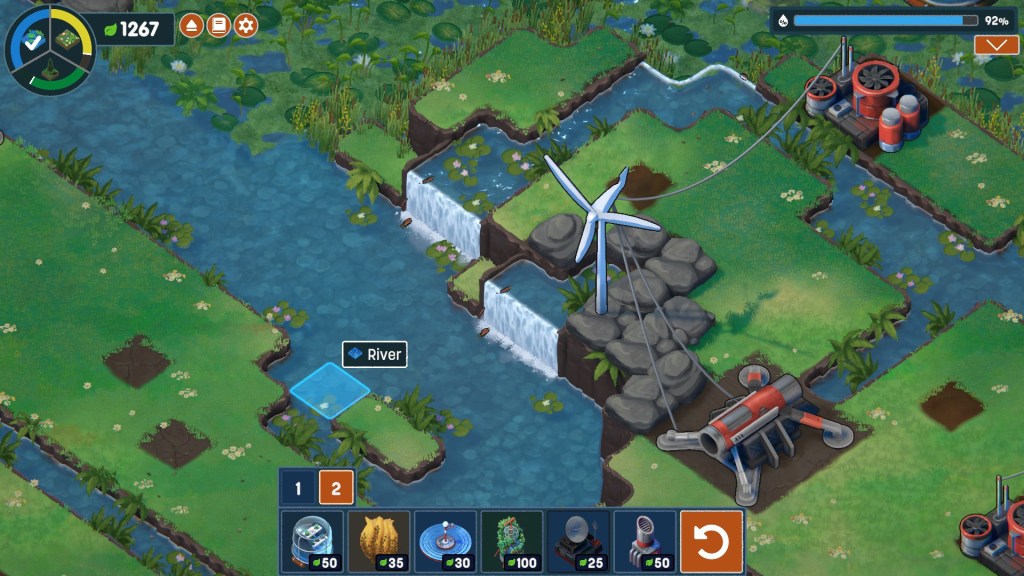
Really I would just pause here to observe that Terra Nil is also a game about control. You carve out riverbeds, and seed polluted fields. At every step, you’re in charge. That’s not a bad thing, necessarily – it’s not a criticism. But in this rhetorical binary of nature vs civilisation, control does not differentiate Terra Nil from games like SimCity. It’s a common feature across both of them. Possibly there’s some confusion in that the end of each map sees the player relinquish control, stepping back from the environment and leaving it to itself. That release is positioned as the final stage of nature’s healing: humans have to put it back how they found it, and then they have to get out of the way. They have to step away from the power that damaged the environment so much in the first place. But if our control damaged the environment, Terra Nil suggests that our control can also fix it. Nature doesn’t fix itself: in Terra Nil, it needs our active, deliberate intervention.
So the game has a complicated relationship with power and control. It suggests that power has the potential to damage the environment – has damaged it, near-fatally. And yet that same power can be used to undo just about all of the damage it caused in the first place. In short, the game’s philosophical statement is that power isn’t good or bad – it depends how it’s used. We enter at a time where it’s been used badly, and we have the opportunity to use it in a better way, but in itself power is value-neutral. The problem, for me, is that that reading leaves us with a loose end. If power is value-neutral, why do we have to leave? Why do we have to exit out of the ecosystem? Why can’t we find a stable place within it? In Block’hood, humans are treated like any other feature of the environment, as beings that have needs and create things – they both consume and produce. We are pulled out of any sort of hierarchy and given a structural position alongside crabs, trees, and flowers. We’re all part of the same system. Terra Nil, on the other hand, ends with the player building a rocket and flying off into the stars, rejecting in the most absolute sense their power over the world. There is no place for us here, it says.
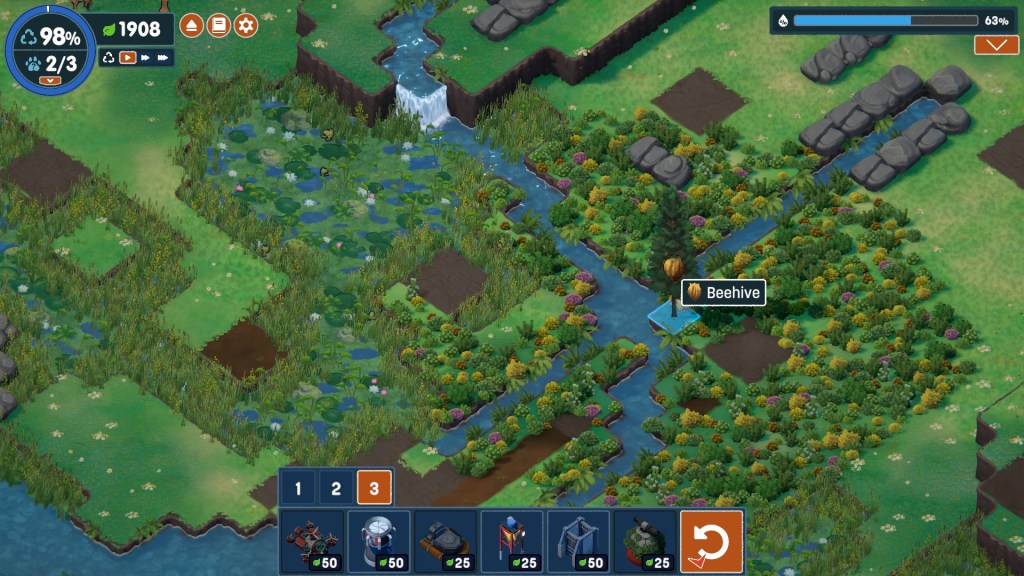
In that final level of Terra Nil, as part of building the rocket ship, you do this little sonar activity where you sweep back over all the places you’ve been before and pick up seeds to take with you into outer space. You draw on the treasures of your environment and rocket off somewhere else – presumably to carry on your terraforming mission among the stars. At its core, Terra Nil is still a city building game. It inherits that same will to control and shape an environment, and to spread that control as far and wide as it can go. For the most part, city-builders are settler fantasies. They are about entering into a space and remaking it in your own image. That remaking often has colonial overtones, as grasslands and natural spaces are remade into bustling Western cityscapes. Terra Nil is part of that ecosystem. It isn’t comfortable with that legacy, and it tries to point in a different direction, but it’s never able to metabolize that basic impulse. It can only ask us to leave the sites of control – to move on somewhere else, a twinned action, both fleeing our troubled relationship with power and exploring for new places to settle and shape. That conflict isn’t resolved. The pattern continues unbroken. We leave each place with only the hope that it’ll do better than the last time we shaped it.
 Death is a Whale
[…] with games like Don’t Starve, Forager, Flotsam (out of early access, time for a revisit), and Terra Nil. This is something that I care about. Possibly it’s partly the slightly preachy nature of the […]
LikeLike