
In 1851, Jean Baptiste Vérany published Mediterranean Molluscs, a study of cephalopods that included forty-one chromolithographs of different types of octopus and squid. You can see one of the prints below, courtesy of the Public Domain Review. It’s a really neat reminder of the heart of natural history. As a species, we’ve come to consciousness in a world with a highly developed set of ecosystems, with staggering variety in all its forms of life. Natural history, as a discipline, helps us understand those ecosystems – in part by spending a bunch of time identifying and categorizing different types of organism. That’s how we manage knowledge between generations, from Vérany in the 1850s down to us today. People find stuff, and they copy down what it looks like and write about what it does.

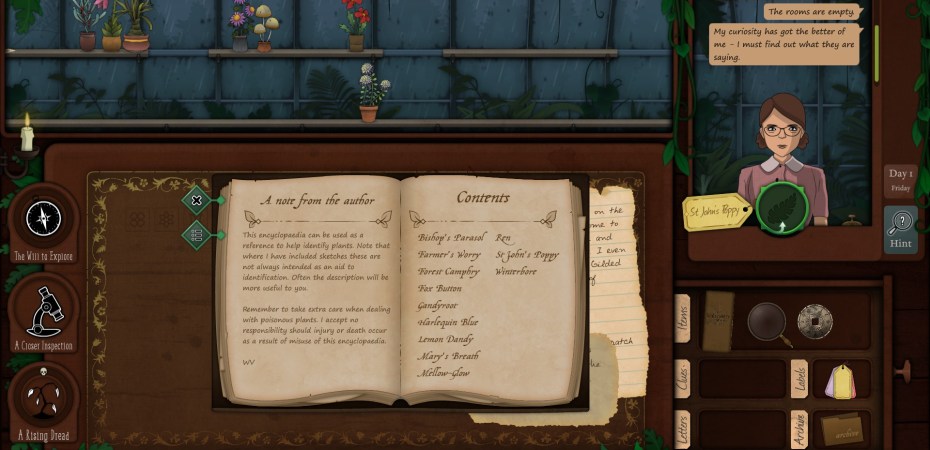
We’re talking today about Strange Horticulture, a 2022 puzzle game from indie developers Bad Viking. Strange Horticulture takes the basic mechanic of Papers, Please and translates it into the context of – I guess a Victorian herbalist? People come in with maladies, and you have to help them out with the right plant. Some plants help people sleep. Some are good for stomach pain. Some will kill you. People walk in your shop and tell you their problems, and you have to flip through a little notebook and figure out which plant might be good for them. Your knowledge, unfortunately, is incomplete. At the start of the game, your handful of plants have no labels. You’ve inherited a notebook, but it’s mostly empty. You have to research the different plants, collecting scraps from textbooks and other knowledgeable people. Some people will also bring you different plants that they find out in the mountains or down the back of their bins – and it’s your job to try and identify them, to try and figure out what they are and what they might do. There’s also some occult stuff and an evil ritual – you know, the usual.
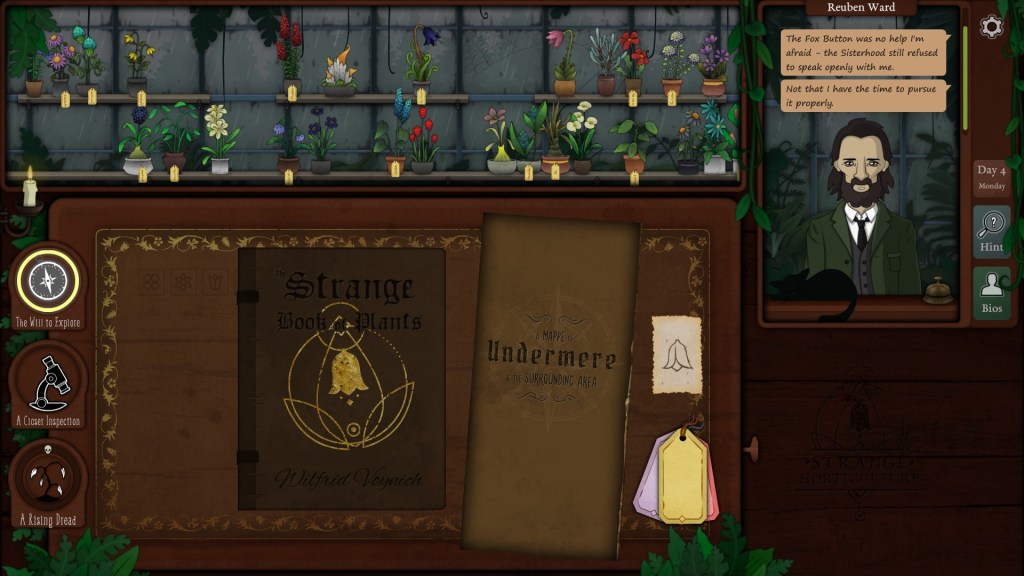
Strange Horticulture is, I think, quite special, because it obscures the function and purpose of the things you collect. You can have a couple dozen plants on your shelf, and you might only know what half of them are called. Having the physical thing in your possession doesn’t give you access to its name or properties. That’s a welcome corrective. In most games, possessing an item is identical with knowing what it’s called and what it does. An RPG might have a magic axe that does +2 extra damage. You’ll be told about that damage up front. Items in games are coded with a set of values and meanings, and most of the time, games make that system of meaning transparent to the player. You’ll be told how much damage the axe does. You’ll be able to compare and contrast different buffs from different sets of armour. In a sense, most games exist in a post-discovery world, where the material environment has already been perfectly and completely surveilled. There is no Jean Baptiste Vérany in The Witcher. The function of every item has already been discovered, and will be made known to you. You might have to work to bring different items into your possession, but there is no gap between having something and knowing what it does. Strange Horticulture, on the other hand, presents knowledge about the natural world as something built up over time. You don’t have that transparency about the function of the world: you have to draw on social and cultural resources. You have to collect information, gather the discoveries of people who came before. Your knowledge is a product of your community – of both your contemporaries and your ancestors. It is a hard-won achievement, and not a right.

One consequence of this shift is that Strange Horticulture is able to confront you with the physical objects you discover. When you come across your hypothetical +2 magic axe in an RPG, the transparency of the game system means that you often only really approach the item in terms of its mechanical function. We’ve all gone through some quest or other where you receive some guy’s family heirloom as a reward. You protect a bunch of farmers, and one of them gifts you his grandfather’s sword. And you check the stats, and it’s worse than your current weapon, so you immediately sell it. It’s so common that there are literally Viva La Dirt League skits about it. When a game’s mechanical value system is fully transparent, players are encouraged to reduce objects to their mechanical function, stripping away non-mechanical elements – whether aesthetic, historical, or cultural. The world is stripped away in favour of the machine. Strange Horticulture takes an alternate approach. It obscures its system and allows each object to confront you – in all of its otherness, all of its foreign nature. The player’s primary, constant question: what’s this? The world is not brought before us, packaged and neat – it’s wild. It’s weird. It’s beyond our control, and it doesn’t immediately yield to our understanding. And as we work to make sense of it, we come closer to all of these fine little details, to all of its fictional texture. There’s a mushroom in this game that leaks a weird milky goo. That’s one of its identifying features. I’m not sure how many other games encourage that sort of familiarity. Strange Horticulture shows us a lesson that the video game industry is learning – slowly, perhaps, but it’s getting there. It’s not about just having stuff. It’s about what the stuff means.
 Death is a Whale
[…] pitch – really Night Call falls in with games like Papers, Please or We. The Revolution, or Strange Horticulture, or any of those other games that sets out to explore a society through the lens of labour. You […]
LikeLike