

There’s a running joke about Marnie in Stardew Valley – you hang out with this lady, and bring her gifts, and after you build up enough trust she goes yeah, you know, I think that maybe you and me are genuinely friends – and you go FINALLY and run into her room to retrieve the purple underpants so you can complete the mayor’s quest, and then you never speak to her again. The transactional nature of video games can often make relationships seem insincere or forced. You’re not really friends, you’re just trying to get friendship points. I don’t think it’s controversial to say that games often struggle to portray genuine connection.
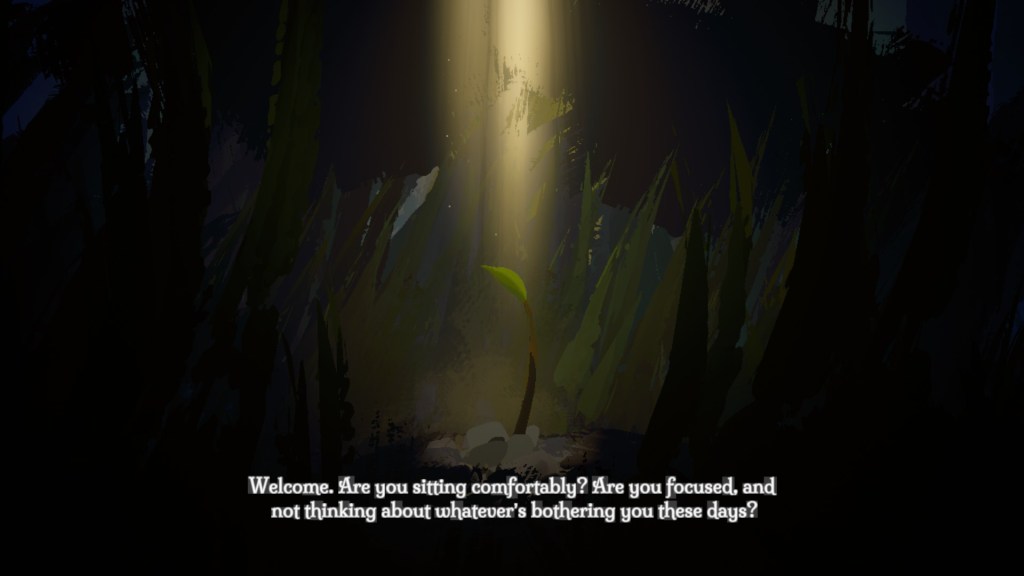
Sunlight is a 2021 interactive fiction from Krillbite Studio, the Norwegian team behind Among the Sleep and Mosaic. It’s – well, you could call it a game, if you like, but it’s more of a meditative experience. It’s built around direct address, where a narrator talks directly to you and tells you a story. That’s not a technique we see all that often in games. Obviously there’s the overt instructions you might get in a tutorial, where a dancing fairy might tell you to press X to jump, and there’s the metafictional cadre, who play around with the player-protagonist binary – but even so, there’s something strangely under-utilised about people just talking directly to you through the video game form. It’s conversational, intimate – confessional, even. In comics, there’s a strong seam of autobiography. People tell their stories in cartoon form, and that level of abstraction somehow makes the story more compelling. You’ve got Maus, Fun Home, Persepolis – there’s something in the move away from realism and towards cartoon that seems to shortcut a mental barrier and give us a deeper sense of someone’s life. Sunlight goes – maybe in a similar direction, allowing for the constraints of the medium. In video games, there’s often a heavy push towards realism, towards your immersive cinematic shooter. The Last of Us, Horizon Zero Dawn, the recent Tomb Raider games. Amidst all of this artifice and technical trickery, the most human thing that Sunlight does is just talk to you like a person. It opens with that very twee direct address – “Are you sitting comfortably?” – and proceeds in an intimate, familiar fashion.
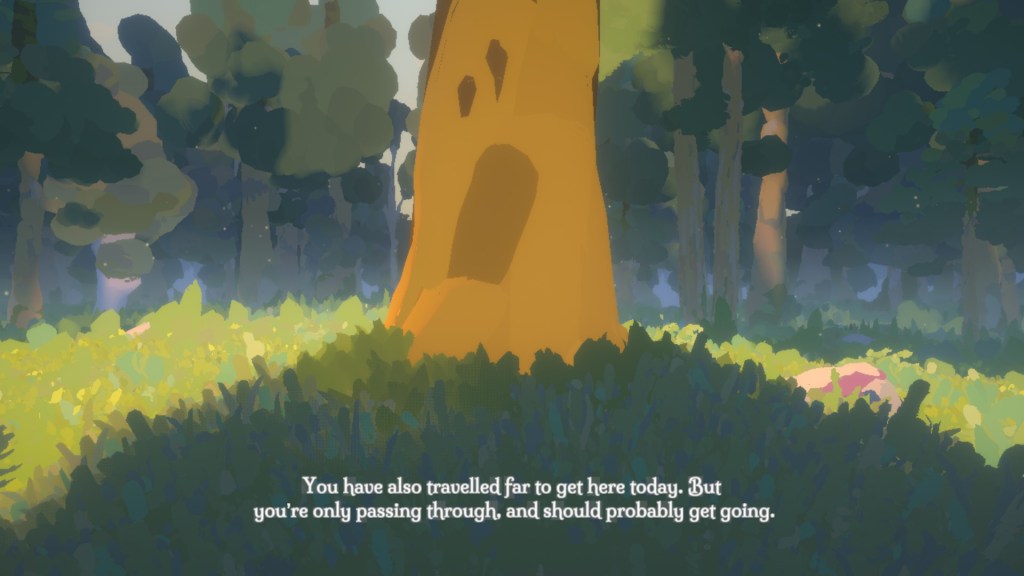
Sunlight has you walk through a forest, listening to a story that is narrated to you by a choir of readers. Each voice is hooked to a tree, so that as you walk, different speakers become louder or quieter. You can stop by a tree and stay with their voice, for a while, or you can walk on, passing through the crowd. Through these voices, Sunlight tells a story of someone’s out-of-body experience. They find a tree in the forest, and it’s leaking sap, and they touch and taste the sap, and then they start to realise that everything is connected. There are lines about “branches becoming aware that they were connected to the same trunk all along,” or, as below, that “five fingers against a surface felt no different than five bodies, or minds.” The parents take this tree-sap kid to the doctor, where they have a full out-of-body experience, seeing everything from every perspective. “There was no longer me and you, no us versus them – it was all just me.” They become aware of the interconnected nature of all things – which is reflected in the way the trees speak to you. Each voice is the same voice, and they are all the world around you, and they are all the person speaking to you. Everything is everything. And then the experience relaxes back into the everyday, with the person (the people?) returning back into their body.

During that return, the game starts to draw to a close. The connection that you have had with this voice – with these voices – starts to shut down in parallel to the speaker(s) drawing back into their own body. We might all be connected, the game says, but that’s not necessarily how we experience the world. That global all-encompassing point of view is fleeting, a glimpse of a broader truth. In our normal lives, we come into contact with each other, and then we move on. We are one, and we will be one, but we won’t always be together. Our coming together is a ritual reminder of the connectedness that joins us even when we’re apart. In the same way, the story comes to an end, “not because [it] has an ending, but because it keeps moving, leaving us behind.” Sunlight, as a work of art, is also a ritual reminder of our connectedness. Maybe that’s partially what art is: a conscious act of togetherness, a return back into the fellowship that we’ve always had.
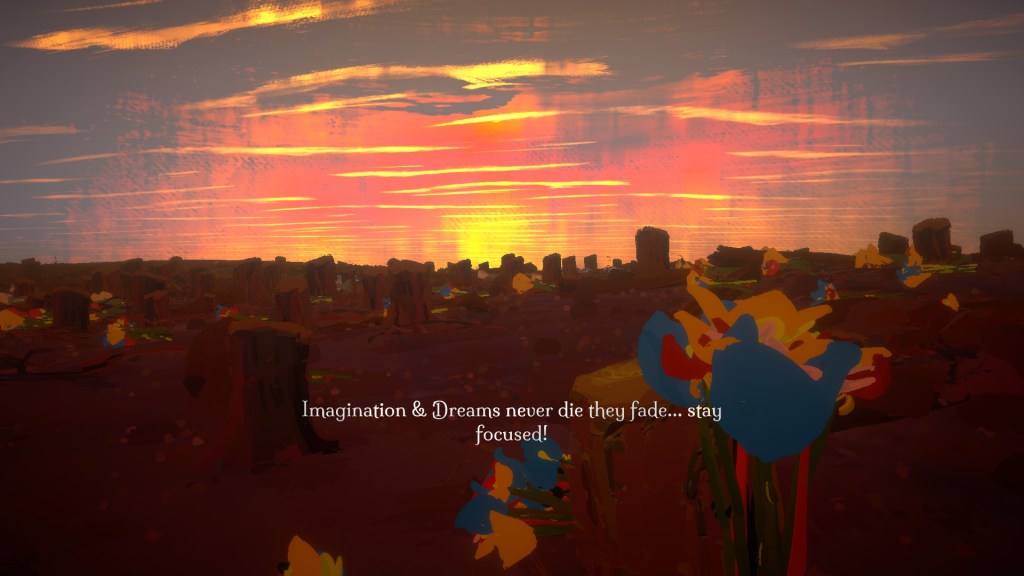
Sunlight ends with a sprawling landscape of hacked tree stumps. The voices are gone, and the sun’s going down. The connection has ended, for now. You’re able to leave the flowers that you’ve been collecting, leave a message for the people who come after you. Our connections don’t have to end when we pass out of touch, Sunlight suggests. We leave traces. We carry the memory of that moment with us, and maybe, one day, we’ll be together again.
 Death is a Whale
As someone who’s currently deep into contemplating interconnectedness, I found this post browsing ones tagged “connection.” This one is beautifully, breathtakingly unexpected; while I don’t game much anymore, to see connection and interconnectedness addressed so eloquently in the context of gaming is … flabbergasting. Fantastic.
I’m so glad the beginning of my day included reading this post.
LikeLike
[…] game where the protagonist is a toddler, and we’ve also discussed their more recent game Sunlight. Mosaic is a game about the horrors of the workforce. It’s about being a cog in the machine, […]
LikeLike