
The Horus Heresy is a long-running fiction series set in the universe of Warhammer 40,000. It’s a terrifying sixty-four books long, and as of writing, I’m about halfway through the series. I’ve been talking a little recently about some of its themes – for example how it deals with agency – and also about how it deploys things like classical allusion to particular effect. It’s just a really intriguing narrative effort, I think there’s a lot to say about it. One question you might ask, if you’re a newcomer, is where you should start. Which Horus Heresy books are worth reading? Which ones are best? Can you pick and choose, or will you not understand what’s happening? Advice will vary: for my part, I’d only really recommend that you don’t bother with the short story collections. They’re not that good.
Short story collections make up about 20% of the Heresy: fourteen of sixty-four volumes. All of them are in the middle chunk of the series – the first is book 10, Tales of Heresy, and the last is book 52, Heralds of the Siege. That tells you something about their position in the narrative. They aren’t filler, per se, but they’re usually not that important. They aren’t substantial enough to fill a whole book on their own. They make up the morass of ‘stuff that happens in the middle’. Some read like chapters salvaged after being cut from novels during the editing process, while others are literal stocking stuffers, derived from ten-minute audio clips produced as part of digital Warhammer advent calendars. Book 31, Legacies of Betrayal, is one of the worst offenders on this front: it contains nineteen short stories, and in the audiobook format, fully half of them are ten minute clips. They sit between one to two thousand words long, and they don’t last long enough to make an impression: they are only around to keep you disoriented as you’re launched into the next piece. I don’t like the short story collections. I’ll just say that up front. And I don’t think anyone else likes them, either. That’s the impetus for this essay: in the spirit of community, let’s look at what the broader reading public thinks about the different books in the Horus Heresy.
Our data set for this analysis will be drawn from scores from Goodreads – which, you know, is already a bit of a red flag. We could spend a long time discussing the problems with that platform. We could talk about the problems with score averaging, or with the social and performative aspects of rating books publicly, or we could ask whether readers on Goodreads accurately represent the feelings of the wider community of readers. We could do those things, but we’re not going to. We’ll just acknowledge the issues and see what we can make of the data regardless. As always, as with any sort of data analysis, use it at your own risk.
So: on 5 October, 2023, I went on Goodreads and noted down the scores and number of ratings for all published titles in the Horus Heresy. That’s our dataset (which you can download for your own experiments here). To date, there are 62 titles published, with two more yet to come. The published titles have been rated roughly a quarter million times (222,045 total), and have an average rating of 3.92 out of 5. The initial data suggests that the series stays pretty constant over time. It doesn’t get dramatically better or worse: as seen in the graph below, scores are pretty evenly distributed throughout, with a minor bump at the end for the climactic final titles.

So we might say the series as a whole is slightly below a 4 out of 5 on Goodreads. If we split up the novels and short story collections, the average for novels is slightly higher, at 3.98, while short stories average 3.73. Novels also have a broader spread of ratings. The lowest is The Damnation of Pythos, with an average rating of 3.23, and the highest rated is Saturnine, with 4.59. Just over half the novels (25 of 48) have an average rating of 4.0 and above. By comparison, the short story collections have a range that is both lower and narrower. They sit roughly between 3.5 and 4: the lowest rated is Born of Flame, at 3.47, and the highest is Garro, at 3.99. None of the short story collections crack a 4.0 average. Based off that data, we can say that there are probably some weak novels, but on the whole they’re better received. They reach heights that the short story collections don’t.
In saying that, we should reiterate all the various issues and complexity making up those figures. For example, the number of ratings drops off rapidly over time. The first book, Horus Rising, has been rated 25,000 times. Books 2 through 5 sit around ten to fifteen thousand ratings, and then things drop away even further. Five thousand, two thousand, nine hundred – interest clearly declines. That’s important for how we interpret these numbers. Fewer readers means that each individual rating carries more weight. There’s also an averaging effect that happens with larger numbers of readers. You can see it below: as the number of reviewers goes up, scores tend towards a center of 4 stars. The highest and lowest average scores go to titles with fewer reviewers. There’s some intuitive sense there: niche titles might be better loved by a smaller audience, or they might be unpopular, leading to the lower ratings. In either case, you can’t just take the scores at face value. As the number of reviewers goes up, different drivers come into play.

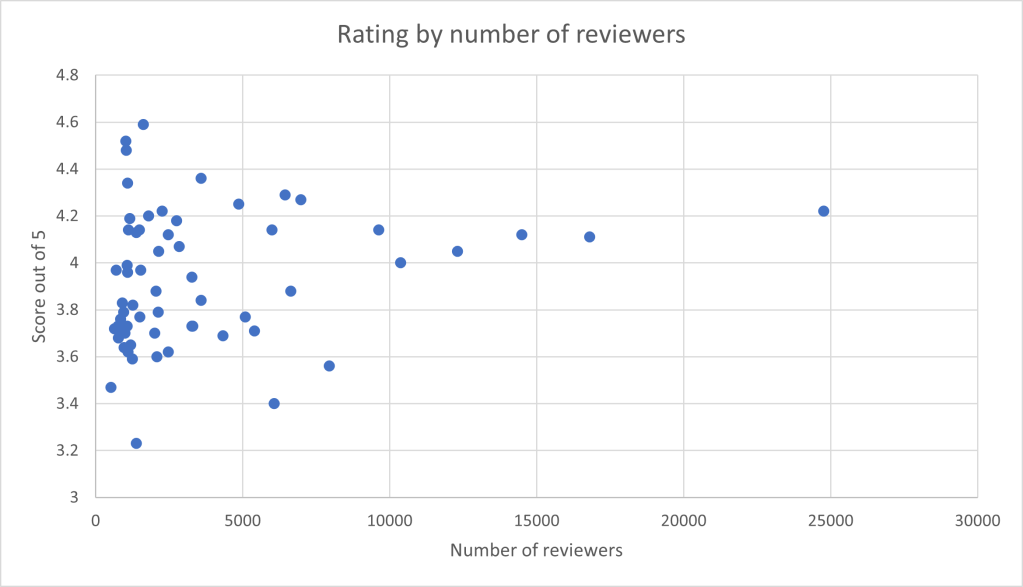
So to assess our different titles fairly, it’s worth looking at books that have been rated roughly the same number of times. The 4.2 average score for Horus Rising, with its 25,000 ratings, is not really the same as the 4.2 average score for Wolfsbane, which barely cracks a thousand. In this final graph, then, I’m only considering titles that have equal or fewer ratings than the most popular short story collection. Tales of Heresy, bk 10 in the series, was rated 5,085 times – so I’ve cut out anything with more than that number of ratings.
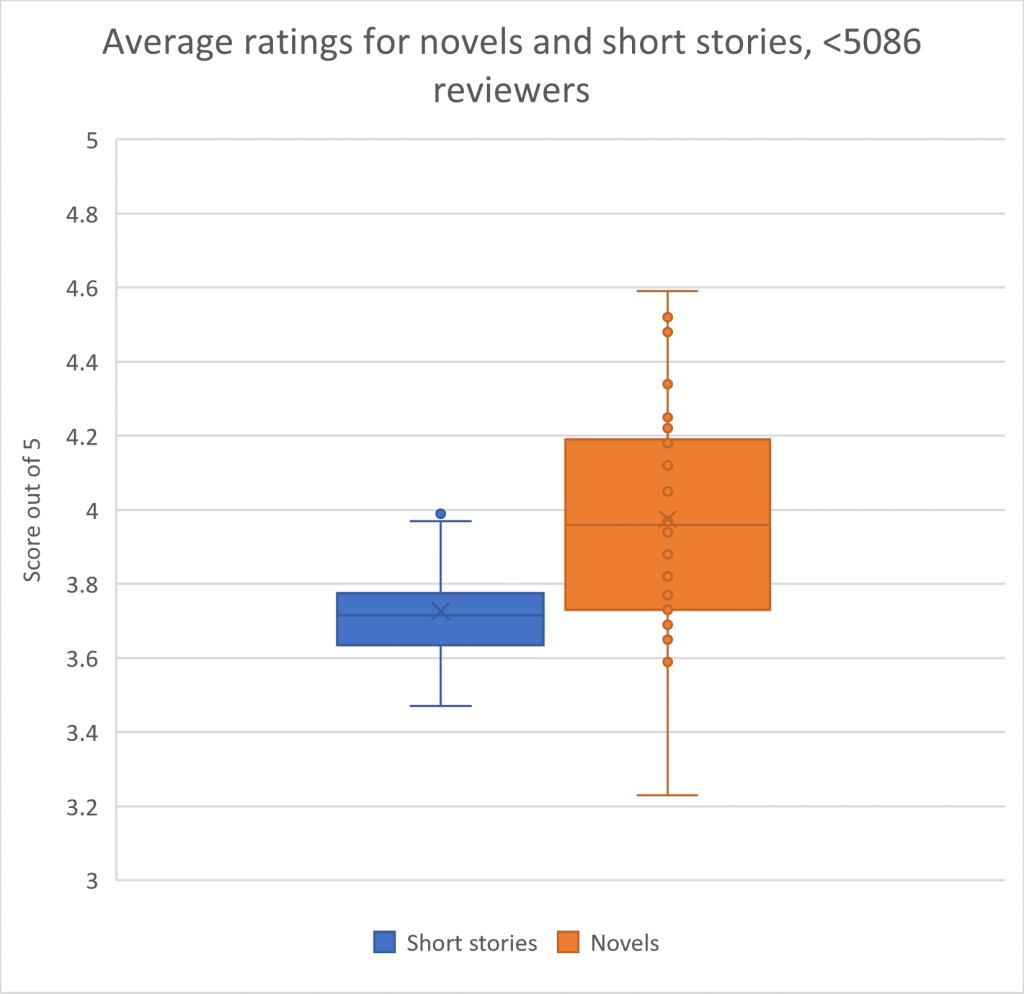
As it turns out, it doesn’t really make much difference. All our basic inferences remain intact. Even with that adjustment, we can still see that the short story collections have a low, narrow band of reception. Half of them have an average score between 3.6 and 3.8. The novels have a wider range of rankings, but are still on average much higher. The median score for novels in this graph is 3.96, which means that about half these novels are better ranked than the best-reviewed short story collection (Garro, at 3.99). People don’t really like the short story collections.
We should acknowledge here as well the limits of the exercise. Obviously there’s no way to say for sure which books are best and worst. Individual tastes will vary. For my part, I tend to agree with some of what the data shows. Some of the lower ranked books are titles I thought were rubbish: in my view, Battle for the Abyss, Descent of Angels, and Deathfire all deserve to be at the bottom of the list. But the book with the lowest score, as of 5th October, is The Damnation of Pythos, a title I thought was really good. It’s got dinosaurs and cultists, I loved it. I didn’t expect it to be rated so poorly. That’s really the strength of data analysis – it can help to soften out some of those individual biases. It gives you a sense of the broader reception, if not any guarantees about what you’ll love.
 Death is a Whale
[…] well-known characters with an established fan base. That’s part of the weakness with the short story collections, which we’ve discussed previously – they’re not really about any specific thing. […]
LikeLike
[…] 3.59 stars out of 5. We’ve discussed Goodreads in the context of the Heresy books before (Which Heresy Books Are Best?), so I won’t rehash too much of that – suffice to say, obviously there are limitations […]
LikeLike