
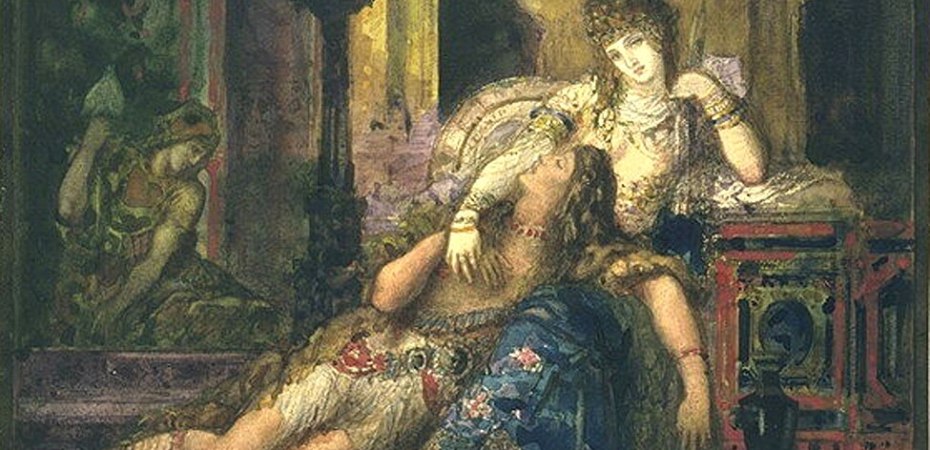
Alright, let’s get into it. I’ve been reading recently about Gustave Moreau, a French painter in the 19th century. He painted these really intricate, detailed pieces like Jupiter and Semele or (one of my favourites) The Triumph of Alexander the Great, below – anyway, he’s not directly relevant, except to say I’ve been on a bit of an art bender. Along the way, I picked up a 2007 book called Christian Art, by one Rowena Loverance, previous head of e-learning at the British Museum. The book is essentially a catalogue – it’s not about Christian art in general, it’s about Christian art from the collection of the British Museum. The book is published by the British Museum Press, and almost all of the depicted paintings and artefacts are from the Museum’s collection. It’s actually part of a sequence of books tracing themes through the Museum’s collection; other titles include Byzantium and Christ, both by the same author.

Because the book has a limited pool of works to select from, the chapter titles are a little idiosyncratic. It’s obviously difficult to write a standard history of Christian art when you can only draw on one museum’s collection – so Loverance makes the reasonable decision to draw out a series of themes, moving conceptually rather than historically. Thus we have chapters like ‘Representing women’, ‘Stewarding the earth’, and ‘Co-existing with other faiths’. All interesting stuff. As you start to thumb through the book, certain phrasings do stand out. There’s just the odd statement that makes you hesitate a little. Chapter 6, for instance, ‘Representing women’, has a section titled ‘Dominatrix’. It opens:
“One reason often suggested for societies’ suppression of women is that men fear their power. Many societies and mythologies apparently felt the need to create a ferocious female figure, from Medusa to Mary Poppins, and at first sight Christianity does not offer much in this respect.”
Similarly, in the next section, ‘Sin and sex’, the key factors leading to the development of patriarchy are identified as “men’s greater physical strength and competitiveness.” It’s a little glib, a little immature – it’s not backed by any citations or any discussion of scholarship, it’s just an assertion made without any further qualification or analysis. The section after that, ‘Equal relationships’, tells us that “Mary Magdalene achieves a unique and moving relationship with Christ, even if the reader rejects the wilder flights of fancy of The Da Vinci Code.” Yes, you heard it here first: we do not have to rely on The Da Vinci Code, 2003 mystery thriller novel, to think that Mary Magdalene had a compelling relationship with Christ. Examples can be further multiplied. There’s a statement about how interesting it would be to speculate about whether a particular icon had a female patron, rather than, you know, getting on with the speculating (“it would be fascinating to speculate whether this icon was commissioned by a female patron”). A change of topic from Eve to the Whore of Babylon is handled by describing the Whore as “a seductress rather more frightening than Eve,” and, we are told that Christianity is like Buddhism, in that both religions try “to meet the needs of women who want but are unable to bear children.” All of these quotes are drawn from a twenty-page chapter primarily concerned with showcasing the collection of the British Museum.

So – what is this book? Why is this happening? Christian Art actually opens with a really intriguing question. Given the state of Christianity today, it asks, is it possible for religious or specifically Christian art to have any sort of meaningful impact? Is there a place for Christian art? The introduction has a competent discussion of the differing arcs of contemporary Christian faith (in the vein of Jihad vs McWorld, which we talked about in the context of the Catholic Romano Guardini). There’s functional description of our current cultural context, 0f the problems faced by the modern church:
“under the pressure of modern scientific thinking and practice, including psychology, and the demands of consumer society and globalization, traditional Christianity is breaking down and there is no agreement on how to revive it.”
The basic problems of traditionalism vs accommodation to the dominant culture are also translated into an art context. For contemporary artists of faith, the traditional imagery of the church (including Biblical characters and long-standing Christian symbolism) is largely lost on the public. People don’t know about the Chi Rho. It doesn’t have a broad circulation. At the same time, “if today’s [Christian] artists were to abandon such imagery and start afresh, even if they could, their work might not be recognisable as part of the tradition.” These are some really compelling questions – and they’re questions I engage with as part of my own work here. But they pull in different directions, making for a text that’s already unwieldy on its own merits, let alone as a catalogue for the British Museum.

Throughout the book, Loverance tries to address these questions by moving between three specific, repeated ideas. She critiques the mistakes in Christianity’s past, she shows how Christian stories can be adapted to modern contexts, and she asserts that Christian art has a didactic function, drawn through from the faith, allowing it to teach people how to be better humans. I’ll pull examples of each from Chapter 6, ‘Representing women’.
One: Christian art as flawed (historical)
Loverance discusses feminine imagery in the Bible, including a verse in Matthew 23 where Christ refers to himself as gathering Israel “as a hen gathers her chicks under her wings.” Loverance notes that the image of a mother bird feeding its young appears in a fifth-century ivory of the Crucifixion, and says: “Perhaps if first-century Galilee had been a less patriarchal society, more images such as these might have illuminated Jesus’ ministry.”
Two: Christian art as relevant (aspirational)
Loverance proposes how Christian artists might explore contemporary themes and ideas without bothering to research whether or how those topics have already been explored. For example, she talks about the significance of the virgin birth in an era of IVF: “Now that scientific advances such as IVF, cloned embryos and the like have made motherhood a practical option for single women, Mary’s virginity has acquired a new and very different resonance, which contemporary artistic reworkings of the traditional Nativity scene might usefully address.”
Three: Christian art as instructive (religious)
Loverance states the doctrinal belief that Mary’s obedience in the face of the Annunciation “redeems Eve’s disobedience and restores the world to order.” We are told that Mary’s choice “cannot be asked of any other woman, but others may learn from that moment how to assent to God’s will.”
Just from those examples, I think we can see how the center fails to hold. The second and third examples seem the most closely aligned – Christian art as both relevant and instructive – although they’re actually pulling in different directions. They rely on conflicting arguments. The relevance argument shows how Christianity could be reshaped for the modern day, while the instructive argument implies that Christianity is already and always relevant simply because it is true. The relevance argument starts from the culture and works backwards to the Bible, while the instructive argument starts at the Bible and feeds it towards the culture. The key question – where’s the balance between this push and pull? – is deferred.
The critique of historical flaws in Christian art really just complicates the issue further. Loverance suggests that a patriarchal social environment deprived us of feminine imagery in the Bible. The dominant culture in some sense corrupted or failed to hear the message of the Gospel. But isn’t our own culture equally vulnerable to that problem? Should we really be so quick to accommodate to the culture of today? Don’t we risk undermining the integrity of the faith? And is there even any way to translate the message out of its originating culture without losing the core of its meaning? Is our culture good enough? Can anything from the Biblical culture be salvaged? These are difficult questions. Theoretical works like Richard Niebuhr’s Christ and Culture are able to unpick them at slow, deliberate length, but it’s an impossible task for a catalogue of artworks from the British Museum. The book is reduced to brief quips shuffled in amongst discussions of Thomas Rowlandson, “the classic chronicler of late Georgian England.” Christian Art invokes problems that it doesn’t have the time or infrastructure to meaningfully address. It’s most compelling when it focuses on being an art book. It’s less compelling when it tries to be, by turns, a revisionist history, a theological primer, a confession of personal belief, and an evangelical marketing playbook. At times it threatens to collapse in on itself, dragged down by the weight of competing goals and ill-advised Mary Poppins references.

I can see how this all might seem a lot of effort to put into criticising some random art catalogue from 2007. It’s probably not deserved. I do think there are too many Da Vinci Code references, but in its best moments Christian Art isn’t all that bad. I think what frustrates me is that these are questions that we’re all asking. Anyone today with religious faith is trying to figure out what to do with it. The debates are very familiar – tradition and transformation, relevance and irrelevance. I can point to essays of my own on shitty parts of Christian history or aspirational ideas about how the faith might be transformed today. We know the questions. I think I’m mostly mad because I thought I might find some answers. And the Mary Poppins reference – what the fuck was that?
 Death is a Whale