
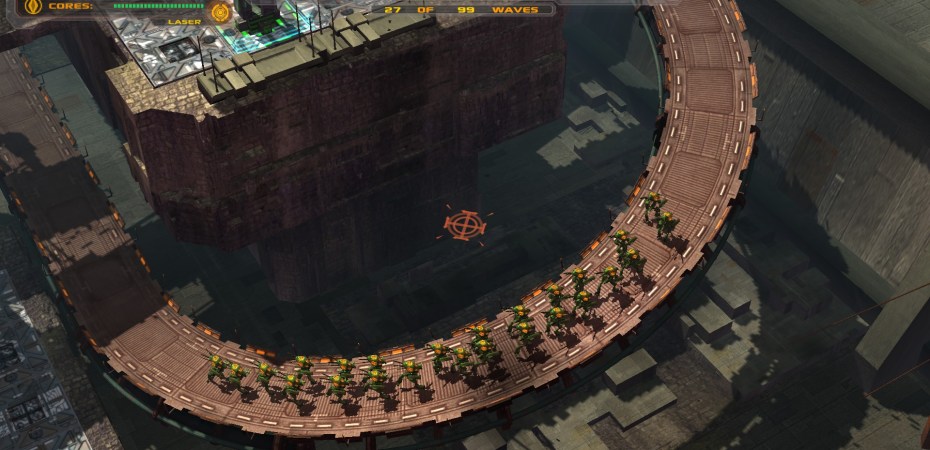
You know you have different sorts of games for doing different things. When I want to switch off from the world, I play a shooter, or something very moment-to-moment. When I want to read, I play strategy games. I set up a really slow game of Stellaris on one screen and watch video essays on the other, or read a book on my lap. In Elden Ring, every time I die, I read a poem. It gets you through the load screen, and, you know, that’s why I’ve been reading so much poetry lately. We play in different ways. When you’re thinking about something like a tower defense, there are almost two modes of gameplay. There’s design, and then there’s waiting.
If you’re not familiar, tower defense is a genre of game where enemies walk along a path towards your base, and you set up towers to deal damage as they walk by. It’s all about tower placement and damage type: if your enemies are going round a corner, placing a tower on the inside of the corner keeps them in range for the longest amount of time. It’s a fairly old genre, really kicking off in the noughties with flash games and mods. You had modded maps for games like Warcraft III and Starcraft 2, and then you’ve obviously got Bloons Tower Defense, the old flash browser game where you had to pop balloons. You’ve also got your classic Plants vs Zombies, your Kingdom Rush games – this was what people played if you were in school in the 2000s.

So in these games, enemies often attack in waves. You kill them, which gets you points or coins to buy more towers. It’s a game of expanding scope: you build your towers, kill some enemies, and use the coin to build more towers to kill a second, bigger wave. It’s a game of allocating resources. What do you buy? Where do you place it? What do you upgrade? Really it’s also a game about math. Say an enemy has 100 health, and based on its speed, it will be in range of a given tower for five seconds. The tower needs to do at least 20 damage a second in order to kill it. But also, enemies often come in groups – so damage to the group will depend on how far back the next creature is. If a tower does 25 damage each second, it will kill the first creature in four seconds. If the next creature is only one second behind, it enters into the tower’s range while the tower is still targeting the first creature. If the tower kills the first creature in four seconds, the second creature will already be three seconds through by the time the first creature dies. By the time the second creature gets targeted, it’s only going to be in range for two more seconds. With this structure, the tower will kill the first creature in the row, and then only deal half-damage (50 health) to all the subsequent creatures in that group, assuming they’re all separated by a second.
The games don’t often give you these numbers in such an overt way, but they expect you to pick up on the general concepts. You have to think about placement, time in range, damage per second – maybe even ways to slow enemies down, so that they spend more time in range of each tower. What you’re doing is design work. It’s system design, or process design. It’s about making sure that everything gets caught somewhere along the way. Enemies can get close to the base, as long as they’ve taken enough damage for the final tower to kill them. Because each wave will change and expand, increasing the number of enemies and sometimes changing the actual pathways through the map (Kingdom Rush is chronic for this), it’s a constant struggle of tinkering and redesigning, moving things around and changing damage types – you’re just trying to build a system that works with the money you have.
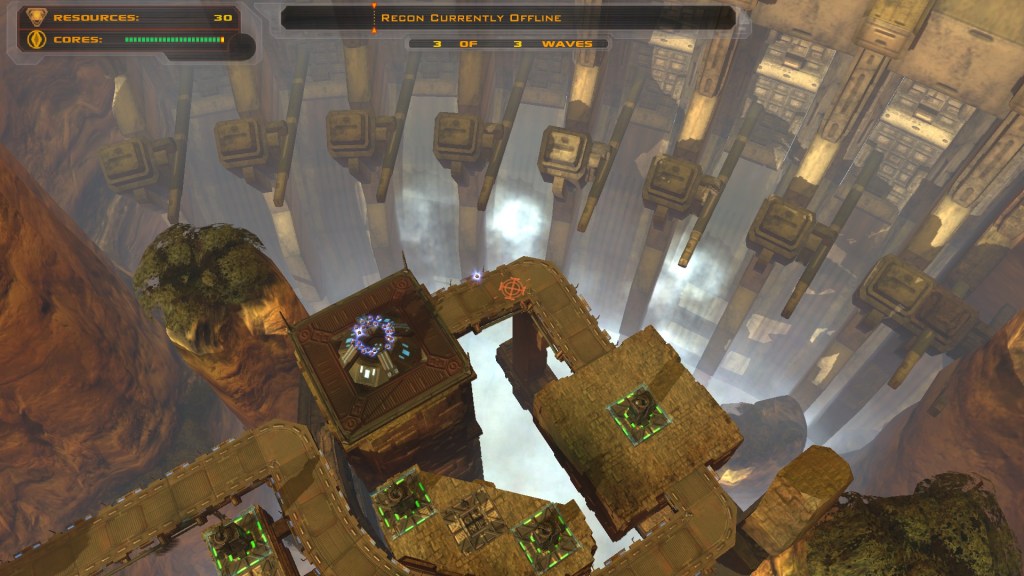
We’re talking loosely about Defense Grid: The Awakening today – it’s not the only tower defense game, obviously, but it’s the one I’m hooked on at the moment. This 2008 game has community maps, a bunch of DLC, and a sequel, Defense Grid 2. It’s developed by Hidden Path Entertainment, which will be better known to some of you as the team responsible for Counter-Strike: Source and Global Offensive. They haven’t released anything since 2019, but they made Counter-Strike and the Age of Empires II remake, so they’re a pretty significant part of video game history. Defense Grid has these levels that are all perched over precarious drops – over dams, like in the image above, or on the top of habitation towers or comms relays. The texture of the landscape is stretched in only the most 2000s sort of way – it’s just where I am at the moment.
So Defense Grid has the standard thing of aliens running along a path. They’re trying to steal your power cores, and you have to blow them up. You get a packet of money at the start, and more for each alien you kill. You have flamethrowers and lasers, and you have to figure out where to put them all. The first wave won’t start until you start placing towers, meaning you have time for planning. You plan, you place, and then you wait. You switch from one game mode to the other, from building to watching. You see where your towers are tested, where things aren’t going to plan. You get a sense for which aliens are coming in the next wave (and maybe the wave after that), and you adjust accordingly. Fast aliens? Get a slow-them-down machine. A swarm? Flamethrower. Fliers? Ground to air missiles. It’s almost tempting to argue that Defense Grid is not a game that you play. You design a system, and then you see if it works. It’s – the terms don’t quite make sense, but you can see the line of thought. ‘Play’ has connotations of being very hands-on, very much on the move. If you think about a first-person shooter, that’s clearly ‘played’. You move the character, you point and shoot. In the tower defense, the ‘play’ that happens is much more outside of the physical console, outside of the mouse and keyboard. A bunch of time is just sitting there and watching. You build the system, and then you let it run. It runs itself – it plays itself, you almost want to say. You place the towers, and they do the shooting, the slowing, the flamethrowers.
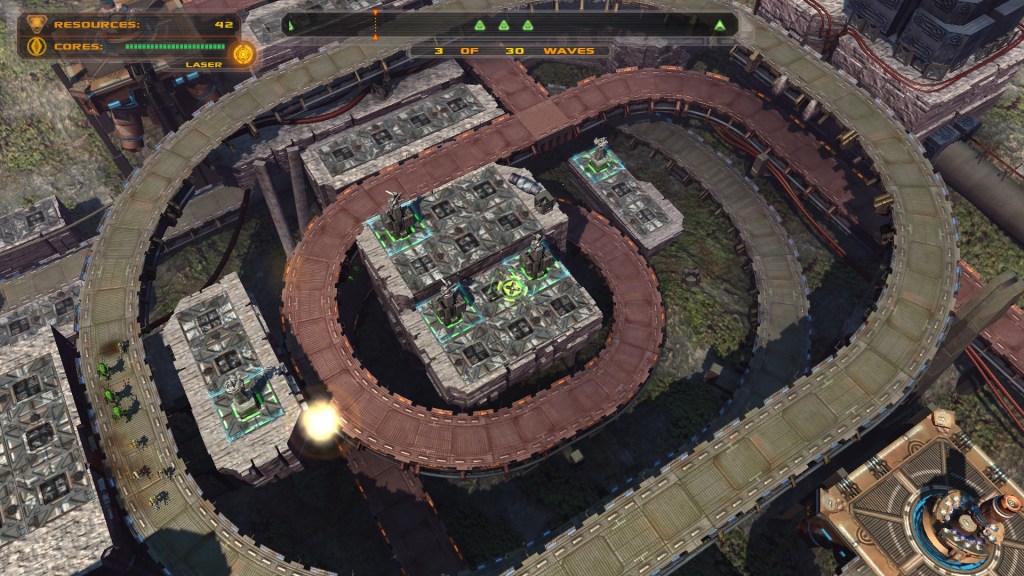
In my day job, I work in online education. I design the systems and processes that govern how learners move through a course. If I see, for instance, a particular type of support query popping up in high volumes, I tinker with the systems to make it go away. People struggling to log in? Make the log-in process better. They can’t find a quiz? Refine the user interface. I don’t necessarily answer all the support queries myself, in that sense: I play the system rather than the people who are in it. Tower defense is honestly very similar to working in user experience. And – you know, obviously these terms of design and play aren’t mutually exclusive. It’s still play even if you’re not wielding the flamethrower. Design is, in Defense Grid, just another type of play. Pretending that they’re different is a way of prodding at these questions of when we play, where our play is located, how we relate our play experience to the actual physical devices in front of us. It’s a way of rehearsing the different types of play across different genres.
 Death is a Whale