
Alright, we’re going to do something a bit lighter this week. We had an extra essay over the weekend, so this is just going to be a bit of fun to wind down. The National Gallery of Victoria is Australia’s oldest art gallery. Founded in 1861, the gallery (or now its sub-gallery, NGV International) has been at its current location at 180 St Kilda Road since 1967. They have a Wikipedia page, obviously, and it has a section on various controversies that the gallery has been embroiled in. I remember looking through the controversies with a sense of resignation: I was sure they would have been involved in something distasteful. Turns out – they’re mostly just really fun. Today we’re going to go through them each in turn and talk about art.
First off the rank: the gallery’s name. Before federation in Australia, each state or colony was self-governing. They were independent political units, and some of them, including Victoria, had their own national galleries. Federation happened in 1901, and some time later, in the 1960s, they got around to creating the National Gallery of Australia over in Canberra. The various state galleries at this point all changed their name, for instance from the National Gallery of New South Wales to the Art Gallery of New South Wales (where there’s currently a very good Mucha exhibition). The National Gallery of Victoria, of course, told them to get fucked. It’s still the National Gallery of Victoria. They don’t care. This really is going to be the speed of all these controversies – it’s mostly petty, hilarious sniping. There are of course good reasons for the NGV to keep its name. It’s a mark of independence, ignoring the compliant, polite option in favour of doing its own thing. That’s pretty characteristic of the inter-state and state-federal relationships, which are often fractious. If you watch any local politics in Australia, you’ll quickly hear people at both state and federal level batting questions back towards their opposite number. ‘That’s a federal issue,’ you’ll hear, or ‘that’s a state issue.’ It came up a bunch during Covid, but it happened before that as well. In 2018 you could see Dan Andrews, then-Victorian Premier, describing then-Prime Minister Scott Morrison as “Prime Minister for Sydney“, as a result of perceived favoritism towards NSW. The National Gallery of Victoria keeping their name is part of the same boisterous relationship. We’re not having some bureaucrats up in Canberra tell us what we can name our gallery. Not a chance.
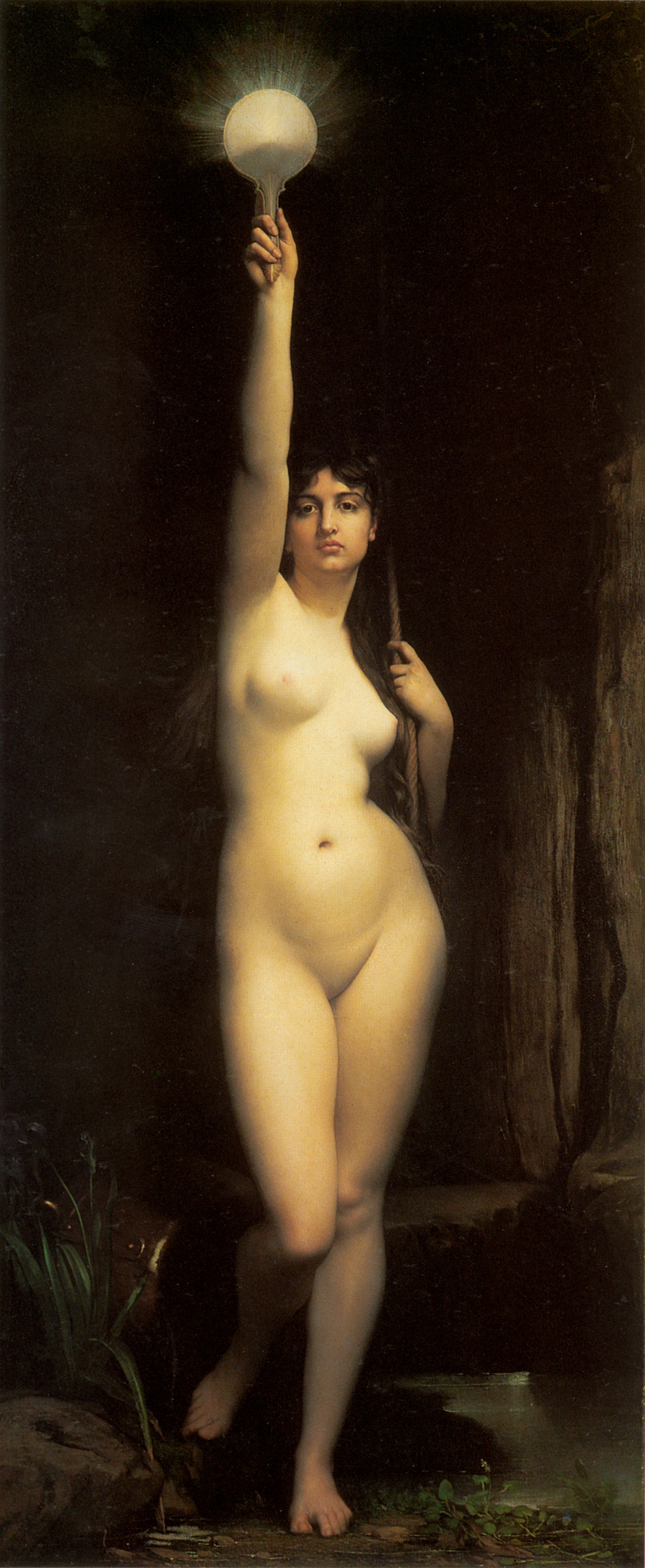
The next scandal relates to a painting of a nude woman – Chloe, an 1875 piece by the French artist Jules Joseph Lefebvre. To my eye there’s really nothing exceptional about it; it’s not bad, but it’s really just a nude. There’s not much to distinguish it from La Verite or Psyche or Diana Surprised, all by the same artist. They’re just nudes. You’ll be aware that the nude has a long history in art, easily stretching back to the Ancient Greeks. To some, it’s one of the highest, most classical forms. It is among other things a study of physical perfection, as with Michelangelo’s five meter high David. When Chloe was displayed at the NGV in 1883, however, the primary concern was prurient. Katrina Kell, in an essay for Index Journal, quotes some of the criticism sent to the newspapers: “I refer to the exhibition of ‘Chloe’ in your Picture Gallery, which is calculated to blunt the modesty of one sex and excite the evil passions of the other.” That picture, the criticism went, is too damn horny. It’s maybe an indication of the different art traditions between Australia and France – you don’t hear any complaints about Watteau’s Jupiter and Antiope hanging in the Louvre, for instance. It seems like it speaks to the culture of public exhibitions in Australia at the time, and more broadly the sense of what art is supposed to do. The complaints rolled in, and the gallery took the painting down – it’s over in Young and Jackson Hotel opposite Flinders St Station now. Score one for conservatives, score two for the pub.
Next up is the very hilarious Ivan Durrant performance art, where he dumped a cow carcass in the forecourt outside NGV. It’s a comment on eating meat, right – if you’re going to eat beef, some cow somewhere has got to be butchered. Durrant’s performance brings the reality of eating animals out into the open, confronting the audience with a part of the process that they’d probably prefer to ignore. Originally, actually, the piece was going to be much worse. Durrant had set up to slaughter the cow live on stage as part of a performance piece at Monash University, with the same basic point. Monash got wind of it and threw him out, so he slaughtered the cow at a cattle yard, drove the carcass to the NGV, and dumped it on the forecourt outside. It obviously prompted shock and horror from the public, and Durrant was fined $100 for littering, but that’s a pretty hilarious piece of art. It really neatly demonstrates some of the strengths and weaknesses of this more conceptual stuff too – for instance, me telling you about this piece is almost as good as seeing it yourself. As you think about it, as you process it, you can see the point. Learning about the idea of it makes the point just as much as if you’d seen it – in fact it’s probably easier to appreciate having not been exposed to the actual carcass. Further, and this is again a curiosity of conceptual art, even as some of the material details change the point remains the same. Slaughtering the beast on-stage really achieves the same sort of thing as just dumping the body at the art gallery. It’s probably much more horrifying to witness the actual moment of death, but both options confront the audience with something they’re not accustomed to seeing – rather, something they’re accustomed to not seeing. Plus I think walking down the street and finding a dead cow has its own sort of shock value.
Anyway, then in 1986 a bunch of dickheads stole Picasso’s Weeping Woman. This is one of the very famous Picasso paintings – it cost the gallery $1.6 million, and was at the time the most expensive painting ever purchased by an Australian gallery. Obviously local artists were annoyed by the purchase, as it’s money spent on international art instead of money spent purchasing and promoting local art, so they stole it. They left a ransom note demanding an increase to local arts funding, including the establishment of a prize for young artists titled ‘The Picasso Ransom’. Again: very funny shit. Two weeks later the painting was discovered in a luggage locker at the Spencer Street station, now Southern Cross. They still don’t know who did it – the thieves were never caught – but at least they got the painting.
The difference between this controversy and the preceding ones is that where the others have centered around the public being outraged by this or that piece, this one has artists getting shitty about art. What ties them together is a shared investment in what types of art should or shouldn’t be shown. They’re all annoyed about a perceived violation of the ‘ought’ – of what ought to be shown, what ought to be promoted. Those questions in turn line up with certain assumptions and beliefs around Australian culture. Those criticising Chloe felt that art ought to be edifying – moralistic, even. Nudity in art was considered immodest, and considered to encourage immodesty or licentiousness among the broader population. The same is true of the Durrant performance. Durrant took a veiled activity and unveiled it. He took something that society likes to keep hidden and brought it out into the light. He received backlash because he violated a social norm. And society reinforced its boundaries: you can’t go around showing such horrible things, they said. Durrant’s question (if you think it’s horrible, why do you allow it to happen at all?) was lost in the backlash, in the repression of the very problem that he’s trying to discuss. The Picasso theft is, in its own way, the same sort of thing – just coming from a different perspective. The painting is stolen to make a point about what Australia is – what its artistic values are or should be. To the local artistic community, the NGV purchasing the Picasso was disrespectful to Australian art. It exemplified a cultural cringe, the idea that European art was better and more important than anything produced in the colonies. In response, they said – right, well, we’re taking your European art away until you start valuing our stuff more highly.
It’s clear that each of these controversies is about negotiating Australian identity. The question ‘What does it mean to be Australian?’ gets pulled into all these other individual questions: What art should be shown? What shouldn’t be? What do we even call this gallery? These conversations continue into the modern day, as with the recent Casey Jenkins lawsuit – not a case related to the NGV, to be clear, but a broader example of how these debates persist. I’m sure as well that we haven’t covered every controversy around the NGV. We haven’t even finished the Wikipedia page – I’m skipping the final entry, but if you want to see it for yourself, it involves our old friend George Pell. There will be plenty of other stories out there too, and no doubt all of them will tie into our sense of self. Probably a bunch of other galleries have the exact same set of questions, all popping up in different manifestations respective to those locations. If we’re lucky, a bunch of them will be on the Wikipedia pages under the subheading ‘Controversies’. The National Gallery of Australia doesn’t have anything, because it’s boring; Te Papa in Wellington might – oh, hang on, it does! There’s a whole section…
 Death is a Whale