
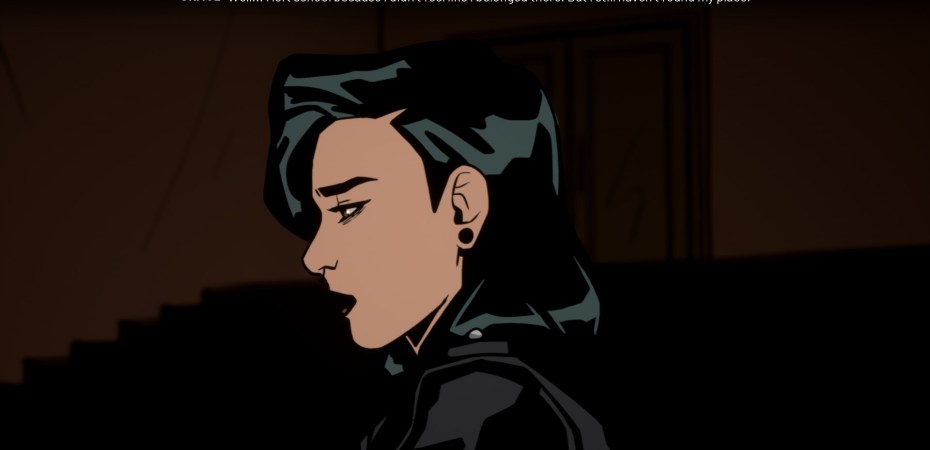
Stray Gods: The Roleplaying Musical is a 2023 murder mystery from Summerfall Studios, an indie studio mostly based in Australia. As suggested by the subtitle, it’s a musical theatre RPG, sort of sitting in that visual novel space but where everybody sings. The roster of voice actors is an industry who’s who (Laura Bailey, Ashley Johnson, Erika Ishii, Felicia Day, Troy Baker, and somehow also Anthony Rapp, who played the original Mark in Rent???). It’s a high-concept award-winning game, but also, and I mean this affectionately, a bit of a weird little guy. It’s the sort of thing you won’t come across very often. It’s also a murder mystery, and we’re going to talk about the ending – yes, it’s our annual instalment of spoiling the end of a mystery game. I think I mentioned this when we were talking about Paradise Killer, or – no, Behind the Frame – but obviously what I’m doing here is writing essays about video games. These aren’t reviews or purchase advice – we’re talking about structure and narrative, the actual craft of telling stories. So we sort of have to talk about the text in its fullness, without worrying about things like spoilers, so-called. But I do like to give a little bit of warning, sometimes, when we’re dealing with something like a mystery, just in case someone new stumbles in. So there it is. Also content warnings ahead for discussion of sexual assault.

Stray Gods is set in the modern day, but where Greek gods and goddesses still exist. It’s a little bit Dresden Files, if you like – it’s just our normal everyday world, but the Muses exist, behind the curtain, as it were. They keep to themselves and people don’t know they’re real. Our protagonist, Grace, is a local musician who meets the Muse Calliope, right before she’s gunned down by a mystery killer. As Calliope dies, her mantle as divine Muse is passed on to Grace, who’s then immediately pulled up in front of the gods’ high court. They all think Grace killed Calliope and stole her power, and they plan to put her to death – unless she can find the killer. That’s the premise for the game. I made a bit of song and dance about not wanting to spoil the mystery, but it’s not really all that mysterious. It’s narratively structured like a mystery – with the murdered dame, the unlucky gumshoe in a tough situation, and the j’accuse denouement – but it doesn’t play like a mystery. It doesn’t have the mechanics of a mystery game – it’s not This Bed We Made. It’s a visual novel. You can sort of just tootle along and enjoy the music, and you’ll end up in more or less the same place. Near the end of the second act, you meet the murdered Calliope in Hades. She tells you she was killed by Athena, leader of the council. You confront Athena, she’s defeated, and the gods (or ‘Idols’) decide to reveal themselves to the world. It’s – again, not really a mystery. There’s a lot of variation in how exactly your final song can sound, depending on the choices you make (see one Steam user’s frankly scary flow chart below), but the game ends in largely the same way.

Despite the variation in that final song, Athena’s defence always seems to begin with her claim that she had to try and kill Calliope. She’d been given a prophecy that the Idols would end if the Muse didn’t die, so to save the Idols she murdered Calliope and tried to pin it on you. Objectively, that’s not a totally unreasonable course of action. The prophecies in this world are guaranteed to come true, and in fact this one does. The fix is that Grace grabs a loophole: she says well, the Idols will not continue, because we’re going to become something else, and then they all go public with their power. That’s considered enough change to fulfil the terms of the prophecy – they are Idols no longer. Who they were is gone, and they have to get used to being something else. If only Athena had thought about metaphors.
I do want to put in a light defence for Athena here – the word games are one thing, but I do feel like this lady gets a bit of a hard time. Most of the other gods are sulks or losers. They bum around feeling sorry for themselves – Athena in many ways is the only person trying to carry things forward. She does a bunch of horrible things, yes, and she has a bad case of parentified eldest child, but she also seems like the only person trying. There’s a bunch of terrible stuff in this world that isn’t traceable back to Athena. Aphrodite is so traumatised that she routinely kills herself, passing on her mantle to a new Aphrodite, who will only get a short time before the memories return and she’s driven to suicide again. Eros, her child, is left to watch a procession of women take on the mantle, break down, and die. Nobody really seems to be trying to fix that. Nobody seems to be trying to fix much of anything. In that sense, Athena’s leadership is owed both to her initiative and to everybody else’s passivity. Her methods do involve murder and scapegoating, which, yes, are both bad, but the biggest critique of Athena is almost more that she’s uninventive. Faced with the trolley problem, or what she perceives to be the trolley problem, she tries to pull the lever. I’m not sure how far we can blame her for that. Further, Athena in her final song critiques the other gods, identifying them as complicit in her actions:
“You all turn away when I gut the fish
Then you cry hooray when it’s on the dish
That’s how we do this
Yes, we! Yes, you and me”
She implicates the other gods in an unhealthy pattern of dependency. They sit around and do nothing, and Athena takes on an inappropriate responsibility for their wellbeing. She pulls the lever, or tries to pull the lever, because she feels like she has to – because these dumbasses are otherwise helpless. That’s not to justify or endorse anything that she does, but I think we can understand the process by which she got there. Let’s talk about regime change.

Stray Gods ends with Grace supplanting Athena – in my playthrough, smacking the shit out of her. The gods reveal themselves, and Grace leads the way, stepping into one leadership position or another depending on your exact decisions. The future is presented as bright and sunny – which really feels like a misunderstanding of what led to these problems in the first place. Often in video games (and plenty of other media) the problem of a corrupt state is boiled down to the corruption of a figurehead, who can be simply excised and the problem resolved. That feels like a misunderstanding of why corruption happens. Athena didn’t just end up like this. She’s part of a social structure that remains largely unchanged. Overland has a recent article on the allegations of sexual assault made against Neil Gaiman, which writer Emmy Rakete describes as more a story about New Zealand. It’s not just about the individuals involved, she says, it’s about the system. The system produces the results that it’s designed to produce. It’s not just about one rich guy (allegedly) assaulting the live-in nanny, it’s about that woman’s experience of housing insecurity and unemployment. It’s about the weeks she spent sleeping on the beach, about the poor job market in New Zealand. “Every concession that New Zealand has made to the profits of private landlords pushed Scarlett Pavlovich into Gaiman’s arms,” Rakete writes. “She had nowhere else to go. None of the women like her do.” We’ve sort of kicked it up a gear from silly Greek musicals, but I think there’s a question about how we talk about regime change. If you’re going to slap Athena, you probably have to slap Pan. You definitely have to slap Apollo, and you should probably slap Persephone too. Athena represents a broken system, but she’s not solely responsible for building it. When she leaves with a threatening warning (“There you go, now it’s yours to drive/ Let’s see how long you stay alive!”), she’s correct. She is, as the domineering eldest child, deeply familiar with all the terrible parts of their broken system. Her criticisms and warnings are valid. She’s also willfully awful, and her criticism is self-serving – she’s trying to excuse or justify her behaviour by pointing at everybody else – but it’s glib to pin it all on her. It doesn’t ring true. You can’t just knock her off the throne and then everything’s fixed. There are broader problems here, and Grace is about to be subjected to all of them.
We see this slightly glib approach to regime change in plenty of other titles, like Papers, Please or Mind Scanners, which we talked about recently. In both of those, there’s a slightly oversimplified opposition between Soviet-era totalitarianism and brave revolutionaries bringing in democracy. Both games treat revolution as a climactic final event rather than the start of a new set of problems. As much as these games identify problems with existing social structures, they also seem to carry that residue of power fantasy, of player empowerment. You’d be better at running Arstotzka. You’d fix the issues. You decide whether you let the revolutionaries in, and on your say-so, everything will change. Shape the fate of a nation. End wars, start them, put the right people in charge. Is there not the same arrogance here that led Athena down her path? As players, do we not lay claim to the right to choose in exactly the same way? What will make our choices better? There are of course titles where you can read regime change in less literal ways – as a metaphor for a battle against the self, or an internal transition from one stage into another. For a not-quite-perfect comparison, we could look back at how Into the Spiderverse uses hero and villain to model two different responses to loss. Those battles between hero and villain (or ruler and upstart) can work metaphorically, representing internal, psychological processes – they don’t always have to be read so literally. But even in that scenario, we need to hold our heroes – hold ourselves – to account. What makes our choices better? Where is the mechanism of self-critique? Where’s that awareness of our weakness? Where do we recognise that a transfer of power won’t resolve the underlying structures? Honestly, during this song I found myself empathising with Athena. I don’t think she did the right thing, but she’s not as singularly culpable as the game wants to make out, and I don’t think there’s any meaningful rebuttal to her critique. The climax of the song has all the Idols standing together, unified, against Athena and her henchmen, and all I could think was – hang on, you assholes were part of the problem.

 Death is a Whale