
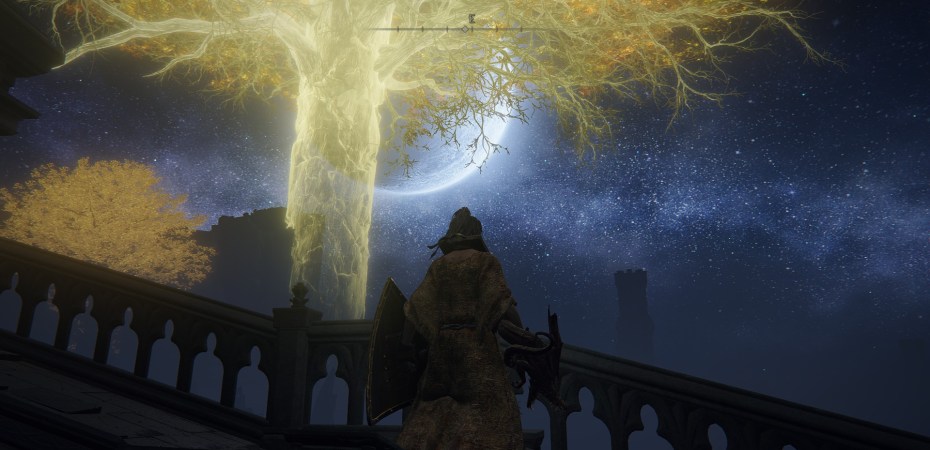
I don’t think I’m ever going to write anything good about Elden Ring. It’s too big. We were talking recently about experiential criticism in Shadow of the Colossus – there are schools of criticism where you essentially write your experience playing the game, evoking the feeling of play rather than trying to capture the game in some more abstract or conceptual way. It’s like the difference between a book of chess openings and an essay on that one time you played chess in high school – top down against first person, so to speak. If you were going to write about Elden Ring, the experiential approach would probably be easier. It’s just so big. I’ve recently started up a third playthrough – I have maybe 250 hours in this game, and I just found a new cave system through Caelid. I’ve never seen it before. Other players have – it was filled with blood splatters, showing where other players had died – but I’ve never been there. You could write a great essay on the experience of forever finding new parts of Elden Ring. Call it ‘Fuck, And This?’
I wouldn’t be able to write it, though – I don’t like writing like that. If I’m talking about a game, I like to be sure that I know what’s in it. If I’m still stumbling into new cave systems after 250 hours (over six working weeks of game time), I don’t think I’ll ever have a good enough grasp to talk about it in full. Part of the difficulty is in how Elden Ring (and the Dark Souls games more broadly) construct their narrative. Take Siofra River, one area in Elden Ring. It’s deep underground, and the sky down there (really the roof of the cavern) is deep purple and studded with stars. Most areas in this game have some sort of climactic boss fight. They aren’t linear per se, but they often follow the traditional video game structure of a gamut of enemies culminating in some form of final boss. Godrick the Grafted sits at the end of Stormveil Castle. He marks the end point, guarding the exit out into Liurnia of the Lakes. Siofra River has a slightly different structure. It’s a corridor level – you can enter from Mistwood and leave up towards Caelid, and the boss is optional on the side. There’s a temple off somewhere with the carcass of a giant antlered stag – if you light a bunch of braziers scattered around, the stag begins to glow, and if you touch it, you’re teleported to a boss fight against the Ancestor Spirit, a happy hopping version of the stag that breathes fire at you. Descriptively, experientially, that’s what happens. You can go from Mistwood to Caelid, or you can light some fires and kill a giant deer. You might also be tempted to ask – what’s that about then? What’s going on here?
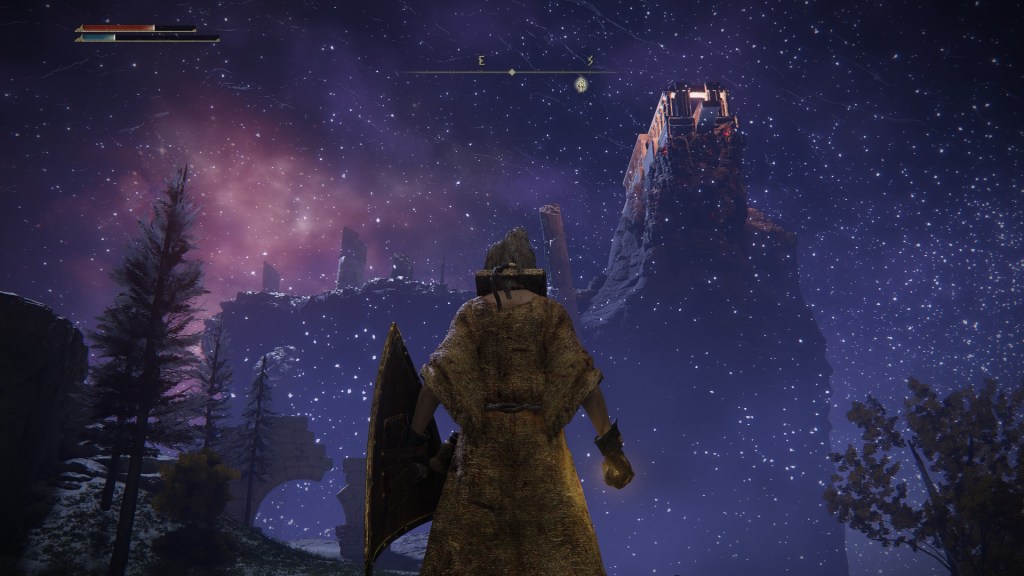
We’ve talked before about how Elden Ring and the broader Dark Souls franchise store a bunch of their narrative in their item descriptions. It’s a slicker version of scattering audio files around the place – it’s a quick little description that, cumulatively, across several items, builds up a sense of narrative. In the item description for the map of Siofra River, we read that “This vast region is said to be the grave of civilisations that flourished before the Erdtree.” The Erdtree is sort of the expression of order and the laws of the universe, in Elden Ring – so these underground civilisations existing before the Erdtree suggests that they’re outside the normal laws of the universe, but also that those laws are impermanent. This is how things are, but it’s not always how they were, and it doesn’t have to be. The beastmen enemies that populate Siofra River glow with a mysterious aura. If they die, their bodies evaporate. Other beastmen can be found above ground, in corporeal forms that survive after death, suggesting that they aren’t really physically present in Siofra – they almost seem like spirits or dreams – or even dreamwalkers, as if they’re stepping out of the world of the Erdtree and entering into a memory of how things used to be.
This alternate order seems to revolve around the antler as its organising motif. Antlers, as you might known, are shed and regrown every year, and grow back bigger as the creature matures. In the item description for the Remembrance of the Regal Ancestor, another ancestor spirit found nearby, we read that this cycle of death and rebirth perhaps indicates something of a previous cosmic order. “Ancestral spirits exist as a phenomenon beyond the purview of the Erdtree. Life sprouts from death, as it does from birth. Such is the way of the living.” It’s a process beyond (more specifically before) the control of the Erdtree. Similarly, in the Ancestral Spirit’s Horn, an item craftable from that Remembrance, we’re told “A number of new growths bud from the antler-like horns of the fallen king, each glowing with light. Thus does new life grow from death, and from death, one obtains power.” That squares with our understanding of the antler motif. The dead spirit is not really dead: it is the ground for new life. Antlers die, they’re shed, and they regrow. Such is the way. When you return to the temple after beating the stag, its body continues to glow. You haven’t killed it – it’s already dead, and this rejuvenation or seeming new life hasn’t been interrupted by your boss battle. Perhaps it’s been accelerated. There’s really no way to know. So you leave, having encountered something profound, some vision of another way of being.
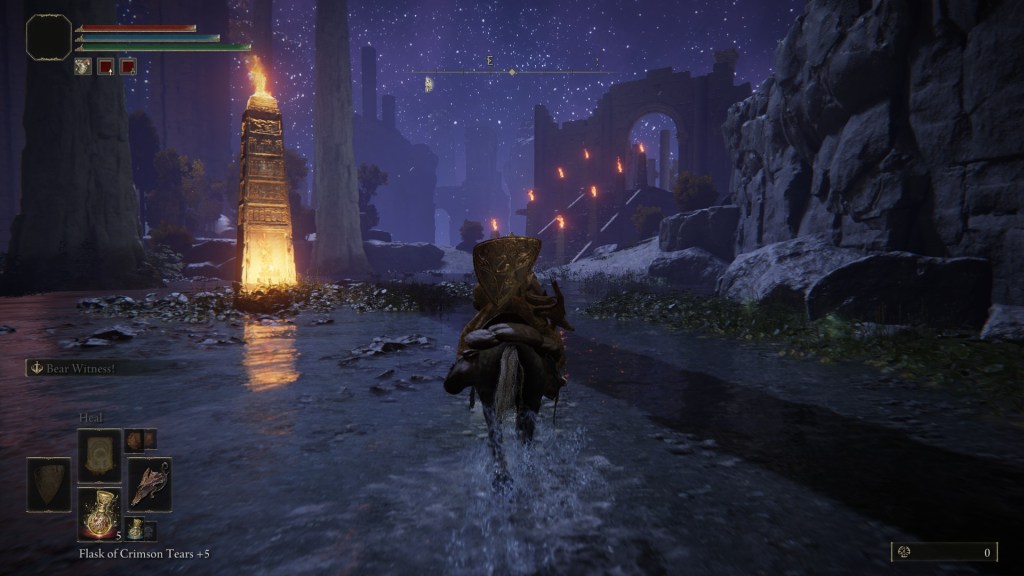
That seems reasonable enough, as a summary, but only because we’re talking about a pretty narrow piece of the pie. There’s not all that much available on the Ancestral Spirits. They are a relic of a prior time – they exist as a trace of the past rather than contemporary agents. And there are still details we haven’t properly canvassed. It’s possible to find a Golden Seed from the Erdtree down in Siofra River. Is the Erdtree extending its reach into this ancient kingdom? And what’s the relationship between the antler and the horn, which has its own existing set of meanings and associations? The horn in Elden Ring is associated with the Omen, who are spurned by the Erdtree, and it’s associated with the Crucible, which is – possibly again a sort of prior form of the Erdtree? There could be some connection. Really this is where I start to lose my way with writing about Elden Ring. We end up speculating based on quite fine details that are only available, sometimes, in optional or hidden areas. If I’m not confident I’ve seen everything, it’s hard to be certain how it all fits together. And there’s reason to worry about being misled. The best ending in Sekiro requires spying on your master and friends, listening in to their conversations and learning they’re withholding things from you. In the original Dark Souls, Gwynevere, a key figure who sends you on your main quest, turns out to be an illusion put together by a non-binary gremlin hiding in the basement. This is a series that builds its narrative around the hidden and secret. The surface account isn’t reliable. And I don’t feel equal to the challenge.
G.K. Chesterton is an early twentieth century writer and critic. Today he’s remembered for works like his Father Brown stories and the surreal nightmare The Man Who Was Thursday, but he’s written just about everything. He had a weekly newspaper column for most of his working life. He wrote essays, literary criticism, philosophy, fantasy, poems, short stories – the total list of his published material runs easily into the thousands. His critical study of Charles Dickens, first published in 1906, is infinitely quotable. His writing style is built around these elegant counterpoints. Writing on the Pickwick Papers, he says that Dickens was a mythologist rather than a novelist: “He did not always manage to make his characters men, but he always managed, at the least, to make them gods.” In the first chapter, he writes that the early Dickens period “may have been full of inhuman institutions, but it was full of humanitarian people.” They’re these very fine phrases balanced against themselves. I feel like Randall Jarrell – may I make a bargain with the reader to regard all of it as quoted in this essay? Chesterton writes that deeply creative work “calls forth not criticism, not appreciation, but a kind of incoherent gratitude.” He sees his own critique as in a sense inadequate: “There is no way of dealing properly with the ultimate greatness of Dickens, except by offering sacrifice to him as a god”. I feel similarly about Elden Ring. It’s hard to be anything other than overwhelmed. The game is cosmic in scope. It is exhaustive, obsessively detailed, incomprehensibly textured. It resists summary. It’s not the sort of thing where you play for a couple hours, pen something easy, and move on. It is a blockage, in some sense an experience that cannot be digested or metabolised.
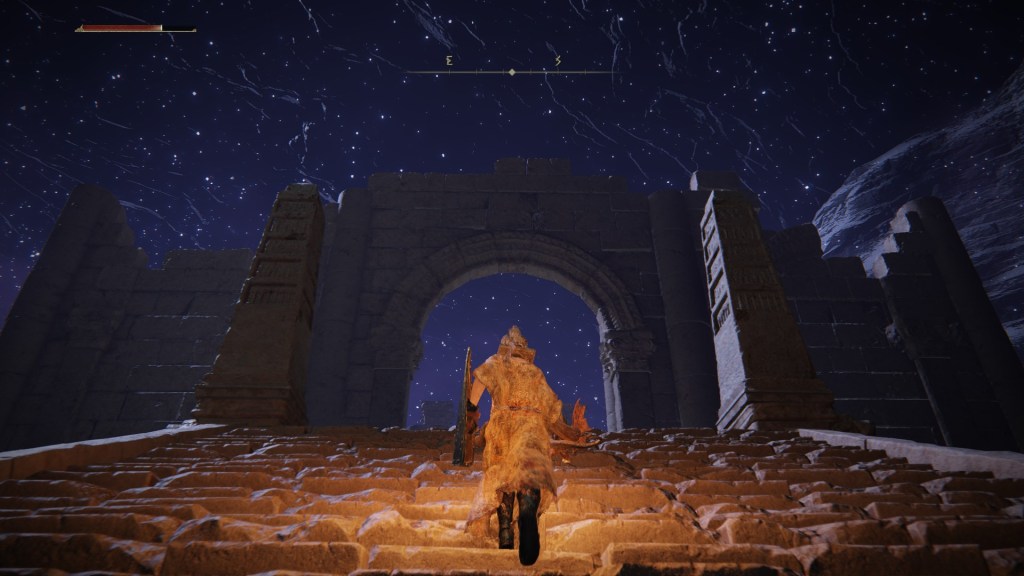
In his chapter on Dickens and Christmas, Chesterton describes the “besetting sin or weakness of the modern progressive” as “the habit of regarding the contemporary questions as the eternal questions and the latest word as the last.” We’ve talked before about the impulse in video games to be focused on the latest new thing. I’ve also mentioned some years back I sent a gaming website an article about Wolfenstein II, which was rejected – it’s already had its moment, came the reply. Fair enough: that’s in keeping with the needs and demands of the website. But you have to wonder how those needs intersect with Chesterton’s criticism – that bad habit of regarding the contemporary questions as the eternal questions, the latest word as the last. I’m conscious of that as well in my own work. I’m often moving from title to title each week – there’s always some new thing. I really treasure these longer projects, like the Horus Heresy stuff, or reworking older essays like the Modern Warfare one earlier in the month. We need to keep coming back. In the introduction to Midnight in the Kant Hotel, Rod Mengham writes that “nothing compares to living with art.” He emphasises the value of the longer term: “Visiting an exhibition or installation several times and layering your perception of a painting or sculpture through acquaintanceship confirms one thing at least – that in your own life experience, what really gives substance and complexity to individual artworks comes out of the history of your relationship with them.” It’s good that it’s hard to write about Elden Ring. Elden Ring isn’t a momentary game. It will be here forever, something to stumble over, something to unpick. There will be no last word. It is one of the eternal questions.
 Death is a Whale
[…] “It’s Good That It’s Hard To Write About Elden Ring” discusses the challenge of writing about Elden Ring, emphasizing its vastness and […]
LikeLike
[…] for thirty years, and – he’s also very annoying. Back in March I wrote a piece about Elden Ring where I talked about how quotable he is. He’s known for a very particular style – he […]
LikeLike
[…] where light is cast variably based on sources in the environment. In the final image of an Elden Ring essay from earlier this year, you can see the dragon fist in the character’s right hand […]
LikeLike