
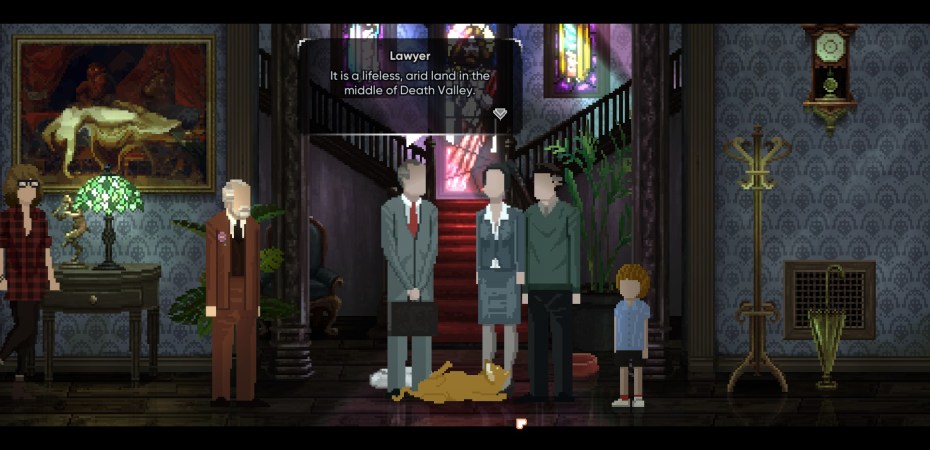
Cats and the Other Lives is a 2022 side-scrolling narrative game from Cultic Games, an indie studio based in Istanbul. It’s a fairly straightforward pixel-art story, with the twist being that you play as a cat, goofing about while all the human drama unfolds around you. The plot of Cats has a family of adult children reunite at their eccentric father’s mansion after his passing. There are tensions and family secrets, and a new generation of kids who stand at risk of inheriting intergenerational trauma, and also the cat has magic powers and can see the past.
The supernatural subplot doesn’t have all that much substance – the cat is named Aspen, which is what Bernard (the deceased father) called all his cats, as a nod to concepts around reincarnation. If you’re not familiar, aspen trees are essentially able to reproduce by cloning themselves – they can grow new trees out of their root systems, so from the surface they look independent but they’re all technically part of the same organism. You have the Pando Tree in Utah, a grove of around 47,000 quaking aspen spread across a hundred acres of land that’s all technically made up of the one same tree – it’s all still connected through the root system. The cat, like its namesake, is meant to be in some spiritual or metaphysical sense the same entity across time – so you either remember or maybe see ghosts of the past, things that you couldn’t have been present for. It’s really just a convoluted in-universe justification for including flashbacks. Throughout the game, you walk around the house and see bits of Bernard’s past: you see him growing up, being a hippy, and his relationship with his kids (now adults in the present day). They explain it with feline reincarnation and the spirit realm – it didn’t need an explanation, but it got one.
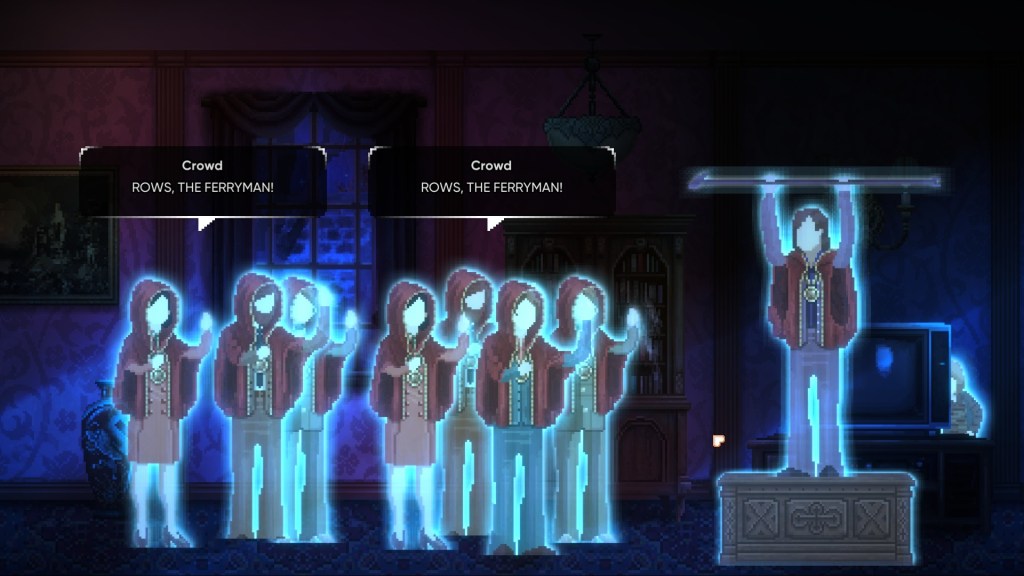
Clearly there are some questions here about what we take seriously and what we discard as incidental fluff. For instance, the occult pops up throughout the game, but mostly in a playful way. The game has a spectrum of magical and supernatural activity, from your mystical cat-powers to Bernard’s attempt at forming a commune, where all his hippy friends get up in robes and do fake mystic rituals, through to Bernard’s game developer daughter Dawn, who plays the in-universe RPG Necrothrone on a handheld console with her niece Addy. The game’s sensibility sits closer to Necrothrone than the magical cat. It’s not a feline remake of The Green Mile – the magic isn’t inherent or necessary to the story. It’s a nod and a wink to the audience, an explanation for something that doesn’t need explaining. It’s Bernard and his hippy friends dressing up and playacting at secret rituals.
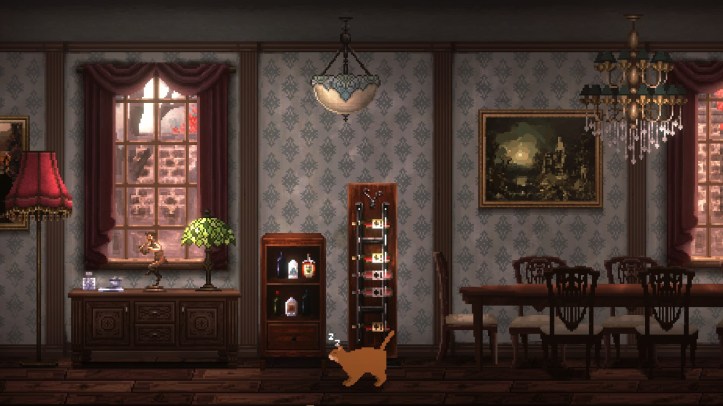
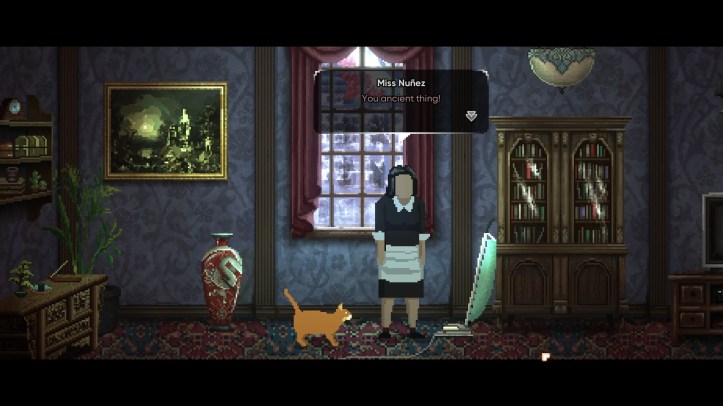
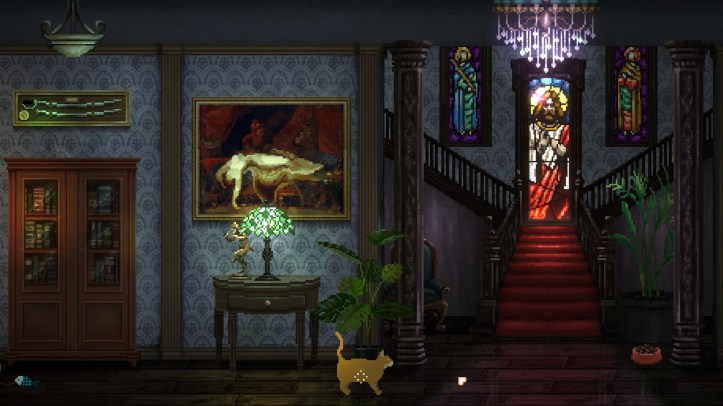
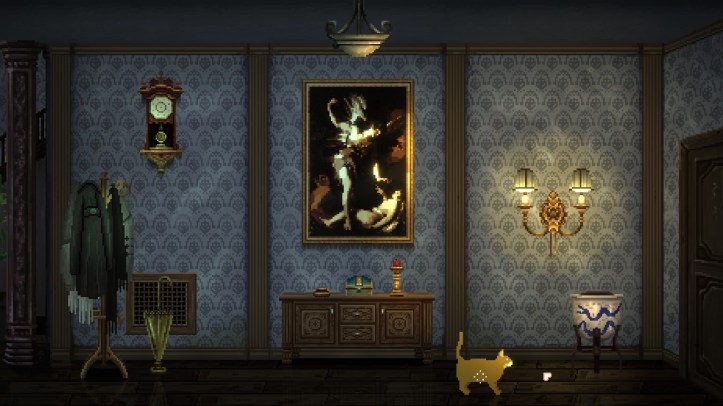
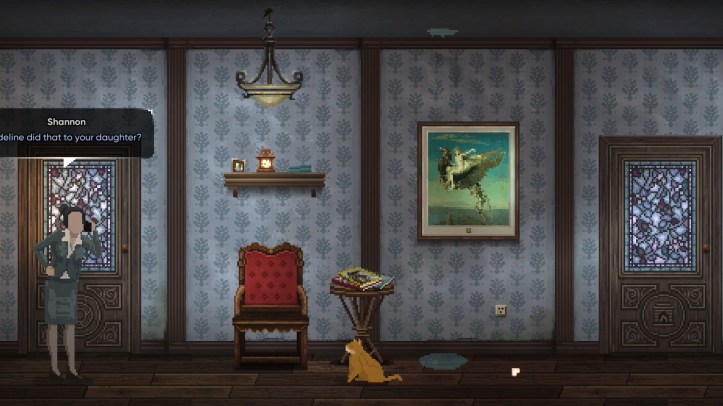
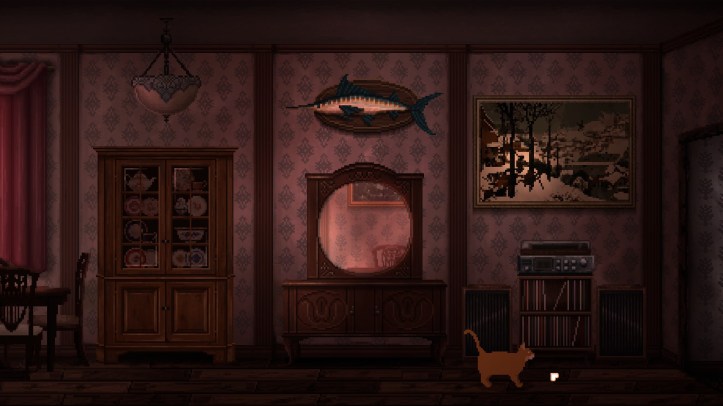
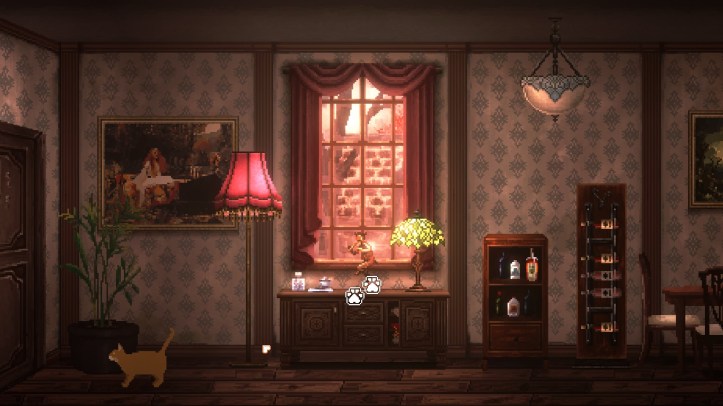
This sort of tension is also present in the mansion’s paintings, which mostly exist as set dressing, but which get a couple of direct mentions throughout the story. I’ve included a few in the gallery here – among others, there’s ‘The Lady of Shalott’, by Waterhouse, Bruegel’s ‘Hunters in the Snow’, and ‘Heptu Bidding Farewell to the City of Obb’ by the Scottish painter John Duncan (they almost got me with that one, I was furiously searching Dali’s back catalogue). These are all deliberate painterly works – that is, they’re either famous paintings or clearly in the style of some major school or era. The Duncan painting looks like something from the surrealists. Bruegel’s snow painting looks like something from the Dutch masters. Even the painting of the angel – I couldn’t find the original, but it’s clearly rooted in the Renaissance tradition. It’s very similar to, for instance, Guido Reni’s 1636 painting of the archangel Michael. It looks classical. It looks like something from the Renaissance – it uses that visual vocabulary. There’s another painting based on the work of Sebastian Pether – again, it’s probably a specific painting that I’ve just not managed to find, but it uses a composition that’s fairly standard across his work. The moon sits low in the background on the left over a lake or body of water, and then an ancient ruin sits in the foreground on the right – as in ‘Moonlit River Landscape’ or ‘Moonlit River Landscape with a Monumental Gateway’, or ‘Moonlit Lake with a Ruined Gothic Church, a Church and Boatmen’. I can’t confirm whether the developers are copying a specific Pether painting or just imitating the style, but either way, they’ve tapped into something. The paintings look painterly. They look like the types of paintings you’ve seen all your life. The cumulative effect is to make the house seem wealthy. It speaks to the prestige of the Mason family that they have all of these famous paintings. You might wonder – are these meant to be the originals, or are they just cute references? Are we meant to understand that this family is rich enough to have the actual ‘Lady of Shalott’ hanging in their dining room?
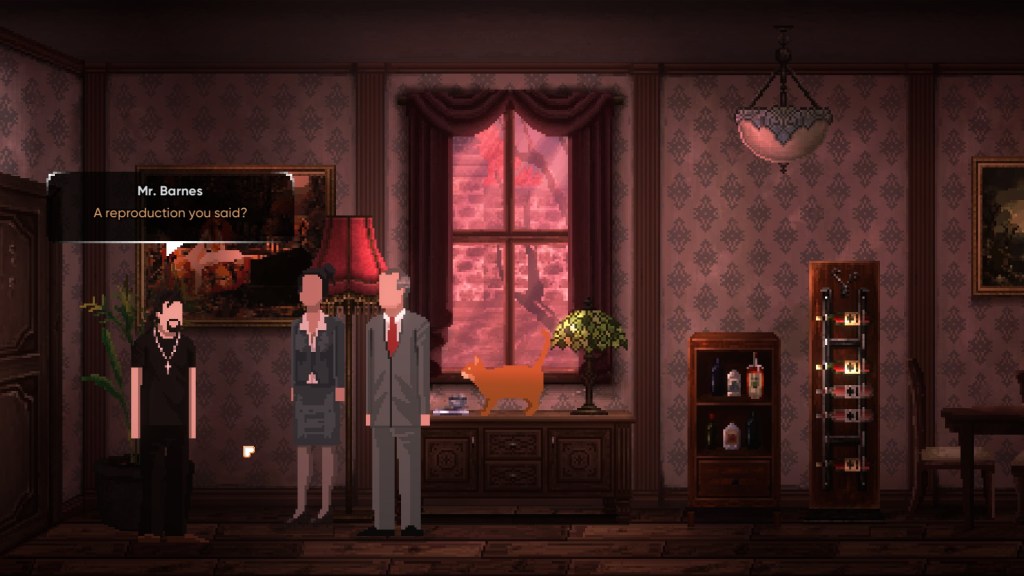
As you move through the story, that question is addressed overtly. After Bernard’s death, the family discovers that the house’s value is shockingly low, and the family lawyer tries to help them dump it on an unsuspecting writer. Standing in front of the ‘Lady’, they discuss how the piece is actually a reproduction. Presumably all these paintings are fake. They’re not worth anything, and neither is the house – it’s pure façade. It looks mysterious and expensive (and the family persuades the famous writer that it’s haunted), but it’s not. Even before that overt comment, there are other clues that the paintings aren’t real – Fuseli’s ‘The Nightmare’ is painted backwards, for some reason, and there are two copies of the Sebastian Pether painting. There’s one in the dining room, and one upstairs in the TV room (the first and second images in the gallery above).
Across a few different aspects, then, Cats engages with the idea of what’s real and what’s not. There’s an unnecessarily magical cat, the family lies about a haunted house, and there are paintings dolled up to look classical and expensive unless you spot the obvious mistakes. The consistent message across all of these instances: It’s Not Real. It’s a broader theme even applied to how the player engages with the story. As noted, Cats and the Other Lives has you play as a cat, running around chasing mice and scratching at furniture while the human family grieves for their father. You can become emotionally invested in the story, but you’re also not really part of it. It’s not your drama. The game touches on the disconnect between the player and the fictional world – something I think that’s inherent in all video games, but that this game particularly tugs out. Often games try to draw you into their fictional world. They try to make you part of the action, ask you to make decisions that impact the lives of other characters – to show how you’re enmeshed within the fictional world. There’s a whole school of game design built around concepts of immersion and that meaningful sense of player agency, which is really about having a sense of presence within the world – feeling that you as the player can meaningfully inhabit that space, can interact and change things. It is very much the Holodeck model of video game design.
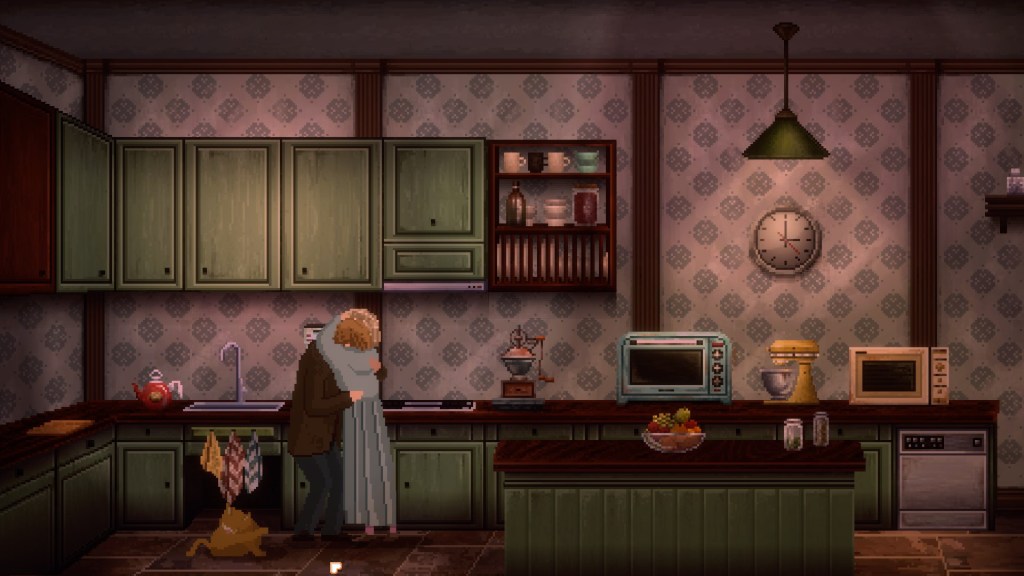
And the Holodeck model isn’t bad, as a goal, but I think we all feel that it sometimes falls short. A game doesn’t let you do something you think you should be able to do, or it seems contrived or artificial, and suddenly the whole thing is gone. Immersion is in some ways a risky goal. Cats takes that issue and says – well, let’s not bother. None of it’s real anyway. You’re not a person living in this fictional world – at best you can be a cat. You’re an adjacent species. You sit alongside the characters, and in some sense you inhabit the fictional space, but not in the same way as everybody else. You’re not the same. Cats will put you in a room where a character’s having a total mental breakdown and let you scratch at the couch. You’re there, but you’re not really there. None of the characters have expectations of you – you’re not bound by social norms. An immersive game might put you into this family scenario and expect you to pick up the ties and constraints of these pre-existing relationships. You might be expected to feel sorry for people, or to express regret or sadness over their feelings. Aspen the cat? He doesn’t give a shit. He can scratch at the couch, knock things off the table, or wander off to another room in search of snuggles. A mother with dementia can have a tearful reunion with her recently hospitalised son, and Aspen can sit nearby licking himself.
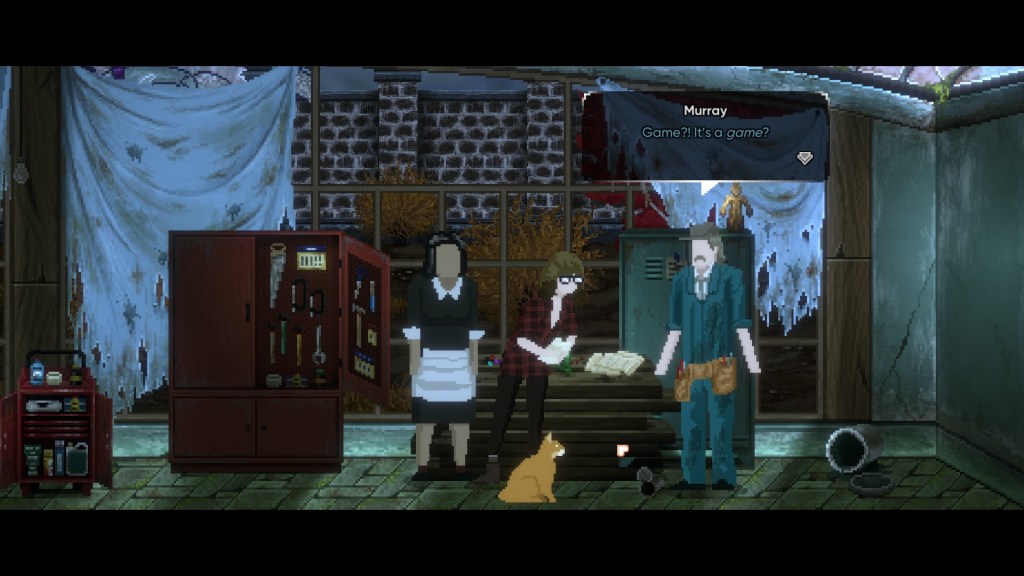
This framing allows the player to be mercenary and self-interested in a way that suits the video game as a mode. In an RPG, a villager might give you an old family heirloom as a reward for saving their family. In real life, you might keep that memento, treasuring it as a mark of your enduring connection to that person. In video games, you immediately sell it. It takes up space in the inventory – it’s just a cash reward with a couple extra steps. In that scenario, the structure of the game works against the texture of the fiction. They have different incentives. Cats leans into that tension. Someone’s upset? Not your problem: knock stuff off the table. Mental illness? Chase the birds. You inhabit the space alongside human characters, but you’re never recognised as one of them. You’re always a figure apart. You can interact with them, and have meaningful impacts on their lives, in places soothing, distracting, or directing the humans (including a Lassie sequence where you save one character’s life by annoying other humans until they come and find out what’s going on), but you’re never expected to operate in the same way as everybody else. There are cats, and then there are the other lives. It’s not realism, it’s not full immersion, it’s not the Holodeck, with its sense of presence and independent decision-making – in many scenes, your only goal is to figure out how to trigger the dialogue so you can leave the room and move on to whatever’s next. It’s not real, the game says. None of it’s real. Immersion isn’t necessarily bad, but it is necessarily partial. You will never fully be part of that world. It’s just a game.
 Death is a Whale
