
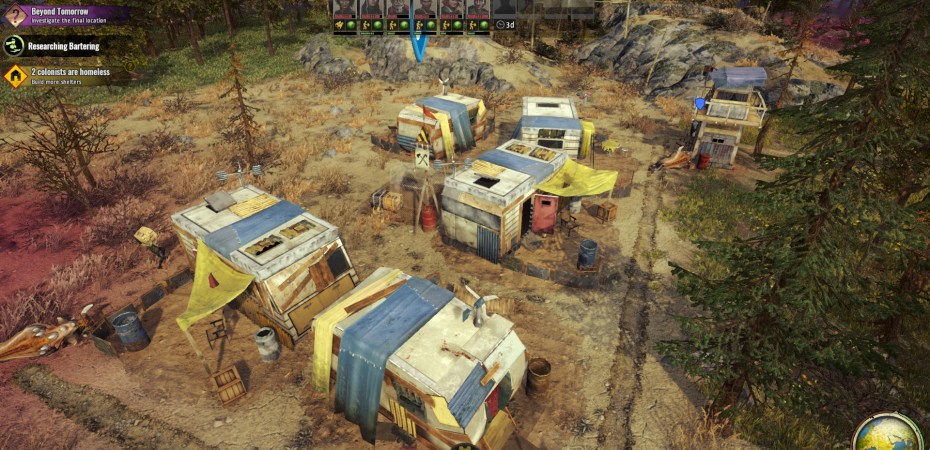
Some of the timing in Surviving the Aftermath doesn’t make sense. It’s not bad per se, but if you think about it, it doesn’t make sense. Surviving the Aftermath is a 2019 survival city-builder developed by Iceflake Studios and published by Paradox Interactive. It’s in the same sort of space as Frostpunk or Before We Leave: the world has ended and you manage a little colony, surviving in the wilderness. It’s post-apocalyptic city building. In Aftermath, the primary unit of time is the day. Each day the people in your colony eat a set amount of food, do a set amount of work. You can produce a set number of daily resources. The game uses its day-night cycle to enforce things like sleep schedules for your workers, and also to change how you produce electricity. If you’re using solar panels, they obviously won’t work overnight, so you have to set up batteries to capture and store excess energy. Most of that stuff revolves quite happily around the unit of the day. There’s a natural ebb and flow that corresponds with our real world experience. You have units called ‘Specialists’ who go out into the world and scavenge for resources, and each new day, they get a new set of action points. That feels straightforwardly analogous to our daily experience.
Other aspects, however, make less sense. Children are born, grow into adults, and then die of old age in a matter of weeks. Sown crops are ready to harvest in days, and complex buildings can be thrown together sometimes in a matter of hours. All of this irregularity is fairly normal for video games – it’s not weird or unusual, plenty of games do it. In Don’t Starve, depending on which character you play, the ‘starvation’ effect will kill you in about two minutes. Two minutes in real time represents about six hours of the in-game day, but even then, that’s not how starving works. It makes little sense in the context of the fiction: first and foremost, it’s designed to accentuate gameplay. Klei wanted a game where starving was an absolute scene. It’s meant to cause panic and a bit of frenzy. In Aftermath, people die of old age a couple months after being born because it fits the gameplay loop. It’s a detail of the fictional world, but it’s not something to give narrative weight. It’s not radiation poisoning or mutation or something – there’s no valid in-world explanation. It’s just an artefact of how the gameplay is balanced. The primary unit of time in this game is the day. That’s not a timeframe across which children can realistically be educated, trained, and join the colony workforce. So they bork it.
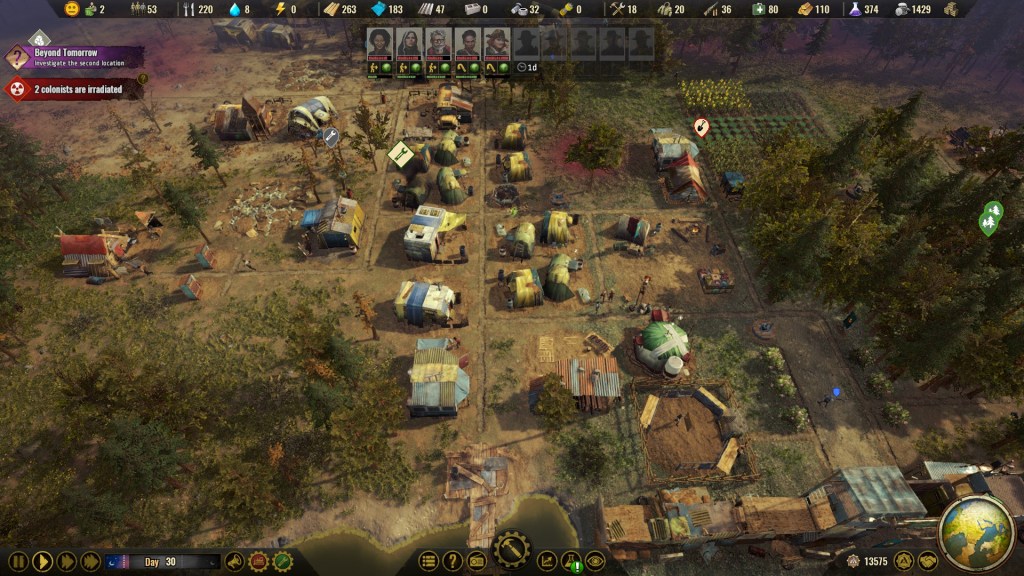
What’s interesting here is not so much the borking – which, again, is industry-standard – but whether or not you notice it. In Aftermath, I don’t think you really notice these inconsistencies unless you look for them. They’re not jarring. In 2018, I wrote a similar essay comparing this sort of thing across Stellaris and Endless Legend – in Endless Legend, your army is represented by a single figure, who moves between hexes on a map of the world. When that army attacks an enemy in an adjacent hex, it feels like you should zoom in on that area – moving down from the overworld, down from the the world map, onto the level of that specific region, where you can see your individual units and plan the battle. Instead, your soldiers get bigger, spilling out across the overworld, which becomes the staging ground for their conflict. The world map becomes the terrain for a single army’s battle, with individual soldiers looming up over mountains and cities. That spatial logic, to me, doesn’t quite gel. It feels wrong. Inconsistent is fine: but this is noticeably inconsistent. Aftermath never has that problem. Even when the inconsistency is pointed out, it’s not bothersome or weird. It doesn’t intrude on the experience. The turning of the days melds into the turning of the years, the turning of the seasons. All of these things are cyclical. The scale is distorted, but there’s a cycle. They’re unified by a familiar logic.
I guess the distortion plays into the concept of the apocalypse. Time is jumbled. Years and days and seasons all run together, like so much wet paint. We’re not even really able to move forward any more. Life after the apocalypse is life after the end times, life after time has ended. We don’t move forward in Aftermath – it’s not a game about the future. It’s a game about trying to revive the modern day. The world has collapsed, civilisation has ended, and we’re living in the ruins. We’re scratching through junkheaps, picking over the carcasses of dead cities. To get resources, in Aftermath, you can have colonists dig through piles of plastic waste or tear apart ruined concrete buildings. You pull from the rubbish heap of the world that was – the world that is today but that will be lost. Society in Aftermath doesn’t progress or advance into something new: it tries to reconstruct a lost now. You reinvent toilets and rebuild a power grid. You upgrade tents into caravan parks. Children learn in the hollowed-out shell of a school bus. It’s never as good as it was – the modern day cannot be restored – but you can scratch out something that resembles some of our modern systems and amenities. Today is lost – you have to rebuild it. It’s not progress, it’s restoration. Rather than looking to the future, Aftermath begins with the crippling loss of what we have now and asks us to claw our way back towards what we already have.
There was a time when people used to write about everything new that would be created in the future. You had these utopian, idealistic futures, built on the back of scientific inquiry and innovation. It’s been observed that all we seem to do today is tell stories about the future that we’ve lost. Tomorrow isn’t tomorrow – it’s a degraded form of today. There is no progress. Time doesn’t seem to move forward any more. Years, days, seasons – they may as well all be the same, because we’re not going anywhere. We can’t get to tomorrow. We might not make it back to today.
 Death is a Whale