

There’s this thing where sidescroller video games all seem to be about some sickness at the heart of the world. Many of them portray a good and beautiful world invaded by a parasitic rot. In Black the Fall it’s a sickness in the state – surveillance, George Orwell, that sort of thing. In Monochroma, it’s industrialisation. In Planet Alpha, it’s colonialism, with a natural world invaded by a bunch of robots. That theme of ‘nature vs the machine’ seems to pop up in a bunch of sidescrolling games – arguably even the original 1991 Sonic fits into that model, with the beautiful, natural forests of the Green Hill zone giving way to Dr Robotnik’s industrial Scrap Brain zone. We also see this structure in Planet of Lana, a 2023 sidescrolling puzzle game where a pristine planet is invaded by a bunch of robots, who (as expected) set about capturing all the natives and wildlife.

In concept Planet of Lana is nothing we haven’t seen before, but the art direction is lovely. The backgrounds are styled in this painterly way. There are impossible blue skies, robust hills rolling into the horizon, and the happiest little fishing village. At certain moments the camera will zoom out, allowing you to appreciate the grandeur of the natural world. The clouds have this solid, dense presence, almost as if they’re made of the same stuff as the mountains or the hills. They look like they would hold your weight if you stepped on them. They reinforce a sense of warmth and heat: they’re not rainclouds, grey and dark and heavy, but they’re also not the thin clouds of vacant desert. They speak to a vibrant, lively ecosystem, just as the gentle turning of a water wheel speaks to the flow of the river. The land is well-irrigated. Water is drawn up and into the clouds, and dispersed back over the land – not right now, of course, but regularly. The game captures its perfect moment by deferring the change in exactly that way: it rains regularly, but not now. Now is an endless now, a moment clipped out of a thriving cycle of life. We see it in the treatment of the robots: once they’re beaten, once equilibrium is restored, the robots are immediately integrated into the now. They pop up in and around Lana’s fishing village. One helps the chef cook lunch. A fisherman uses one as a perch in the bay. Nothing has changed: the robots have been absorbed into the now. And the clouds keep watch over it all. They are markers of an eternal summer, sitting heavy over the land in guarantee.

In a weird way, the actual puzzles in Planet of Lana feel alien to the aesthetic. You’re presented with the visual language of paradise, but then you’re subject to the gameplay demands of these silly little puzzles. The puzzles are mostly based around stealth or physics, which is roughly in keeping with your typical sidescrolling game. In one early sequence, a robot patrols back and forth across a strip of land. While it’s on the far side, you have to run to a patch of long grass in the middle, where you can hide. You sit in there and wait for the robot to pass over you, and then you run for it. The sequence could easily be lifted straight out of Planet Alpha or any other of the games mentioned. Similarly, we get the classic puzzle of a high ledge and a box. The ledge is too high to reach, but you can push and pull the box around. Even without any visual reference, you immediately know how to solve this puzzle: you push the box close to the ledge and climb on top, using the extra height to reach the lip. Many of the other puzzles simply extend these two basic forms. Sometimes you have to create a distraction to pull the robot out of its patrol loop. Sometimes you have to figure out how to navigate the box over to the ledge – you might have to move it through a complicated pulley system, or around other obstacles. It’s all fairly run of the mill – without being disrespectful to the game, it’s all fairly simple, garden variety stuff. And it clashes with the visual aesthetic. You live in paradise, but you have to do physics puzzles.
Partly I think the juxtaposition of art and gameplay can be understood through the lens of the world invaded by robots. You live in nature, in this beautiful paradisiacal environment, but you have to jump through a bunch of hoops to escape the robots and save your sister (who’s kidnapped at the start of the game). The stealth puzzles certainly lend themselves to that interpretation. Lana’s life in the fishing village does not revolve around stealth: it’s imposed on you by unexpected circumstances, by this robot invasion. If it feels unnatural, if it clashes with the visual tone, that’s intended. It expresses the disruption to the wider ecosystem. Paradise is disrupted by a robot invasion: the serene visual aesthetic is invaded by some menial puzzles.
Obviously that reading sits in contrast to the reading centered on colonialism – we’ve talked about it before with Planet Alpha, but it’s a framing familiar from films like Avatar or Pocahontas. The peaceful, harmonious natives are invaded and colonised by foreign European military forces. The natives have a close bond with nature, evoked by their reliance on natural materials like wood or rope, while the invaders are associated with the industrial forms of guns and steel. The robots, with their black metallic bodies, are contrasted against the natural fabrics worn by Lana and her community. All familiar stuff. As noted with Planet Alpha, the concept of colonialism-through-sidescroller is maybe a little glib, a little simplistic – it’s probably inappropriate to gamify these brutal histories in such a cutesy way. But Planet of Lana gives us an alternate reading. You could read the game as yet another expression of sci-fi colonialism, or you could read it as a fundamental conflict between different components of the game. You can read the game’s narrative as an expression of the game mechanics invading the art. Robots from outer space invade a happy planet, just as a bunch of puzzles intrude on this beautiful landscape. The relative mediocrity of the puzzles in contrast to the beautiful art actually reinforces this reading. The ludic/aesthetic judgement lines up with the moral judgement. The puzzles are bad and the art is good. The robots have invaded, thrust themselves upon the land, an external and parasitic rot preying on something that is otherwise beautiful. The art’s nice, but the puzzles are rubbish.
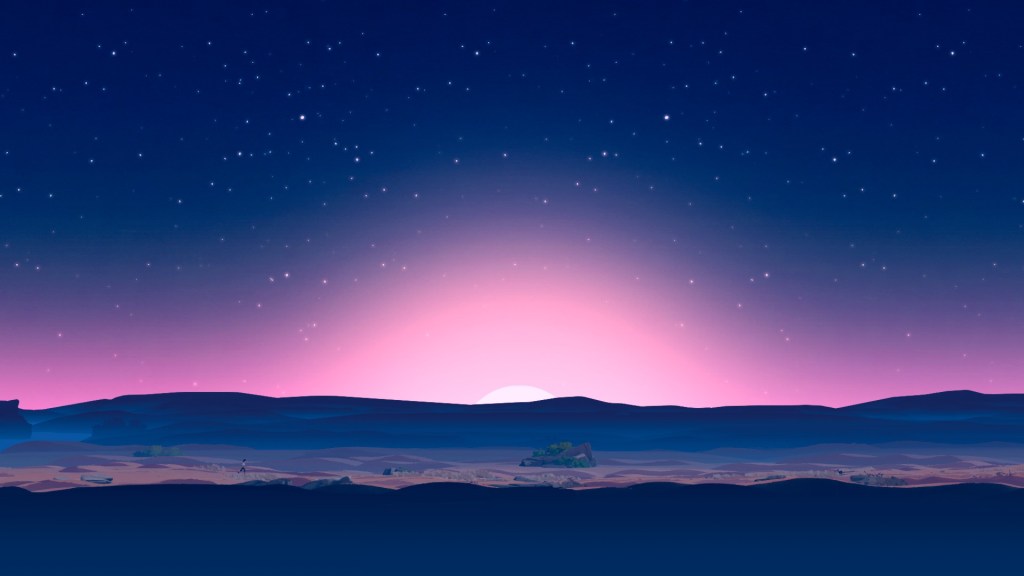
This reading is a bit meta, and maybe a little abstract, but it helps articulate certain feelings that come up in playing the game. Planet of Lana is beautiful more often than fun. At points, the puzzles wear thin through repetition or meniality. They can become annoying. The landscape, by contrast, is powerful. Often the game will pause to show you a cutscene with some beautiful vista or little interaction. On the lake, some sort of leviathan swims up under your boat, eyes you a little, and then swims on. The environment feels inspired, while the gameplay feels obligatory. In one stunning sequence, partly pictured above, Lana runs through the daybreak, with night sky slowly bursting into glorious orange sun as the level transitions into the desert biome. Compare that to your efforts pushing some stupid box around – it just doesn’t quite measure up.
In one sense we’re touching on an issue that’s already very familiar to other media forms. Texts are often imbalanced: some aspects are better than others. When Gladiator II came out, I saw the comment that the script was bad, but Denzel Washington was amazing. Everybody else deals with this stuff all the time. As video games stabilise as a form, part of what we’re seeing is the evolution of our language around the aesthetics of play. We’re developing a more sophisticated vocabulary. Obviously we can make jokes about things like ludonarrative dissonance, but the question at the heart of that concept is valid. How does this gameplay work? What is its art? How does it relate to the other aesthetic components of the game at hand? Sometimes that relationship is complicated, unbalanced, imperfect. Sometimes that imperfection gives us curious little gaps and byways. In Planet of Lana, you want to sit around watching the sun rise, and it’s sort of annoying when you actually have to play.
 Death is a Whale