
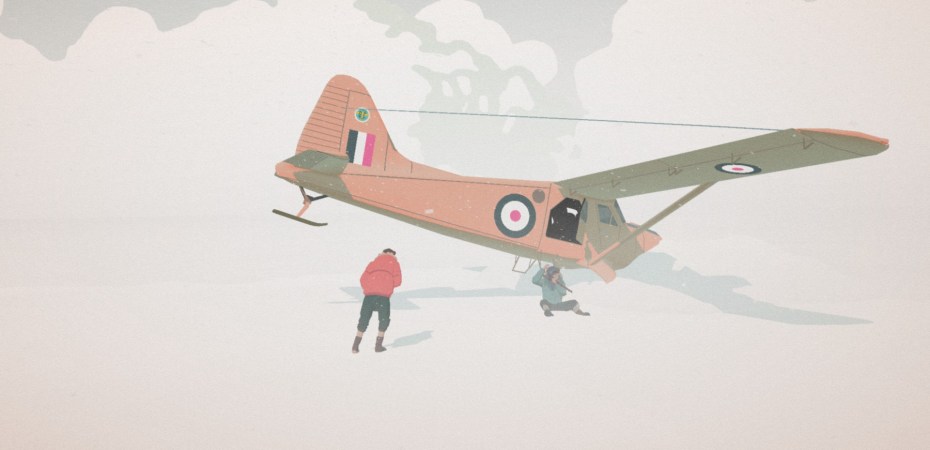
South of the Circle is a 2022 narrative game from State of Play, the team behind Lumino City and Kami. It’s about the relationship between two academics, Peter and Clara, in 1960s Cambridge, and deals with themes of feminism and nuclear disarmament in the context of the Cold War. The game plays in two parts. In the present day, Peter has crash-landed on a flight to Antarctica. He runs around looking for help, while a number of flashbacks show us his relationship with his lover and research partner Clara in the leadup to his trip. I’m going to take a bit of an unusual slant on this one – I’m not normally much for talking about art direction, as it’s not my training, but that’s really what caught my eye with this game.
Despite being rendered in a 3D environment, the art in South of the Circle often looks quite flat. In places, it looks like felt. There are no lines demarcating the edges of things – if you look at cartoons like Snoopy or Tintin, you have that very thick black edge line – that’s the clear line (or ligne claire) style pioneered by Hergé, the creator of Tintin. South of the Circle is the opposite. It has no edge lines. The edge of each object is suggested instead by a change in colour, as with the stacks of books at the back of the room below. They’re all one shade of that light turquoise, with the idea of different books or book covers suggested by the dashes of lighter or darker colour. It’s very 1960s – it feels inspired by Saul Bass, like in the title sequence for 1963’s It’s a Mad Mad Mad Mad World.


This art direction gives rise to a specific aesthetic of shading. It doesn’t have a complex spectrum of shadow – things tend to come in blocks of colour. Games like Elden Ring will have dynamic lighting, where light is cast variably based on sources in the environment. In the final image of an Elden Ring essay from earlier this year, you can see the dragon fist in the character’s right hand spilling light out onto the stairs. In particular, notice how the light falls off over distance – you can make out concentric circles of light with decreasing levels of brightness. South of the Circle has none of that. Surfaces have one colour when they’re lit, and another slightly darker colour to indicate shadow. It’s most obvious on Clara’s skirt below: white on the left, and a darker grey on the right. The primary colour, and the shaded variant. The same effect can be seen in Clara and Peter’s shirts, in their hair, or in the bowls stacked on the left. There’s no variation in the shadows to indicate distance or intensity. The far side of the skirt isn’t darker for being further away from the light. In South of the Circle, shadow exists in a binary state. It’s there, or it’s not.

We’re touching here on the game’s stark approach to colour and light. It often functions through a series of binary oppositions, as in the pairing of red and green to symbolise Peter and Clara. The colours tend towards the bold, the symbolic. It’s not meant to be realistic – it’s stylised. Details are often occluded. The papers are blank, the books have no titles, the frames on the wall have no pictures. The game withholds detail in order to direct our attention. It doesn’t matter what the books are called – what matters is that there’s a lot of them. It’s not what’s on the papers, it’s the fact that they’re piled up on Peter’s desk, reams of printouts and data. He has all this information and no way to make sense of it. It’s organised but not meaningful. This interior, organised, academic world is contrasted against the great outdoors, which is messy, organic, and powerful. Scenes set in the past, in the forest or the woods, are characterised by a mottled, composite set of colours. The rocky path up to Peter and Clara’s first kiss oscillates through moss, grass, dirt, and rock. It’s a noisy, jagged environment, where the colours threaten to become incoherent. They almost seem like they don’t quite fit together, as if they’re about to dissolve into their composite parts. They seem close to scribbles, noise, scraps. They resolve into an overall picture, but only just. The snowy mountains of Antarctica are austere, powerful environments. They are viciously bright sheets of colour. Early on, a slope leading up to a snowmobile is a single white sheet, punctuated only by some footprints up and down. Elsewhere the wind and snow are whipped up around Peter, such that he can’t see anything in front of him. In the game’s opening sequence, shortly after the crash, the player stumbles through the snow towards the red light of an outpost. Nothing else is visible: the single sheet of blue-white colour has taken over the screen. The landscape is either textured, composite material, or vicious blocks of unbroken single colour. It is at once wild and sublime, refusing organisation or human control. In one scene, which references Hopper’s Nighthawks, the couple sit in a café watching the world heaving with rain. The built environment serves as refuge against the wild, uncompromising outside. It offers order and protection, a sense of safety, but it also disconnects the couple from the blunt face of the earth.

The arc of the game, then, is about how the interior world infects the outdoors. Antarctica and the past are the before and after of infection. In the before times, Peter and Clara travel freely around the countryside in pursuit of their weather readings. They hike and climb, send up weather balloons, get caught in the rain. They drive through the woods, or take long walks along the pier. The outdoors is tied to campaigns of nuclear disarmament and women’s liberation, with the couple meeting Clara’s friend Molly Shanahan out at a protest. This freedom and openness is contrasted against interior spaces, which are often characterised by dark, unilluminated regions. Peter’s office, above, is lit by strict circles of light, leaving corners and background in darkness. Peter’s childhood bedroom is treated similarly: we see the top of a table but not its sides, the foot of a metal bedframe but neither mattress nor sheets. When Peter and Clara meet on the train, we see a cutaway into the side of the carriage, with the implied surrounds left in black. It’s both a practical way to show the characters and a symbolic gesture towards their enclosedness, their sense of being trapped in a social system that doesn’t fully work for either of them. Of the two, Clara is better able to articulate the oppression she experiences as a woman. She finds the language to communicate it. Peter never finds a language for his experiences. He struggles with his father’s hostile, violent vision of masculinity. He knows something is wrong, and he knows that he’s part of it, but he’s never quite able to find the words. As such, by the time of the present day, the free and open natural world has become cold and hostile. Women’s liberation has been parked (no women are allowed in Antarctica), and Peter’s research has been harnessed by the government, who want him to look for radiation, to check whether the Russians have been testing nuclear weapons at the pole. The natural world still retains its austere power – it is not fully controlled, as evidenced by its best attempts to kill off Peter with hypothermia – but it is infected. The time spent in Antarctica is driven by nuclear anxieties and made inaccessible to women. Disarmament and women’s liberation are shelved in favour of an environment restricted to men for nuclear research during the Cold War. The game ends with Peter escaping in his plane as a mushroom cloud erupts off in the distance. He survives, but he doesn’t succeed. He never gets out of the dark.

 Death is a Whale