
There’s an Iain Banks novel, I think possibly The Bridge, with a line that goes something like “Her breasts were a pair of ( )s.” It’s some tortured postmodern thing about drawing attention to the fact that you’re reading a book, it’s very self-aware – you know, whatever. It’s sort of insufferable. Oh, it draws your attention to the nature of textuality – but for what? I’m not really that impressed by books that try to disrupt your immersion. It often feels clumsy and awkward. John Fowles’ 1969 novel The French Lieutenant’s Woman has three separate endings, presented to the reader as a radical refusal of closure. Literature doesn’t have to be a linear progression of events, it suggests: literature can be indeterminate, messy, left open to the reader, even on such key points as the novel’s actual outcome. It’s presented as this very high-brow intellectual idea, which is funny, given that the most notable successor to The French Lieutenant’s Woman is Choose Your Own Adventure #1, The Cave of Time (40 thrilling endings!).

When it comes to video games, by contrast, efforts towards anti-immersion are often very interesting. Most games are built around a gameplay loop, which has its own rhythm and tone – often difficult to describe, difficult to articulate, but unquestionably real. Harmony Corpsepit has a blog post that touches on how we remember the feel of games: “I’ll remember a fragment of texture, or a functionless room, or the slippery feeling of grinding against some invisible collision box, and often these half-memories seem stronger to me, more charged and mysterious, than the experience of playing the game itself.” If I think about the feel of Don’t Starve, for instance, I remember the rhythm of the crafting animation, the speed of Wilfred’s stride, the run and attack patterns of the dogs. There’s a tactile memory of how the game feels to play (the ‘playfeel’, which – actually sounds a little gross, maybe don’t use it). It’s a body-memory, held by your fingers, your hands. To me, anti-immersion in games – it’s not the same thing as anti-realism. It’s more about disrupting that rhythm of play. Anti-realism we might think of as shattering the illusion of the fictional world – as the sprite in the tutorial telling you ‘Press X to jump!’ We have a high tolerance for anti-realism in games. We’re used to it. Anti-immersion seems more like the practice of drawing you out of the gameplay loop, interrupting that cycle. It’s doing something slightly different than to when books interrupt your reading by pointing out that you’re reading a book. It’s interrupting your play.
The curiosity here, I think, is that games are already vehicles for play. It’s interesting when they acknowledge that reflexively, playfully playing with play. The Dark Queen of Mortholme does this by inverting the Dark Souls experience, having you play a boss in a boss fight. The first time the little hero enters, you just – bop – squish him with no effort. It’s very funny. It’s playful – it takes a familiar gameplay loop and turns it on its head. If you’ve played Dark Souls, or any of the successive titles, you’ve had that experience of fighting a new boss and just immediately getting pulverized. It’s brutal – and also slightly shocking to have that inverted, to have it made so simple from the boss’s perspective. It’s not satire or parody, but it’s something close by. It’s clearly commenting on that Dark Souls system, reshaping familiar play. And it’s powerful. It’s validating – you sort of laugh at how easy it is playing as the boss, which evokes and validates your own struggles in playing the games. There’s something liberating in that. It also feels true to the essence of games, if we can talk about such a thing – this playful, joyful reshaping, this playful approach to play. It’s very different to the plodding, inflexible, slightly dogmatic play paradigm of your typical hero fantasy. Call of Duty has you shoot and shoot and shoot some more, and you just – yup – you – there’s a single core loop, and you do it over and over. Dark Queen, and some of these other titles, I think, showcase a light, dancing approach to play, rejecting immersion in a single loop in favour of something weirder and ultimately more vibrant.
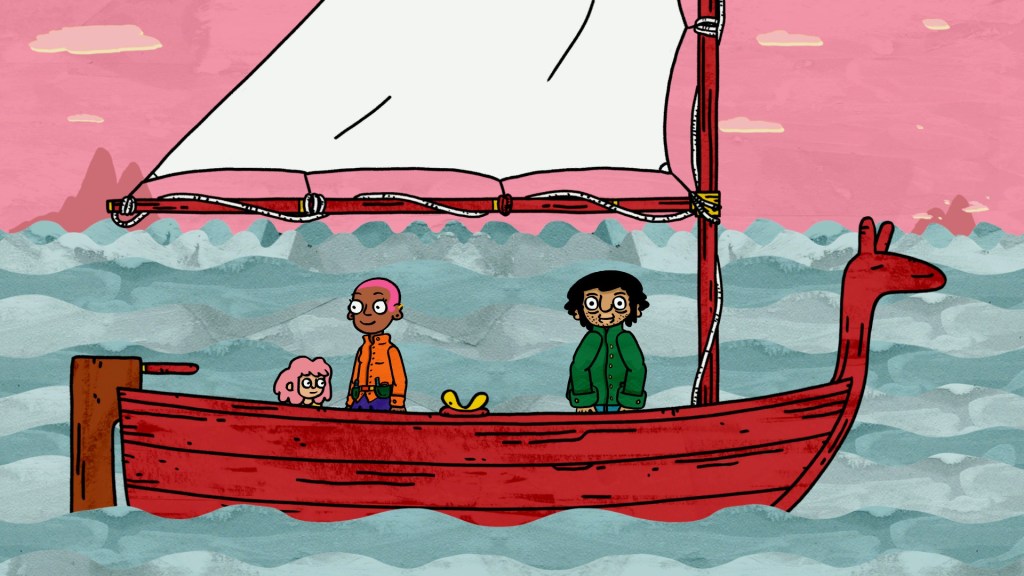
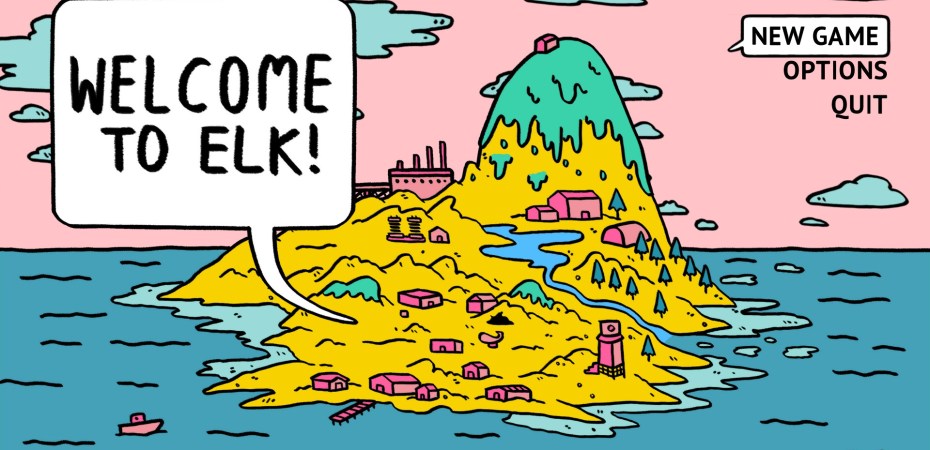
Welcome to Elk is a 2020 game by Triple Topping, a Denmark indie development studio that is now sadly closed. It’s a weird little narrative game where you go to an island and meet a bunch of locals, in the vein of Mutazione or ‘returning home’ narratives like Night in the Woods or Lake. Graphically, it’s quite stark. It’s presented in a hand-drawn style, almost like one of those hidden object games. Straight lines aren’t perfectly straight: they look as if they’re drawn with a free hand, with curves and imperfections. There are pockmarks and blemishes across most surfaces, which give a sense of texture, but which also speak to the drawn line of the pen. For the most part, the game is presented in black and white. If something’s interactive, it’s given in colour – and the colours are often acid-washed variations. The wood in the carpenter’s studio isn’t brown, it’s pink. The fireplace in the home of Frigg, the main character, is an acidic green on green. Frigg’s fridge is yellow and pink, and the frame of her front door is light blue. It’s this slightly psychedelic colouring, all cast against a black and white background that looks like a blank illustration in a colouring book. The animation style is similarly bizarre. Characters move as if they’re being puppeteered – there’s nothing smooth or organic about it. It’s almost QWOP movement. Limbs rotate around circular joints at elbow and knee. Walking is a jumble of spinning tubes, more like cycling than footsteps. It’s not crude, because crude implies a certain roughness of technique. It’s artificial. It’s illustrated, weirdly coloured, puppeteered. It’s not blunt – it’s often quite delicate – but it’s also clearly not in any sense realistic.
Welcome to Elk also never quite settles into a gameplay routine. In theory, you come to the island to do carpentry, in a sort of apprenticeship with a local craftsman. Each day you’re interrupted in that goal, with the carpenter sending you off to deal with local events, or even just because you run into someone who offers to take you fishing. Carpentry represents a stable gameplay loop, a consistent set of tasks leading towards a definite goal. Welcome to Elk builds its loop around deferral and disruption. Insofar as there is a routine, it’s a routine of redirection. The gameplay consists of a series of minigames or minor activities associated with the people you meet. When you go fishing, you have to cast out a line and pull in beer bottles from the river. You follow tire tracks to find a drunk man lost in the snow, make up a song, and go through a DDR-style dance-off. This shifting instability is part of the game’s resistance to immersion. You never settle into the steady pattern built up by other games – you’re always learning, playing a new system. You’re always being oriented and reoriented. You remain mildly curious about what you might be asked to do next. The 2019 puzzle mystery game Observation, easily one of my favourite games of all time, uses different interfaces and control structures to explore the materiality of technology, the physical experience of using all these different machines. There, the disruption of constantly having to work through new mechanics and processes is a way of exploring the depth and complexity of the world, exploring the physical form of all these different technologies. In Welcome to Elk, it’s more a matter of disruption, of emphasising at all times: This Is A Game. It pushes you out of the fictional world rather than pulling you into it.
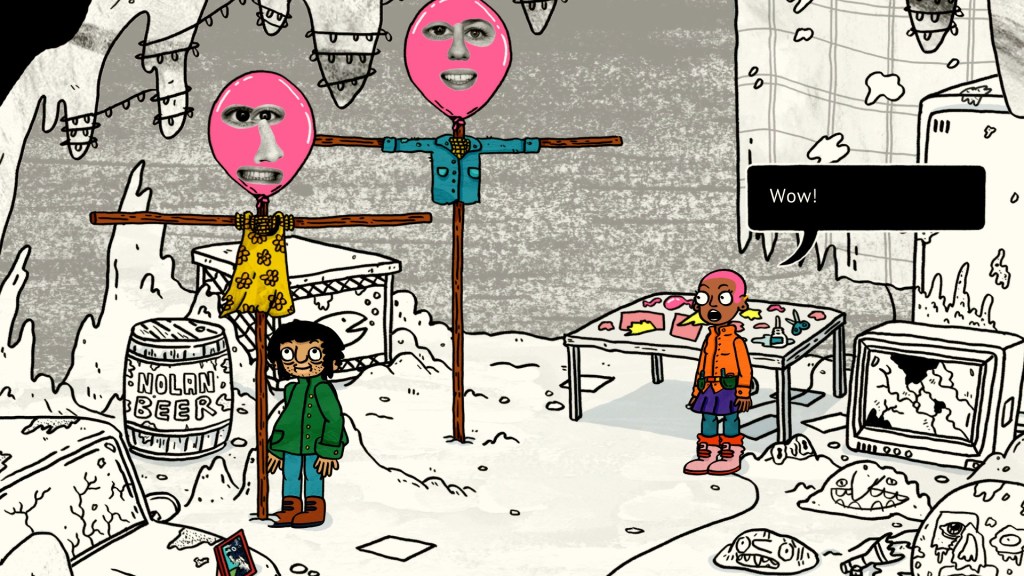
Several features of the game reinforce this pushing out. Early in the game, Anders, a weird cave-dwelling guy who’s certain that he’s dead, asks you to help him build his parents. You’re presented with a balloon and a bunch of real human features – eyes and mouths, noses. You paste together faces to look like his mother and father, Mr Potato Head-style, and they sit on scarecrow frames in his cave for the rest of the game. The visual style obviously doesn’t match up: these are black and white photographed human features pasted into this hand-drawn game. The real world constantly bursts into the game. Anders has a picture of a real dog sitting on his broken car. There’s a real guy’s face on the ‘out of order’ sign on the pinball machine (possibly one of the developers?), and each act ends with a recording of a real person telling the real story that inspired the events of that day. They’re all family members of the game’s director: her mother, father, and brother. In a manor on the hill, there’s an audio recording of the developers discussing their design intentions for one of the early sequences, and at the end of the game, you leave the virtual environment altogether and get a filmed walkthrough of the developers’ work space, with all the various members of the dev team waving and welcoming you into the real world.
Welcome to Elk, at every moment, is made out as a vehicle for story. It’s not an immersive, suck-you-in sort of game. It doesn’t have an addictive gameplay loop. It refuses the loop: it disrupts you, delays the loop, sends you off down rabbit holes. The illustrated art style is routinely punctured by traces of the real world, which often run in parallel to the fictional world. The family members retell stories that inspired the events of the day. They are fiction and not-fiction, in the world and out of it. The family members appear in illustrated form before the game cuts to their real-world interviews – it’s a constant clashing between the world of the game and the real world outside, for which the most obvious point of reference is Art Spiegelman’s Maus. Like Maus, or other biographical comics like Persepolis or Fun Home, Welcome to Elk wraps a cartoon skin over real-world stories. Where the biographical comics have a consistent through-line in the lived history of the creator, Welcome to Elk offers a collection of scraps. It’s not one story, it’s fragments of story, washed up on the shore like the messages in bottles that you receive at the start of each day. The game as a whole is a vehicle. It brings you a bundle of stories, a crate of bottles, given a semblance of continuity but really all from different times and places. It refuses immersion as part of this tension between the inside and outside worlds, the world of the fiction and our world, where that fiction was created. It plays with the concept of play. It’s a game about games, a game where we pretend to inhabit this fictional world, but only in a knowing, self-aware sort of way, always with an eye towards the real lives that built it.

 Death is a Whale