
I don’t know if people particularly remember this, but Borderlands: The Pre-Sequel was a weird, slightly hateful game. Developed by 2K Australia in 2014, the game is set on the moon of Elpis between the events of Borderlands 1 and 2. It featured moon monsters, space lasers, low gravity, and all the characters were Australian. I remember playing it when it came out: one of the early side quests revolves around a pack of environmental activists, where they’re allegedly trying to protect nature, but in reality they’re just a bunch of power-tripping losers. It’s very much a right-wing caricature of the Greens, or other grass-root environmental movements – I remember it sat weirdly even back then. In keeping with the Borderlands tone, The Pre-Sequel is (in most regards) a relatively progressive game. There’s a joke early on where Torgue (loves explosions, always shouting) asks a girl out. She turns him down, and he howls “FRIENDZONED!” He pops back in moments later to clarify that he’s not in a great place, and he understands the friendzone is a misogynistic concept – you know, they complete the joke by making out that he’s a bit of a goober but really he’s got a heart of gold. That’s reasonably progressive for a 2014 video game.

It’s slightly strange, then, to pivot from that 2010s friendzone discourse into a conservative caricature of environmental activists. If you’re not familiar with the series, it’s worth noting that Borderlands has always been about the evils of corporations. The psychos, so-called, and the other bandits are all miners abandoned to insanity by corporate overlords. In Borderlands 2, we have whole regions irreparably damaged by mining or other acts of environmental vandalism. The Pre-Sequel takes all that context and goes – yeah, but activists are sort of prissy little wankers though, aren’t they?
I think part of that attitude comes down to the context of the game’s development. 2014 was a weird time for Australia. Tony Abbott was Prime Minister: it was the start of a decade of the right-wing Coalition government, a decade of inaction on climate change, which included Liberal treasurer Scott Morrison, later PM himself, bringing coal into Parliament to wave at the Labour benches: “It won’t hurt you!”. That decade culminated in the 2020 bushfires, which burned millions of hectares of land, pushed 700 million tonnes of carbon into the atmosphere, and wiped out over a billion animals. Anyway, activists though, right? That hostility struck me as misplaced, even before the bushfires – but having lived in Australia a good few years now, I understand some of the other cultural baggage a bit more closely. I’m getting a bit more out of the game. For instance, Borderlands: The Pre-Sequel has this very specific anxiety over maintaining a social façade. It’s concerned with status and appearance, in a way that I don’t think we find in the other games.
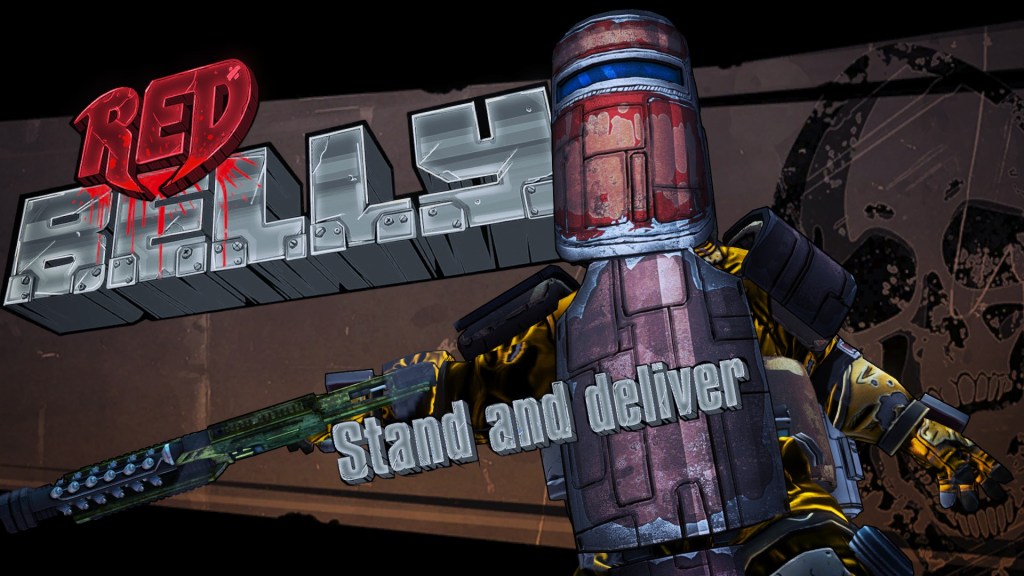
Borderlands: The Pre-Sequel tells the story of how Handsome Jack became the villain of Borderlands 2. It explores his rise to power within Hyperion, from lowly programmer to head of the company with an army of death robots, and the slow twisting of his character over time. In the game’s tutorial level, he acts heroically, saving you and risking his own life. Over the course of the game, that nobility is replaced by callous violence, and Jack slowly morphs into his familiar monstrous form. I was going to mention Better Call Saul as a point of reference, but maybe the more accurate touchpoint is Cruella. Where the main games play out across Pandora, most of the Pre-Sequel is set on Pandora’s moon, Elpis – the other side of the world, so to speak, and so naturally full of Australians. Most of the characters have Australian accents, there’s a distasteful ‘played for laughs’ reenactment of colonisation with Captain Chef (instead of Captain Cook), and you get references to Ned Kelly and ‘Waltzing Matilda’. It’s Borderlands in Australia. It’s made by 2K Australia, and it’s obviously built quite closely around Australian jokes and references.
It’s interesting, then, to see the game’s focus on status and appearance. It’s a consistent thread through many of the game’s quests. Some quests simply play with the idea of people not being who they seem: for instance, in ‘The Other Pickle’, you track a young girl who’s running about scamming people before they can scam her. She sells one guy a part for his car: he plans to run her over and take his money back, but the car part explodes and kills him first. She sold him a faulty part. Later she offers valuable Moonstones to a guy, and then jacks his ride before he can rob her. All these characters say one thing and mean another. They are dissemblers, thinking something different to what they say out loud. Other characters are built around some sort of secret. The Meriff (a combination of Mayor and Sheriff) is caught out trying to have an illicit affair with a robot, the Russian-coded Nurse Nina is revealed to be on the run from some shady corporation, and in one particularly famous moment, Mad Moxxi, this hyper-sexual seductress character who runs various bars across the Borderlands universe, is revealed to be a dorky hillbilly mechanic. In the bar, she drops suggestive innuendos in a layered, honeyed voice, but you break into a secret back room and hear her native accent, humming ‘Bubbles and birds, bubbles and birds,’ all greased up in mechanic’s overalls. When she realises she’s being observed, she refers to it not as being caught in a private moment, but as being caught out of character. She explicitly describes her public face as a fictional construct, like something out of a play. There’s the façade, the presentation, and then the real Moxxi behind the scenes. Those two roles are alternately portrayed as real and fake, as public appearance and private personality, and it’s understood that they have no inherent relationship to each other. That’s just an accepted, normal part of how people behave in this game.

Elsewhere, the game mocks characters who fail to uphold a convincing public face. The Bosun is a pirate captain who rules a grounded starship. He has a whining, wheeling voice, and comes off generally like a bit of a loser. His girlfriend, the Skipper, is openly embarrassed by him. At one point he shames himself by bringing his private discussions out into the open. The Skipper is talking to him, and he protests (in that wheedling voice) “We’ve talked about this, my love! You’re to address me as ‘baby’ or ‘my dear’, especially in front of the others!” It’s an embarrassing thing to say – it’s controlling, insecure, desperately vain – but it also exposes publicly his private construction of character. It crosses those boundaries. It’s indecent exposure. The Bosun is embarrassing because he cannot maintain a convincing public face. He tries to build himself up as this dashing pirate, and then when that construction fails, he admits the failure, which is itself a further form of collapse. By the end of the Bosun / Skipper sequence, we discover that the Skipper is an AI forced into servitude by the Bosun (actually a guy named Keith), who just happens to be a programmer. It’s a moment of seeing the man behind the curtain. The private figure is exposed as this gross little guy sitting in an armchair. The public construction is ended, and all that’s left to do is shoot him.
The game keeps repeating this trend where embarrassing or stupid characters are those who can’t maintain their public image. The child racer Napykins Lunestalker makes fun of you for not being able to beat his time, but then if you do beat him he immediately bursts into tears and runs off crying to his dad. He puts on the front of a tough, hard racer, but really he’s a spoiled kid – and he reveals that private self when he chucks a sad. You’ll notice that none of this is really closely tied to the game’s plot – we’ve not really talked about Handsome Jack and his villain arc. It’s just a repeating pattern in how the Pre-Sequel is made. This game is obsessed with the gap between who you appear to be in public and who you really are in private. It’s a repeated motif across many of the game’s characters. It comes up as well with the environmentalists. The game struggles to imagine people who genuinely care about the environment – it’s portrayed instead as part of a construction, part of a poorly crafted public image that’s really in service of some other ulterior goal. Some of the group only like the cute animals, and ask you to kill all the ugly ones (in the name of protecting nature). Some of them are backbiting political figures grasping for power, and some are obsessive bureaucrats. At every turn, environmentalism is imagined as a joke, as part of a poorly maintained public self. Like Scott Morrison, like the Liberal party, The Pre-Sequel thinks it’s all just done for clout. It’s just status – just appearance – just public image. And how embarrassing is it to be getting high and mighty over the environment? It’s just coal! It can’t hurt you.
 Death is a Whale