
The interesting thing about D&D (or any other tabletop role-playing game) is how it operates on two distinct levels. On one level, D&D is a collaborative storytelling exercise. It’s a bunch of people round a table co-creating the events of a fictional universe. On another level it’s a series of luck-based dice games where the results of your roll feed back into the narrative. It’s a game and a story. It’s not interesting for being both those things at once – it’s incredibly ordinary in that sense. What’s interesting is how distinct those parts are. They’re built around separate components. The dice aren’t part of the fictional world – they’re not integrated into the narrative. They sit outside the shared fictional space, and whenever they’re needed, everyone agrees to put the story on hold and play a little sort of minigame where one person goes off to roll some dice. The results of that roll are then reintegrated back into the fictional world.
So – for example – say your character goes to jump over a river. You’re told you have to roll an Athletics check to see if you make it. You have to roll a 15, and you get little modifiers to your roll, and you roll, and the total comes to 12, so you lose. Then – the interesting part – that result is translated into the story. Oh, you didn’t clear the river, you fell in, and there’s mermaids in there and they try to drown you. The game of rolling dice is in some sense a separate activity to the telling of the story – not disconnected, but distinct. The story is paused, the dice are rolled, and the result is taken across, woven back in. That weaving is the interesting part. It speaks to a gap that isn’t always visible.

In video games, for instance, most of the time there’s no separation between the game, strictly conceived, and the world of the fiction. In Borderlands, you control a character, and other characters will move markers through a virtual environment, and if their markers match the location of your character too many times, you lose. That’s the game. In fictional terms, we call those other characters enemies and their markers bullets, but – you can see how the gap has closed up. We don’t pause the fictional world to play a minigame somewhere else. Game and fiction are overlapping, largely congruent. There are certain gaps and edge cases, but your actions are much more closely aligned. They are in a sense synchronous, dual actions that resonate across both domains. Shoot the baddies, and don’t die.
I’m not wanting to be reductive about D&D – obviously the way you tell the story is itself part of the game, and you could probably elevate the dice into some abstract in-world concept of fate or destiny – really this is just to labour the conceptual gap between story and game. D&D as an analogue tabletop game is one of those weird little cases where the gap becomes visible. Most of the rest of the time they seem identical. Playing the game is (or is seen to be) engaging with the story. Shooting enemies is an in-world action. Both gameplay and narrative. The two are so heavily synchronized that we don’t often pause to interrogate what the gameplay actually means.

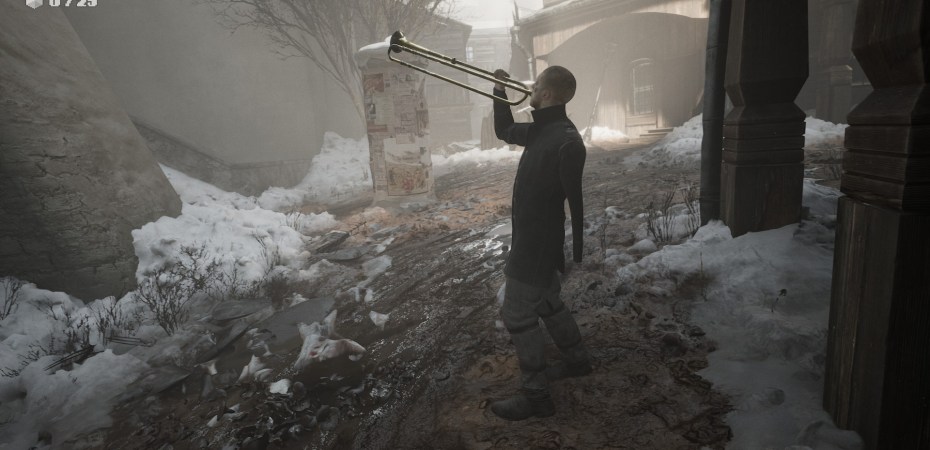
INDIKA is a 2024 adventure game with light puzzle elements. In terms of production, it’s sort of akin to Hellblade: Senua’s Sacrifice or The Fidelio Incident – it’s an indie game from a smaller studio with a hefty visual complexity. It looks expensive – it clearly took time and effort to produce. I’ve seen it described as ‘AA’ – not quite triple-A, but something close by, something that draws on the visual grammar and design principles of a big-budget title. In narrative, the basic arc is familiar. A young nun questions her faith against the backdrop of civil war, wanton violence, and the cruelty of her religious peers. That theme of the loss of faith isn’t remarkable ground, even for video games (see The Talos Principle or Sagebrush), but it is curious that the game’s set in Russia. It’s not just a ‘loss of religion’ game – it’s set in the context of the Orthodox Church at the turn of the 19th century. It’s a game grappling with the legacy of Russian modernisation, including the dismantling of the ecclesiastical hierarchy. While communism is never directly raised, it exists as a future-spectre, as the ghost of something about to happen. In the game’s closing scenes, the one-armed soldier Pasyuk tries to play the trumpet in a stupor in the street. It’s an absurdity, a symbol of impending collapse, the devastation of social norms and any sort of cultural continuity. He embodies a mauled Russia, even before Stalin or the World Wars. His loss is Russia’s loss, and, shortly, Indika’s loss as well.
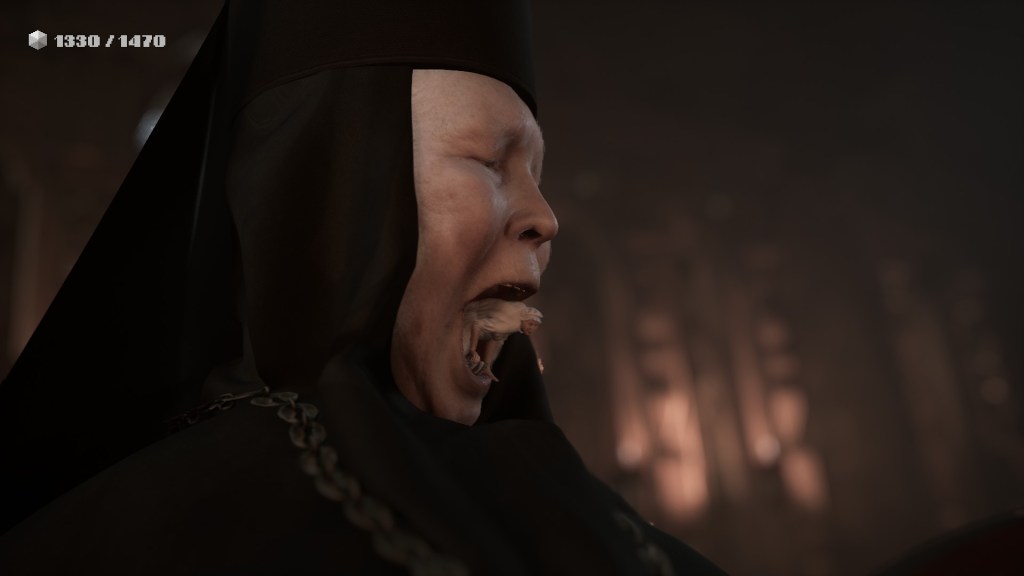
In brief, the story follows Indika and Pasyuk trying to reach a holy relic to heal Pasyuk’s damaged arm. Indika, a young nun recently out of her convent, hears the voice of the devil, who tempts and taunts her. He also seems to manifest in these bizarre, surreal little moments, like when he climbs out of the mouth of the monastery’s abbess, appearing as a miniature version of the abbess in a nightgown – this is a very weird game, right. It juxtaposes this lush, detailed environment against obvious absurdities and spatial anomalies – giant tins of fish, an unholy dog-monster, and puzzles where you move about components of city architecture like so many Legos. These are the effects of modernisation – the human being both decreasing in scale and increasing in size, becoming both smaller and larger. Indika is tiny against the fish tins, but large enough to move around bits of bridge and scaffolding. This industrial surrealism is matched by puzzles where the devil literally rips the earth apart. His voice, if heeded, creates cracks in reality, pushing apart the physical environment. In one moment, you’re trying to cross a bridge, but the devil’s ripped the world apart, and you need to pray (and ignore his voice) to bring the world back together, bringing the other side close enough to cross. Elsewhere, you deploy tactical listening. In a slaughterhouse, you need to get past an enormous bull (the size of a middling yacht). You listen to the devil, allowing him to rip the beast in half, and giving you space to cross over. This process of winkling in and out, listening and not-listening, represents the loosening of Indika’s religious faith. You don’t always have to listen to the devil, but sometimes it can be useful.
The game similarly moves back and forth between the modern day, represented in this closely rendered triple-A environment, and a pixelated 8-bit past. The past in this game is idealised, fed through the lens of nostalgia (much like its 8-bit graphics). It’s simpler, more pure. It carries intimations of lost innocence. One aspect that appears carried over into the modern day is the coin counter, present in the top-left corner throughout the game. If you complete tasks or pray to icons, you get giant pixellated coins, obviously at odds with the smooth, lifelike graphics of the world. Collect enough coins and you can level up. You can choose between different stats that really (on reflection) only increase the speed at which you gain additional levels. The pointless acquisition of coins is part of the game’s vision of religion – “Useless labour is the basis of spiritual development”, as the narrator (the devil) observes. The coins are a relic of an idealised past that, like all idealised forms, is false. This is where we loop back to D&D. INDIKA tells you early on that collecting coins is a useless labour. It tells you that there’s no point. And yet the close identification between game mechanic and story encourages you to soldier on regardless. Just as shooting the bad guys in Borderlands is both gameplay and narrative event, collecting coins is part of the narrative. Engaging with the game mechanics is playing out the story. If we weren’t meant to do it, why would it be in the game?

This little sleight of hand is eventually the basis for the game’s twist ending. After being arrested, imprisoned, assaulted by guards and soldiers, chased by a giant dog-monster, and betrayed by several members of the ecclesiarchy, Indika sees herself in a mirror as the devil. She is her own internal monologue, the monster she is afraid of. She is her non-belief, her movement away from religiosity. She has lost all of her coins, all of her spiritual levels, after a string of irreligious acts make her feel dirty and unclean. Paysuk’s arm is gone, and the relic, the kudets, has been traded to a pawnbroker for the trumpet (“They didn’t even give me five rubles for it”). While the pawnbroker goes out to tussle with Paysuk, Indika holds the relic, her demon-self reflected in a nearby mirror. She crosses herself and shakes the relic. Coins fall out. As the player, you can shake the relic for as long as you like, collecting coins, restoring your lost dignity, your lost pride – and the number will keep on climbing. Hundreds, thousands of coins come spilling out. If they didn’t want you to collect the coins, why would the mechanic be in the game? If it wasn’t part of the story, why would it be there? The game gives you space to come to terms with this empty act on your own. You shake that relic for as long as you need. Take what you need from it, and when it’s time – when you’re ready – put it down and walk away.

 Death is a Whale