
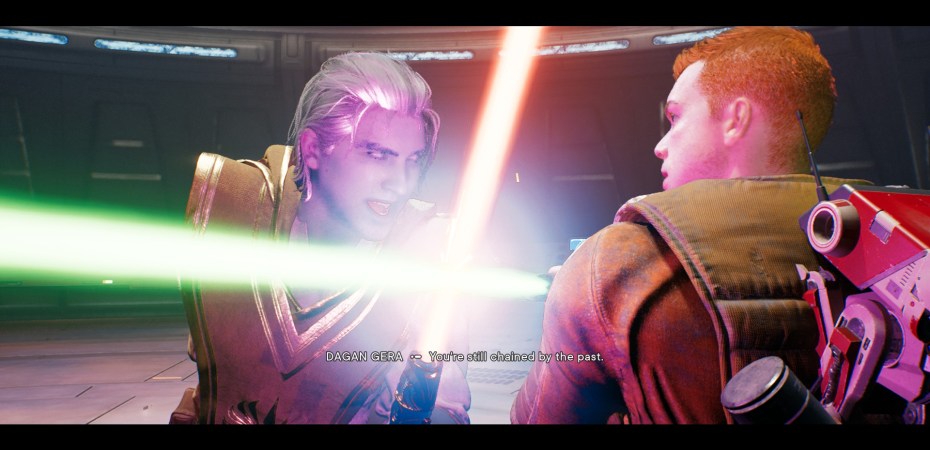
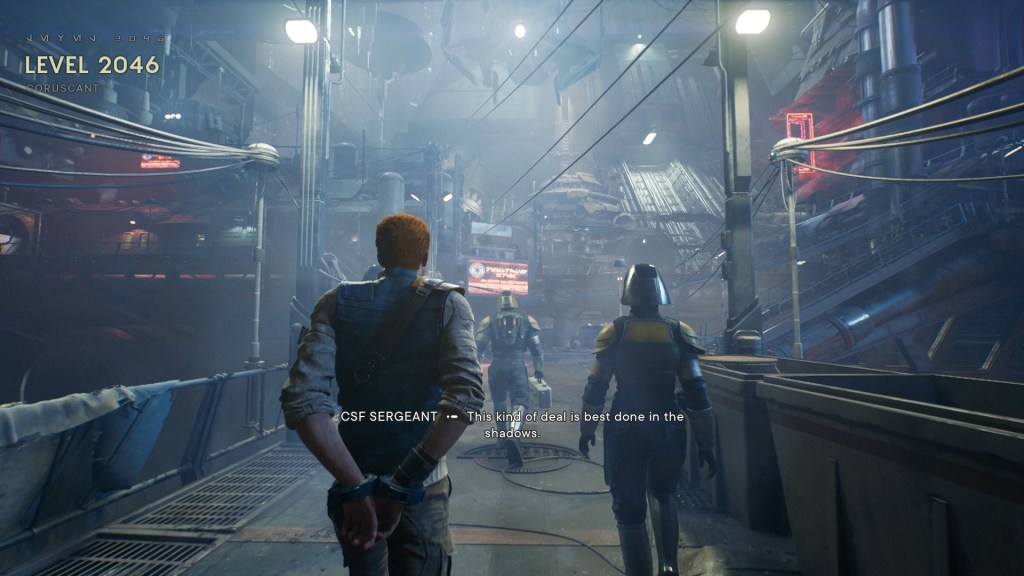
It took me a minute to get to grips with Star Wars Jedi: Survivor. The second game in the Star Wars Jedi series, I wrote a cheeky little piece on it to round out 2025 – just sort of having a dig at the customisation options for the main character. There’s a point where intentional character design gives way to this sort of collect-’em-all outfit parade, and I think it was on the wrong side of that balance. Now having finished the game, it’s time for a second pass. Star Wars Jedi: Survivor is the 2023 sequel to 2019’s Star Wars Jedi: Fallen Order – which is, firstly, a very strong game. I’ve written before about how it constructs nature and technology in this very classic Star Wars way. Jedi: Survivor is something else. It takes a minute to hook onto its DNA, its sense of direction. Where Fallen Order moves you relatively evenly between several different planets, each with key narrative beats, Survivor settles on one central planet with satellite levels in other places. The thematic axis of nature and technology isn’t gone, but it’s shifted. Fallen Order saw nature and technology in terms of the individual against the mass-produced. It was about fascism – it cast Rebels wearing homespun outfits against stormtroopers all wearing the same mass-produced uniform. Survivor has the same conflict between nature and technology, but it’s centred around urbanisation. The dirty Coruscant – crowded, visually noisy, with neon signs and smog and wires everywhere – is contrasted against Koboh, the game’s hub world, which is framed as a frontier planet. There are cowboys, bounty hunters, prospectors looking for gold (or the Star Wars equivalent), a saloon – it’s a Western. The city is choking, so people escape to the Outer Rim, looking for a future outside the strictures of civilisation.
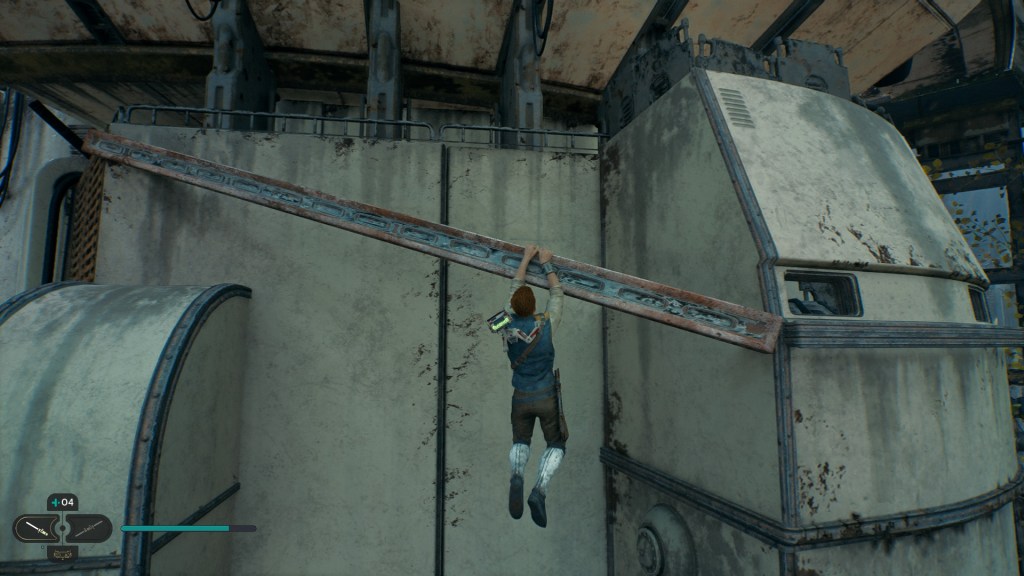
Jedi: Survivor also has this weird little thing about showing off its physics capabilities. Early on Coruscant, there’s a room filled with slabs of processed meat, and if you walk into them they wobble. Cut tubes will spray about – it seems like a little bit of technical display for no real narrative effect. Sure, the meat slabs wobble. Cool. It’s not fatal, but it feels emblematic of how this game wrestles with scriptedness. It often feels scripted – obviously every game is scripted, right, every game is designed and directed, but there’s still this veneer of fiction. We want to feel like the story unfolds naturally from within the events of the world. Nobody wants to see the clumsy hand of the puppet-master. Jedi: Survivor feels scripted. It hangs a room full of processed meat so that you can brush past it and watch it wobble – look! Look! We have wobble physics! You climb around decaying buildings, and they collapse and crumble, but only ever in a way that unlocks access to the next area. When you climb along a strut and it bends under your weight, it’ll stop right at the point where you can climb onto the next ledge. It was meant to fall – it was scripted. It’s only moving to allow you to continue. When a game feels this scripted, there’s often a feeling of cynicism or disconnect from the actual events. You’re never shocked or surprised by the goings-on, because there’s no real engagement in the fictional world, no suspension of disbelief. When the strut fell in that picture below – you know, I didn’t care. There was no jolt of concern for my character. I just held down the ‘move right’ button and sort of glazed over the whole event. You can almost imagine a little thread of drool hanging out of my mouth – the impulse is to say that it’s not really play, at that point, right, we’re just going through the motions. It feels like a sort of witless consumption. We know what a game feels like when we’re immersed in it, and we know what it feels like when it’s fake and wooden, and Jedi: Survivor often feels fake and wooden.
As another example, Survivor has these Old Republic testing chambers, secret dungeons around Koboh where you can unlock extra traits to strengthen your character. They’re all old and in disrepair, and some of them are actively falling apart, but they’re also video game puzzle chambers. You go in expecting that they’re able to be solved, because that’s their gameplay function – and that basic expectation cuts against their aesthetic. They’re old and crumbling – will they work? Yeah, because it’s scripted. They’ll work because they’re supposed to work, and never mind the aesthetic. It’s the same principle across the board. Never mind the collapsing building – it’ll take you where you’re supposed to go. The game even opens with a sequence that explicitly teaches you to disregard narrative tensions. At the start of the game, main character Cal Kestis has been captured by a squad of mercenaries. He’s taken to the evil Senator Sejan, who’s trying to use Cal for political gain, and then – wouldn’t you know it – turns out the whole thing was staged. The mercenaries are working for Cal, and the ‘capture’ was engineered to get Cal close to the Senator. The game opens with a sequence about how the stakes aren’t really real. If it looks like Cal’s in trouble, he’s fine. If he looks lost, it doesn’t matter. It’s all just part of the script.
The risk with this sort of game is that players proceed through it largely unbothered by any of the actual events. It’s slick and predictable in a way that switches your brain off – to the detriment of the underlying story. In the broad view, Jedi: Survivor has a coherent, well-structured narrative. It’s a game about learning to let go of the past. The resurgent past is a key motif: minor plot details from the previous game have ongoing effects, as when characters who were only mentioned in the previous game (like Eno Cordova) make a physical appearance. The central plot is also about things coming back from the past. After landing on Koboh, Cal finds mention of a hidden planet, a utopia where refugees fleeing from the Empire could hide in safety. While investigating, he accidentally frees an ancient Jedi from the High Republic era, Dagan Gera, who, feeling betrayed, attacks Cal and tries to claim the hidden planet for himself. In his conflict with Cal, Dagan draws on the resources of an old Separatist lucrehulk, which means you spend the whole game fighting both the Empire and retooled prequel-era battle droids (complete with trademark silly dialogue). The past reasserts itself in all these little ways.
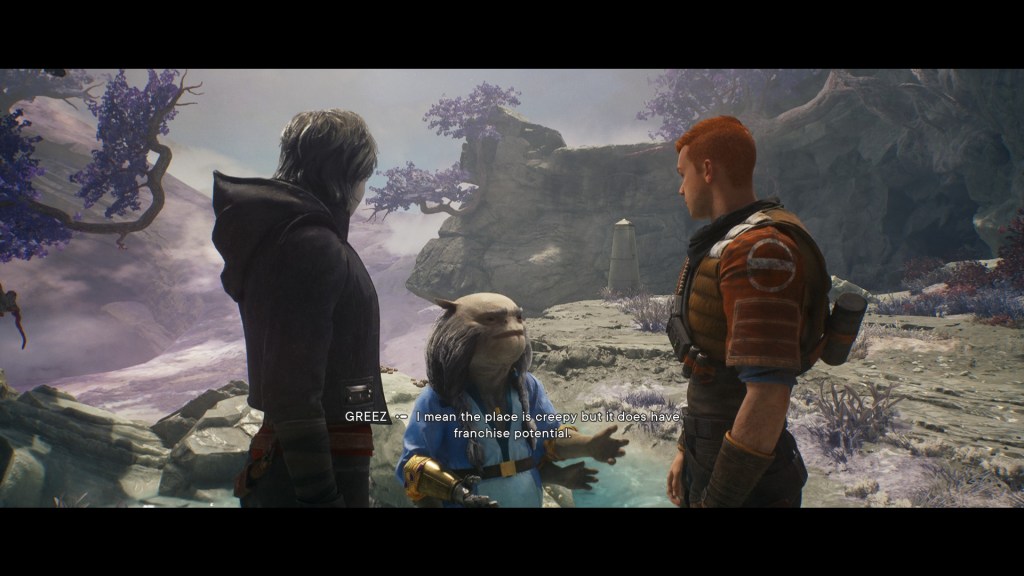
So the game rakes over a lot of old coals. The High Republic, the Clone Wars, the Jedi Purge – there’s a lot in there. The recurring philosophical question is – with so much history, how do you move on? The hidden planet, Tannalor, is posed as the answer. For Cal, it’s a place to hide from the Empire. For Dagan, it’s a place to rebuild his power before making war on the galaxy. The motivations are paired and opposed. Cal wants to protect while Dagan wants to nurture a grievance. Cal ultimately defeats Dagan by playing on his fears, impersonating a Jedi from Dagan’s past who was involved in his imprisonment and then killing Dagan in an unguarded moment. Dagan is killed by his past. He’s killed by a spectre, by the wounds that he’s failed to leave behind. It’s the same as Into the Spiderverse – the paired characters embody positive and negative ways of dealing with the same basic problem, and the negative ways lead to their own destruction, modeling to the hero (and the audience) a better way of being.
And that’s the game. It’s a well-structured narrative that doesn’t quite hit because the game as a whole feels a little fakey. It’s just a little too predictable. All of Cal’s mercenary teammates die in the first mission, because it’s called Jedi: Survivor and Cal is the Jedi survivor. The first clue towards the secret planet is found in a hidden area under your old friend’s saloon – everything’s just a little too tidy and convenient. And then there’s a secret second movement. After beating Dagan, you return to the rebel base with the map to Tannalor. The whole team has an end-of-game debrief, with a couple loose ends (one companion, Bode, still has to go pick up his kid), but the game is essentially over. The lesson is learned, the boss is defeated, and the secret planet is open for business. It feels like the game is winding down – but it ramps up into a whole new narrative. The base is attacked by the Empire, and your companion Bode turns traitor and steals the map. Two main characters are killed, and Cal embarks on a revenge quest. He tracks Bode and meets his daughter. He invites Bode to surrender, Bode forces a fight, loses, and dies, and Cal adopts Bode’s orphaned daughter and goes back to Tannalor.
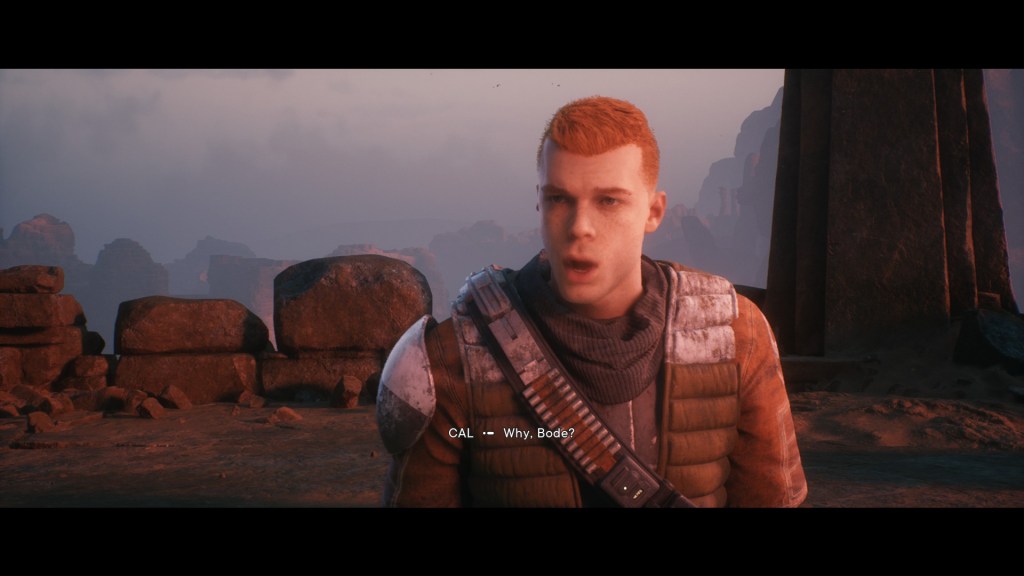
So – this is a bit of an oddity, especially in a game that’s otherwise pretty paint-by-numbers. This extra act expands on key themes, but doesn’t change the basic outcome. After defeating Bode, the story is returned to where things were after Dagan. Cal just takes the refugees to Tannalor. It’s not really a development – at most it’s a minor delay, completely disconnected from the originating quest. It’s a genuine second movement, which I don’t think I’ve particularly seen before. There are games where a minor antagonist has taken on so much life as to dwarf the central villain (Vaas in Far Cry 3 and Lady Dimitrescu in Resident Evil VIII), but this isn’t upstaging, it’s a second movement. They wrapped up one story and then turned to tell another. That’s odd. In one sense, it seems to violate a rule of narrative efficiency. They set up a premise, a key philosophical or psychological question, they set out hero and villain and their two different ways of approaching the question, and then they resolved it in favour of the hero. That’s complete. It’s the end of the story – and then it continues. There’s also something disorderly about the internal structure of this extra movement. The Empire attacks your base, and Bode turns traitor, and the two happening at the same time seems to imply that Bode revealed your location. It later transpires that there are conflicting factions within the Empire: the base was raided by Darth Vader and his troops, but Bode works for an Imperial intelligence officer, who knew about the base but wasn’t planning to raid it for some months. Vader found and attacked the base independently, and Bode took the opportunity to steal the map and escape, running away from both Vader and you. There’s also no clear villain hierarchy. In the battle for the Rebel base, you play as Cal’s mentor, Cere Junda, and fight Darth Vader. After you beat Vader’s boss fight, he kills Cere anyway in a cutscene (scripted), and Cal runs after Bode. It throws out that sense of intensifying action across the rest of the game. With Dagan, you work your way up to him, fighting his lieutenants and key warriors until you get to the final battle against Dagan himself. Vader, meanwhile, turns up almost incidentally, kills Cere in a side sequence, and then vanishes again, leaving Cal to chase after Bode, who comparatively seems like a very low-stakes final boss.
In the most charitable reading, it seems like Cal, Bode, and Dagan offer three responses to the question of Tannalor. Dagan wants to hide while he builds up an army to conquer the galaxy. Cal wants to shelter anyone fleeing the Empire, and Bode wants to reserve the hiding place just for his daughter. With some reframing, you could see the two movements as Cal’s response to each of the others in turn. We can’t just be bitter about our past, and we can’t hide from our responsibility to society at large. That’s plausible, as a concept, but it doesn’t justify the Vader interstitial, and it pulls awkwardly against the twist. Bode’s position isn’t clearly staked out. You don’t fully understand his motivation until his final boss fight – the game really rushes through the whole Bode sequence. It’s difficult to see the contrast of these arcs if you’re only piecing Bode’s position together in retrospect. The Dagan narrative is also relatively impersonal, for Cal, while the Bode arc is a revenge quest – there’s not a strong sense of balance or symmetry between the parts.
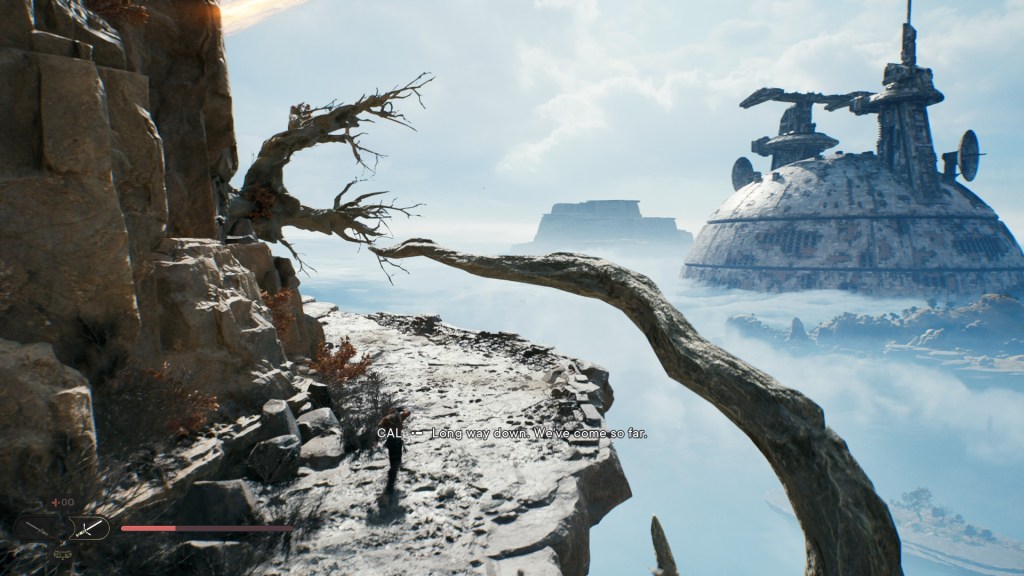
If there’s one thing to say about this second movement, it’s definitely not paint-by-numbers. It retains an undercurrent of scriptedness, as in the death of Cere, who dies only after you defeat Vader (he killed me so many times, and then I finally beat him and he kills me anyway?), but it’s also such a weird, unexpected story beat that it breaks down some of that inertia. At its worst, Jedi: Survivor feels like a game where nothing’s going to happen. It feels slick, in the way where it slides off you. In that final sequence, in that second movement, it’s unruly and a little wild, sure, a little disorganised, but it opens up space. The narrative cracks open into something that’s not quite clear or obvious. There’s possibility. Bode betrays you, but you spend a bunch of time talking to his young daughter. Are you going to murder a father in front of his kid? Earlier unsettling decisions start to haunt you. Before killing the Ninth Sister, Cal reminds her of her name. “Masana Tide. It’s time to set you free.” Similarly, Dagan’s lieutenant, the Gen’Dai warrior Rayvis, demands an honourable death after he’s defeated. “Give me my warrior’s death.” Cal obliges him, and it’s not quite clear that he’s doing a good thing. Is – is something bad going to happen? Is Cal going in the wrong direction? The game never tips over into this or that, but it becomes unsettling, as much for the disorderly narrative as for Cal’s actions within it. It breaks down the sense of scriptedness that was honestly its biggest impediment.
 Death is a Whale