
For a couple years now I’ve been trying to write about the joy of the collection. I was trying to write this essay three years ago, when I was writing about Magic’s Kamigawa: Neon Dynasty set. I worked through some stuff on book collections: there’s a Walter Benjamin essay, ‘Unpacking My Library’, Umberto Eco has a thing about collecting books you won’t have time to read – none of it was quite right. I had a look through the autism research as well. If you’re familiar with autism, you might know that many autistic people have a predilection for order and organisation. Play in autistic children often involves lining things up or setting things in rows. I liked organising buttons. There was a little wooden box, and I would upend it, organise everything by shape and size, and then put it all away again. In adults it’s often paired with a preference for structured work. In her autobiography Nobody Nowhere, Donna Williams, an autistic woman and autism advocate, talks about working in a shop, in the storehouse out the back, and keeping all the stock organised and shipshape. That partly touches on the appeal of the collection – not all of it, but in part. Noting as well, by the way, Nobody Nowhere is full of the most horrific family violence, just in case you’re thinking of reading it.
So I’ve been digging away at this concept for years now – at least three years, since I wrote that Kamigawa essay. I’m not quite there, but I’m getting closer. Georges Perec, in his modal essay ‘Think/Classify’, argues that utopias are dull and boring: “All utopias are depressing because they leave no room for chance, for difference, for the miscellaneous. Everything has been set in order and order reigns. Behind every utopia there is always some great taxonomic design: a place for each thing and each thing in its place.” It’s a comment that takes in both Thomas Aquinas and the Dewey Decimal System. The Dewey Decimal System is obviously a tool for organising books in the library – it’s an information system, allowing you to store and retrieve vast numbers of books by topic. It has utility, it’s got a practical purpose, in that sense, but it’s also deeply philosophical. It’s about modelling and structuring the breadth of the human experience, the full sum and total of our knowledge. Between the numbers 000 and 999 is everything. Everything is set in order – given a place, a number, a sub-number or sub-sub-number. Everything sits on the same spectrum of knowledge. That vision of a comprehensive and complete model of human knowledge is similarly the goal of Thomas Aquinas’s Summa Theologica, alongside any of the other medieval Summas. We’ve done a bunch of work with the Summa previously – the title literally translates to ‘summary of theology’. It is a cathedral of doctrine, a palace, intended as a full and complete account of everything that exists. Every aspect of theology is set in place. The same practice is carried through in Dante’s Divine Comedy, a buddy cop road movie where Dante tours through the afterlife with his drinking buddy Virgil. They go through heaven, hell, and purgatory, and at each level everything is in its place. There are different circles of hell, different terraces of purgatory – it’s a taxonomy, a spiritual taxonomy, a religious vision of the inherent order of the universe. For Perec, that’s sort of boring. He wants room for surprise, for the miscellaneous, for the uncategorisable. Where do you shelve a book that sits across multiple disciplines? Where does it go if it’s about both geology and cooking? On what level of hell do you put the gluttons who also committed tax fraud?

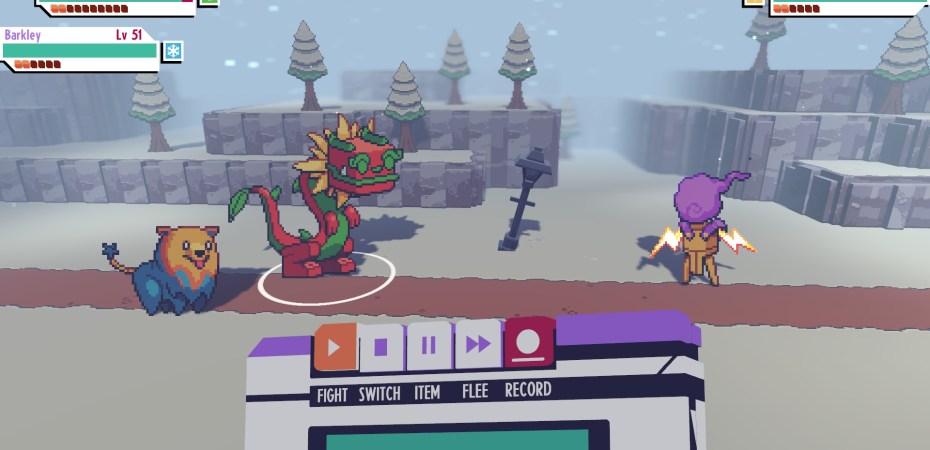
Cassette Beasts is a 2023 game from UK-based indie developers Bytten Studio, published by Raw Fury, who also put out Kingdom, Norco, Sable, Call of the Sea, The Signifier – they’re great. The pitch for Cassette Beasts is essentially ‘ethical Pokémon’. It’s a Pokémon game, but instead of forcing animals into indentured servitude, you use a tape recorder to record monsters, and then you use those recordings to transform during fights. As with Pokémon, you have a encyclopedia (or ‘bestiary’) of all the different monsters. Every creature has a numbered place, and that place gives structure and shape to the game’s ecosystem, if we can call it that. Crucially, the encyclopedia predates your experience in the world. You can see the number even if you haven’t seen all the preceding creatures. It is already set in place, set in relation to the other monsters in a complete and comprehensive system of knowledge, regardless of what you’ve actually seen or experienced up to that point in the game. Thus Spooki-onna, creature #115, implies the existence of 114 other creatures. The encyclopedia tells you at all times how many monsters you’ve seen, how many you’ve caught, and how many remain undiscovered. It prompts that same basic collector’s impulse: gotta catch ’em all. In one view you could see that impulse simply as rampant consumerism – as a trick the game deploys to get you to spend money. That criticism carries special weight in trading card games like Magic: The Gathering, where the primary mode of sale is the booster pack – a sealed packet of randomly selected cards. When you buy a booster, you don’t know what you’re going to get. Neon Dynasty has 302 unique cards, or a little over 500 if you include all the variants with different art and so on. If you want to catch ’em all, you would have to buy a heinous number of packs, and most of what you open would be commonly printed cards of lower rarity. It’s gambling. It’s not that players particularly try to collect every card in a set – I’ve not met anyone who does that – but the way that cards are obscured at the moment of purchase ties into the thrill of collection. What if you get a card you’ve never seen before? What if you get something rare, something exciting? What if you’re able to fill a spot in your collection?
You could make a similar argument about a collection franchise like Pokémon, where they spin out a new region with a new bunch of monsters every couple years (along with all the attending merchandise – the TV shows, the films, the video games, the plushies). There is a sense there (increasingly, as the franchise wears on) that the new batch of creatures only exist to incentivise another round of purchases. But that argument doesn’t immediately seem to have as much purchase within the single game of Cassette Beasts. It’s one game, which you purchase once, and you’re able to capture all its various creatures without any further transactions. It’s clearly part of a collection genre, if we can call it that, and the strong stylistic and mechanical ties to the existing Pokémon franchise mean that it doesn’t entirely escape the gravitational pull of that earlier critique. But it maybe seems a little weaker, a little more distant or removed, and certainly nothing like the booster pack model of Magic: The Gathering. Perhaps more appropriately, we could associate the numbering of monsters in this game with the concept of exhaustion. George Perec’s short 1975 text An Attempt at Exhausting a Place in Paris is a literary experiment where Perec attempted to write down absolutely everything observable or distinguishable within a certain area. He tries, in writing, to exhaust a place, to capture it entirely, to write it down so thoroughly that there’s nothing further to write. The results I guess were mixed, depending on your point of view, but there’s something of the collector’s impulse in that as well. The itemised list of monsters is exhaustive. It’s comprehensive – it covers every monster or creature that it’s possible to find in the world of Cassette Beasts. Where Perec had to wrestle with the chaos and diversity of the real world, the encyclopedia in Cassette Beasts is facilitated by the nature of the game as digital object. Each monster has been bound in code. The developers drew up graphics for each creature, for their attack animations, their fusion forms. Somewhere in the game development files is a folder marked ‘Enemies’, and it’s just a static list of a hundred and thirty-six cassette beasts. The encyclopedia in Cassette Beasts is a marker of the boundaries of the game. It exhausts the game’s monsters, capturing everything that there is to capture, absolutely everything observable or distinguishable. It tells you the stats that govern a creature’s attacks and defenses, all the technical math that goes on behind the scenes. It gives you random little biographical snippets that you couldn’t find anywhere else. In a sense, the encyclopedia is the game mutated into another form. It is an expression of the full and entire being of the game-world. Summa Cassette Beasts.

In a way it’s sort of disappointing. If you complete the encyclopedia, you feel like you’re done. What else is there? You’ve seen everything, collected everything, and there’s nothing left to do. The territory is exhausted, and you need to move onto something else. We return again to capitalism, or more accurately to the intersection of capitalism and colonialism – to the financial demand for ever-increasing profits and its corollary demand for ever-expanding horizons, for eternal new worlds to find, exploit, itemise. In one view, our demand for novelty is itself an expression of our economic state. Give me another world to explore, another encyclopedia to fill, and when it’s done, when the game is drained, exhausted, used up, I’ll move on to something else. We’ve finished Cassette Beasts, give me another one. But it also, I think, points to the aesthetic tension in video games between freedom and constraint, between the system and our free decisions. Do we play games or do games play us? Games limit and structure our behaviour. They control the full range of our expression. There is nothing we can do in a game that is not already an affordance of the game. It contains in itself the full spectrum and limit of possible behaviours. When we play, then, when we make choices, we’re only expressing one of the possibilities given to us by the game system. We are being played. At the same time – you know, I choose to play this game. I choose to enter into the system, and I can turn it off. There’s a creative tension between those two poles. It’s in Bioshock, in the philosophical question of choice and free will that that game explores. It’s in The Walking Dead, with its exploration of choice as absurdity. It’s in Spec Ops: The Line, Shadow of the Colossus, Red Dead Redemption, any other game with a tragic, inexorable arc towards an unavoidable end.

And in response, a number of games lean towards randomness as an expression of beauty, as an opportunity to model and explore some of the incidental serendipity that we find in everyday life. No Man’s Sky has its infinite universe, and in all of it, across all of its randomly generated worlds, sometimes you find a place that’s really sort of nice. Nobody designed it, nobody intended it, it’s just there – and it’s pleasant. It’s still an expression of the machine, part of the contained spectrum of designated experience, but that spectrum (in the case of No Man’s Sky) is so vast and complicated that it’s indistinguishable from the variety of everyday life. Shadow of War, too, encourages this emergent, evolving set of relationships with enemy Orc captains. You brainwash Shaka into working for you, but he betrays you, and takes on the new moniker ‘Shaka the Backstabber’. It’s not planned, it’s not intended, it’s just this one asshole Orc. It’s the randomness of the computer masquerading as the randomness or unknowability of our inner selves, of the selves of the people around us. I’ve said previously (in that link above) that one of the weirdest parts of Shadow of War is that the Orcs seem more human than the human characters. The human soldiers are mostly just background figures, repeating patterns with no existence or permanence outside of a single fight. Orcs stick around. Your relationship with them changes, develops over the course of the game. They are in the absolute sense a composite of a range of pre-programmed features, an array of noses and chins and names and apparel randomly selected and arranged into a compiled figure. But you can relate to a composite. In a sense you are just a composite yourself, a product of your environment, of your genetics, your parents, your upbringing. You have one of the noses that is within the spectrum of possible human noses. We are subject to these same constraints, the same tension between choice and the deterministic system that surrounds us. The numbered bestiary in Cassette Beasts is just one expression of that system, one method of organising and arranging the possible spectrum of experience available in that game. I haven’t quite captured every monster – I think I’m somewhere over halfway there. Maybe that’ll be all I do.

 Death is a Whale