

Here’s a little secret for you. As I draw near to the end of the Horus Heresy project, I’m looking at a new project where I work through all the Call of Duty games, probably from Modern Warfare in 2007 through to WWII in 2017, or Black Ops 4 in 2018. To me that’s a fairly set period in the Call of Duty franchise, with the original Modern Warfare setting the scene for shooters for the next decade, and Black Ops 4 as the final title before the Modern Warfare reboot in 2019. I’m bulking up a few of the old essays (the impetus for the rewrite of that old Modern Warfare essay, now The Untouchables), and playing through the couple of games from that period that I missed. I’d not played Black Ops III or Infinite Warfare, so I got them both during the recent Steam sale, and they’re sitting in my list for the next couple months.
I probably won’t write about those games directly until much later in the process, maybe another two or three years from now – in the meantime, I thought it would be funny to offer some first impressions of a game that came out a decade ago. Call of Duty: Black Ops III (2015) is pretty good. I haven’t finished it, but even just off the bat the plot steals beats from Advanced Warfare, the previous game in the series, as a way to get the protagonist into cybernetic upgrades. If you’re not familiar, the multiplayer for Black Ops III is built around cybernetic battle-suits, which allow players to run along walls and hack enemy robots – all these high-tech weird little maneuvers that they invent to keep the gameplay interesting. In Advanced Warfare, the first level has you playing as a normal human soldier. At the end of the level your arm gets blown off, and it’s replaced with a cybernetic robot version, which sets the scene for all your cyborg black ops combat throughout the rest of the game. Black Ops III follows the exact same process, including your mutilation at the end of the first level, but this time a robot rips off your arms, breaks your legs, and nearly beats you to death. The same, but more.
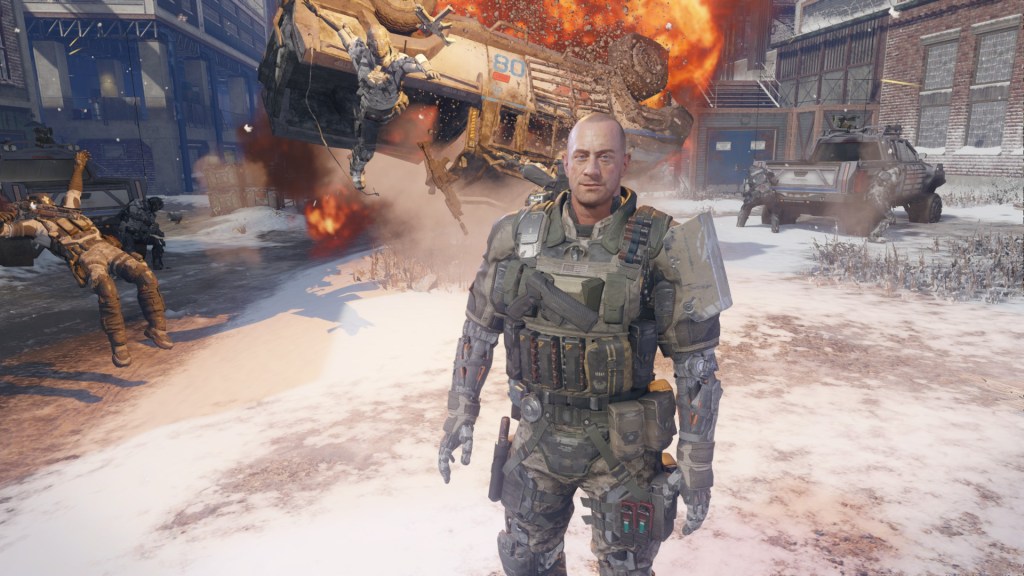
The COD games around this time are also trending away from real-world politics and towards a sort of abstract future-nowhere, where countries exist and have names but no real relation to our current day. For instance, Ghosts in 2013 had the USA invaded by South America (just the whole continent, I guess). The first three Black Ops games seem to move on an arc from the historically grounded into this sort of fantasy future: the first one is all about Castro and the Bay of Pigs, the second one splits its focus between a sci-fi 2025 and the Soviet-Afghan War in the 80s, and the third one (at least as far as I am through it) doesn’t care about history at all. It’s all robots and drones, conspicuously lacking in any sort of CIA-style covert operations against foreign countries. There’s almost no reason to call it Black Ops other than branding.
The shift lines up with the series’ developing focus on online multiplayer. It’s built around unlocking tech, around character progression – you have to unlock upgrade weapons and develop your character’s abilities. Progression has always been a component of Call of Duty multiplayer, easily as far back as Modern Warfare‘s prestige system in 2007, but by the time of Black Ops III there’s so much mythos around the concept that the narrative itself is pulled into the gravitational orbit of progression and unlockables. The levelling takes pole position. Add to that the soft multiplayer aspect of the campaign, where story missions can be played by multiple players, as well as the strong focus on Zombies mode, and you have a game that’s more of an arena for interactivity and social performance than a traditional single-player campaign. It’s all about putting on bells and jingles, unlocking custom camo options for your upgraded mega-zapper – it’s fashion. The historical or political concerns that characterise earlier games are replaced by a focus on identity and self-expression as mediated by unlockable character customisation. The range of self-expression is expanded by playing the game, by unlocking new options. Higher level players have a broader vocabulary, a wider range of terms or expressions with which they can articulate their identity. It’s similarly unsurprising that the game’s key villain (or apparent villain) is a team of cybersuited soldiers. It’s another story beat stolen from Advanced Warfare. In the game’s vernacular, the only characters – the only real people – are those able to express their identity through the configuration of their cyber suits. You can only be opposed by your equals.
Of course, these are just first impressions. Given that the game has been out for ten years, I think it’s a good time for a first pass – you know, often those first impression videos and articles are sort of rushed out to capitalise on SEO when a game is released. They aren’t the best first impressions. They’re not about saying something, they’re about saying anything – they’re about chasing clicks, maximising site traffic. The best form of first response is at least a decade on. I’ve been making this silly little jokey joke for years now, and – partly it’s a goof, but partly also I think we need to be looking ahead. In 2090, the only people talking about Black Ops III are going to be people who weren’t there when it was released. We’re going to get more and more first impressions coming after the fact. That’s going to be normal – for every game. Every game, like every book or film or every other form of media, is turning into something that came out in the past. All first impressions will be new impressions. The reception of a game when it first came out will be part of the history, but that’s all it will be. The future is in looking back. It’s all going to be ten years later. We might as well start now.
 Death is a Whale
[…] First Impressions of Black Ops III, Ten Years Late(deathisawhale.com, James Tregonning) […]
LikeLike