
There’s this hbomberguy video about Yooka-Laylee, a 2016 platformer in the style of Crash Bandicoot or Ratchet and Clank – it’s a deep dive on certain mechanics that had gone out of style and that were repopularized by the game. One of the mechanics he lists, from about the nine minute mark, is purposeful movement. Yooka-Laylee is a platformer – you have to move precisely, or you’ll fall and die. He compares the game’s movement to other modern games like Shadow of War and the Assassin’s Creed series, where, you know, you do all this jumping and running and hurling about just by holding ‘forward’ and ‘up’. “It’s really unengaging,” he suggests, “because most of the work is done by [the player-character] for you. You just point him at the thing.” That’s an interesting angle. As another approach to that point, we might ask – what does that easy, simple movement style do for these games? Is it really unengaging, or is it filling a different need?

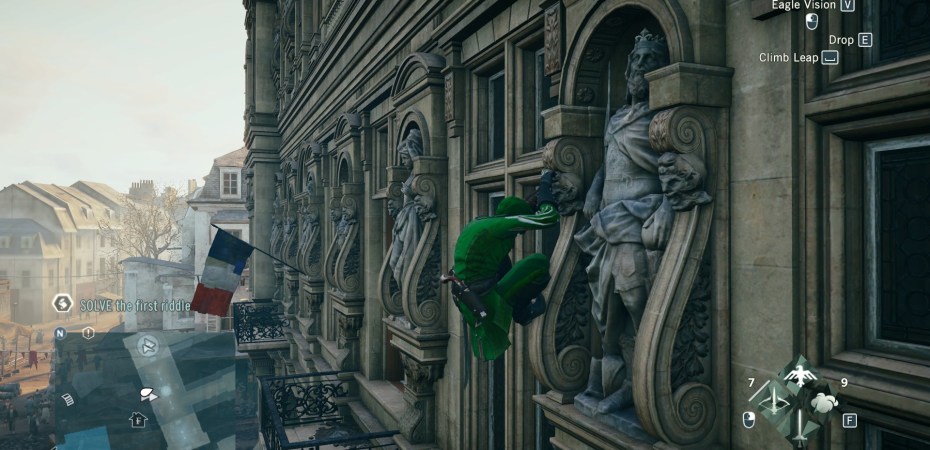
Let’s talk about Assassin’s Creed: Unity, since it’s been recently on the boil. In my essay about extremists in AC Unity, I talked about how the game engages in a sort of historical hacking. It reinterprets historical events through the lens of the fictional conflict between Assassins and Templars, giving meaning to historical moments by putting them in a simple narrative framework. Assassin’s Creed deals with space in the same way it deals with history: in both cases, it applies the ethos of the hacker. We’ve been talking here for years now about how the built environment shapes our movement through everyday life. We are meant to use buildings in specific ways. There’s literally a person whose job is to account for and encourage particular ways of using a given space – that’s part of the role of the architect. If we want to go to the second floor, we’re supposed to use the stairs. That’s what the architect intended. Of course, in Assassin’s Creed, as in Dishonored and other games, the player can resist the architect’s guiding hand, using and misusing built space in a variety of ways. Dishonored has a teleport function, while Assassin’s Creed lets you scale buildings. You hack space, repurposing the environment to facilitate your sneaky assassin needs. Someone left a window open for fresh air? Sounds like a way to sneak in and kill everyone. Empty balcony? Cut through the building’s interior and catch a fleeing criminal. The roof on your house keeps the rain out but also you can sit on it and shoot crossbows without being noticed by people in the street.

This spatial hacking is, primarily, an interpretive function. It’s a way of reinterpreting the environment, of making it make sense. You approach the building in a way that draws out its implicit affordances, the opportunities and meanings that (however unintentionally) serve as part of its total form. Architectural features become handholds or points to anchor yourself during the climb. When you look at particular buildings, or parts of buildings, you start to ‘read’ them – you can tell which way you’ll have to climb, where progress might be blocked or circuitous. It becomes something that you’re able to make sense of. Crucially, that sense is something that’s not available to the general public. Unity features a deliberate contrast between street level, which is crowded and squalid, and the open freedom of the rooftops. On the ground, you’re confined to the grid of the city’s streets. You move along roads that function more like funnels, or pipes, or corridors in a maze – you can see it best with a bird’s eye view, as in the image above. The walls of the buildings on either side of the road hem you in, corralling or herding you in specific directions. If you’re on an east-west road, you can’t just turn at any moment and go north. You have to follow the road until you find an intersection. The best analogy for the city streets is found in the literal hedge maze that you navigate in one of the story missions. And most people are stuck on that street level. It’s your skill as an Assassin that allows you to transcend beyond that form of social control. You aren’t hemmed in by the buildings. You can climb them, and make your way freely across the rooftops, where you can go in any direction at any time. You don’t have to head along the Rue Saint-Honoré until you hit the Rue du Louvre – you travel as the crow flies. You sit above the petty dominance of the urban grid. It’s all part of the thematic interplay of freedom and control – you go beyond how the built environment is intended to be used and explore how it’s able to be used. You climb.

In this way, Assassin’s Creed: Unity asks you to re-interpret buildings, to take their most obvious function to you as a pedestrian – as walls or barriers – and reinterpret them as a series of pathways, leading you up and above this mode of social control. You’re encouraged to start paying much closer attention to the actual contours and lines of each building – the architectural detail becomes much more relevant. With Notre Dame, for example (pictured above), you can see a sort of ledge, a first floor balcony, along the bottom right of the image. Then to get to the roof you can either go up the flying buttresses (the supports with the little towers on them) or climb up past the stained glass windows. These details become meaningful because they represent paths that you’re going to traverse. This interpretive task, I’d suggest, fills a gap in our understanding of what buildings mean. We’re all aware that the architectural details of buildings often carry symbolic or philosophical meaning. It’s especially the case for religious buildings like cathedrals, or buildings of state that carry national identity. Think Notre Dame, the Pantheon, the Palais de Justice – all places that Unity focuses on. I think it’s fair to say that – you know, we know these buildings have a language, we know that they carry meaning, but we don’t all carry that language with us. We don’t necessarily know what it all means. We look at this doorway into Notre Dame (below) and feel that it’s obviously bearing great meaning – we’re immediately certain that there’s a story or a message here. We know the figures and statues must represent specific people, even if we don’t know who they are. If you’re familiar with Notre Dame, you might know that it’s the Portal of the Last Judgement, and the statues are the twelve apostles – six on either side. But that’s not history that most of us carry around. When we look at places like Notre Dame, in Unity or in real life, I think most of us approach it with a sense that it carries buried meaning. Unity taps into that sense. It gives us a way to create meaning, to exercise sense-making on the built environment and to some degree reconnect us with cultural knowledge from the past. It’s not genetic history – not as simply as the Assassin’s Creed conceit makes it out to be – but it is, for many of us, part of a cultural backdrop that underpins much of our lives.

This is the reason why these games are obsessed with secret societies and mystical codes, with invisible symbols that you can only see with your Assassin’s Eagle Vision. The Assassin’s Creed games, and Unity in particular, are fixated on reconnecting with the past, with drawing out lost knowledge and seeing things that otherwise go unseen. I think that’s something we can relate to. There is a history out there, and it’s a history that many of us have simply and straightforwardly lost. Assassin’s Creed, in all its hackneyed, half-assed faux-historicism, taps into that instinct. It presents the out-there, the heritage in the past that we feel we’ve lost track of, and it gives us ways to decode it, or to feel like we’re decoding it. We know that iconic and important landmarks carry symbolic meaning. We feel that they’re speaking to us. Unity affirms that impulse. It gives us a way to hear them, to read them, to navigate across them. It draws attention to the nuances of their material form, weaving the built environment into the key themes of freedom and control. It’s easy to move around in this game, sure – that’s part of the metaphor. If Assassin’s Creed is a power fantasy, it’s specifically a fantasy about the ease with which we can reach back and make sense of the past. The ease with which we move around the environment is indicative of the ease with which we are meant to craft our new understanding of history. It’s glib, yes, superficial, skating across the surface rather than diving in deep. That’s part of how Unity builds up in its players the confidence to take hold of its narrative.
None of this, of course, takes away from the thrust of the Yooka-Laylee argument. It’s good to have a diverse range of games drawing on different mechanics. There are alternatives to the mechanics Unity offers, and it’s good to explore them. It’s particularly important to revisit mechanics that have dropped out of fashion in the face of contemporary trends. Old-fashioned mechanics are part of our history: we benefit from broadening our perspective on that front. But by the same token, it would be criminal to boil the argument down to good mechanics and bad mechanics, to good game design and lazy garbage. Unity is trying to do something really specific, and its movement mechanics play a key role in that vision. It’s to all of our benefit to better understand it.
 Death is a Whale
[…] but I’ve been enjoying writing longer essays over the past few months (like the pair on Assassin’s Creed: Unity). We’ll see how we […]
LikeLike