

Call of Duty 4: Modern Warfare (2007) is a watershed moment in video game history. The previous three Call of Duty titles, released between 2003 and 2006, all focused on WWII. Call of Duty 4 moved into the context of post-9/11 global conflict, setting a standard for shooters that would continue through to the current day. It wasn’t the first military shooter to take a modern setting (for example 2005’s Battlefield 2 saw the European Union go to war against Russia and China), but it was the big one. It spawned the wildly successful franchises of both Modern Warfare and Black Ops, a similar series also under the Call of Duty banner, and set the visual and stylistic tone for video games for the next ten years.
One of the game’s key themes is that the wars of the modern day are shaped by the wars of the past. The plot revolves around an unnamed Middle Eastern country, where a Soviet-backed revolutionary ousts a Western-aligned president. You play for the most part as one of two factions – as the Americans, on the ground in the Middle East, trying to stop this hostile takeover, and as the British, flitting around Ukraine, protecting informants and uncovering secrets. The British have already encountered the Russians fuelling the revolution, it turns out, as the British team lead – Captain Price – was sent to assassinate the Russian leader (one Imran Zakhaev) during the Cold War. New wars are shaped by old wars. Price’s failed assassination in the past leads to a second run-in with Zakhaev during the war in the Middle East. It all touches on the real-life history of Cold War conflict in the region – I think it’s fairly well-known at this point how the USA funded, for example, the Afghan mujahideen in the 80s during the Soviet-Anglo War, in what they called Operation Cyclone. That funding leads through into the Taliban taking control of Afghanistan in 1996, and then in 2001 both 9/11 and the subsequent re-invasion of Afghanistan by the Americans, in a twenty-year war that has only recently ended with Biden’s withdrawal from Afghanistan in 2021. The game isn’t directly about 9/11 or Afghanistan, but that’s the cultural referent for the ideas that it’s working through. Old wars shape new wars. The Cold War shapes what’s going on in the Middle East today.
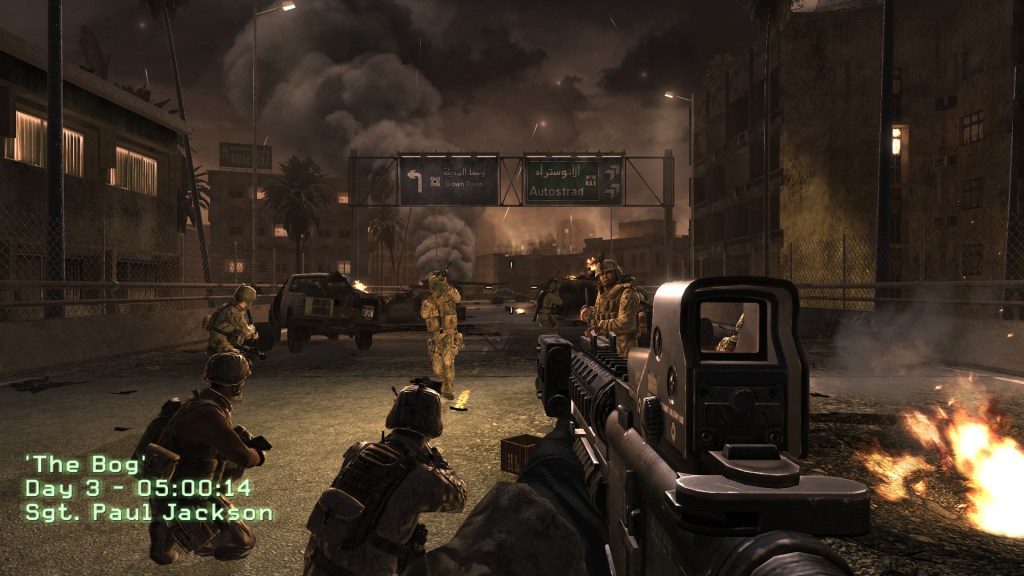
In 2019, I published an essay on the Arab and Russian characters in Modern Warfare, sort of reading against the grain of American imperialism in the text. You won’t immediately be able to find that essay – I’ve retired it, in favour of this updated version that you’re reading now – but the basic concept was around the victims of your Russian and Arabic enemies throughout the game. As noted, the Middle Eastern levels are set during a violent military coup. You see Arabic militias breaking down doors and setting up firing squads to execute civilians. Similarly, in another early level, you become embroiled in a Russian civil war. The evil Russians, quote-unquote, are firing missiles at a town full of Russian civilians. You never see the people in that town – they are only ever talked about. You see rockets fired down into the valley, you see them launched, but you never see them land. Really all I did in that essay was foreground that second, persecuted group of people. Often these games set up a simple binary between ‘good Americans’ and ‘evil Russians’, or ‘evil Arabs’, or whoever the villains might be. I wanted to nuance that picture a little bit – so I just noted that in Modern Warfare there are ‘evil Arabs’ and also ‘victim Arabs’. I thought the nuance of talking about those victim groups was interesting, back in 2019, sort of seeing the trace of where they do actually exist, but also – let’s be clear – they function as a prop. They are the dead wife at the start of a revenge movie. They die to legitimise the violence. That is the limit and scope of the game’s interest in them. They have no real presence or meaning in the game other than to justify your war of retribution, making them part of the game’s racism rather than working against it.
Modern Warfare is in some sense sociological in its vision. It’s interested in the social context and history of conflict. A revolution in the Middle East means the ruling political party getting thrown out. It means the violence of the uprising, where regular people suffer and die. Modern Warfare understands that war takes place within a social context. It is embedded in a time and place where other people continue to live. Especially compared to games like Modern Warfare 3 (2011), which is exaggerated to the point of arcade shooting gallery, Modern Warfare is very concerned to contextualise war within a broader social fabric. In the mission ‘Hunted’, Russian militia haul an old man out of his house to interrogate him about whether he’s seen you. In the next mission, ‘Death From Above’, the British soldiers intercept a couple of civilian cars on the highway and steal their rides to make a getaway. The soldier and the citizen do not live in separate worlds: they overlap. They can be drawn into each other, come into conflict. This, Modern Warfare suggests, is part of the nature of modern war. It’s an aspect found in terrorism, where combatants do not announce their presence with uniforms or insignia – where they pretend to be civilians. War has a social context, and that context has a history. The Russian and Arabic civilians in the game make up part of that broader social fabric, and in a sense they carry the trace of an alternate future – they are the promise of a peaceful existence for those places, an existence outside of military conflict and violence. But within the narrative, their function is simply to legitimise the violence that you visit upon non-Western enemies. We have to keep the balance between those aspects really clear.
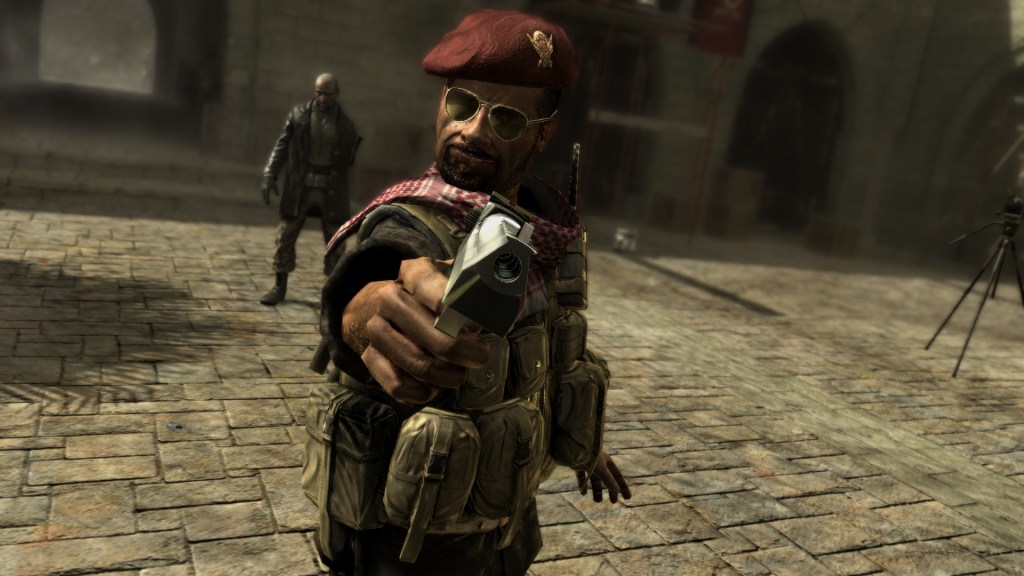
Another way to frame the issue would be in terms of which characters are untouchable. You’ll be familiar with the idea of plot armour, the concept that some characters can’t be killed because they’re too important to the plot. They survive by virtue of their narrative importance rather than any sort of experience fighting or general survival skills – in other words, for reasons of structure instead of any logic based in the fiction of the world. Arguably plot armour is inherent to every video game that’s not a roguelike. In Modern Warfare, if your player-character dies, the scene is reset. You cannot die – that is, you can be killed, but only in an aborted narrative pathway, in a Game Over. Your character in a sense is untouchable. So too the core cast: Captain Price, Gaz, Staff Sergeant Griggs. During combat they can be shot by your enemies, but they can’t die. I had Nikolai (another core character) run in front of my gun at one point, and the gun immediately stopped firing. You can’t shoot them, your enemies can’t kill them – they might limp around for a bit if they get targeted, but there’s no game mechanic to process their death. They cannot die. Modern Warfare then uses this game mechanic of plot armour to explore the thematic concept of Western invincibility. If modern war means that old wars are started by new wars, it also means that the West isn’t really going to be directly affected. All of the conflict in Modern Warfare takes place outside of Western nations. As the British, you carry out special operations in Ukraine, and as the Americans, you invade the unnamed country in the Middle East. War is contained within those foreign locations. It’s moved offshore, made external to the everyday lives of people in Western countries. Western society, as such, is untouchable. It’s exempt – all the suffering belongs to the people whose countries make up these war zones. Thus the split between victim Arabs and evil Arabs – it’s part of the expression of Western untouchability. There’s war over there – civilians die over there. It’s unsafe over there. Here is fine – it’s only happening over there.
This motif of untouchability is explored repeatedly throughout the game. In ‘Death From Above’, you play the pilot of an AC-130 gunship, firing down at enemies on the ground. They have no way to target or hurt you in return: you are untouchable. You shell them at your leisure. It becomes, hauntingly, a game, reinforced by the chatter of the gunnery crew. “Whoa! You got that guy!” Western characters offer distanced commentary on global conflicts, the sort of neutral observation only possible when you’re not personally involved. In the game’s opening scene, the British soldier Gaz gives Captain Price a briefing on the state of the world. “Good news first. The world’s in great shape. We’ve got a civil war in Russia. Government loyalists against ultranationalist rebels, 15,000 nukes at stake.” Captain Price replies “Just another day at the office.” His view is professional, detached, largely unbothered. He knows he is untouchable. He goes to war like you go to work, knowing he’ll come home at the end of the day. That experience is contrasted against the experience of Al-Fulani, the Arabic president toppled in the game’s second level. As Fulani, you are thrown into the back of a car and driven to your execution. You are unable to act, unable to move or shoot – the behaviours that characterise your interaction with the game at any other time. You become a victim. All you can do is watch – watch your countrymen die, watch the militia move in, watch as you’re tied up and shot in the head. It’s compelling game design – varying your level of control, giving you that sense of powerlessness as a point of contrast for your empowerment throughout the rest of the game. Modern Warfare uses this marked, racialised difference between those who suffer and those who can’t be touched to lay out its vision of the new world order.
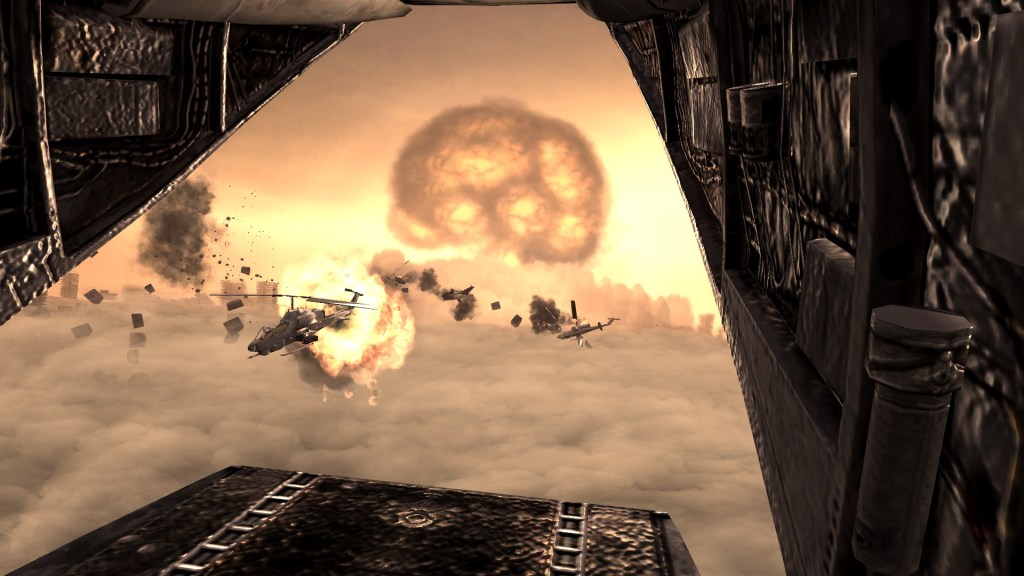
So – there’s sort of an obvious tension here, right. Modern Warfare is a game about Western invincibility, but it’s also a game about modern war, about post-9/11 conflict. 9/11 is of course a moment where that perception of Western invincibility faltered. The West is not invincible, it turns out. It’s vulnerable. It can be damaged. People can destroy its buildings, kill its people, visit upon it the sort of carnage that it normally quarantines to other places. Modern Warfare projects an aura of Western invincibility, but it’s also clearly haunted by 9/11. It doesn’t address the topic directly (that’s left to Modern Warfare 2), but it does explore the idea that this aura can falter. In one of the game’s key moments, the Middle Eastern revolutionary Al-Asad detonates a nuclear bomb in his capital city. The player, inhabiting the character of Sergeant Jackson, is caught in the blast, and Jackson is critically injured and killed. In this level, the player moves from the perspective of Western invincibility through vulnerability, through restricted movement and agency (only able to crawl out of a downed helicopter, echoing the limited mobility of Al-Fulani in the car), and into a permanent and irreversible death. The principles of the Game Over reset are suspended in a way that is unusual for Western characters. Al-Fulani can die, but he belongs to the over there. It’s shocking to see a Western character – and a player-character, no less – permanently removed from the story.
This moment of weakness then sets the stage for Modern Warfare‘s climactic scene. A coalition of Price and the surviving Americans are able to stop Zakhaev’s evil plan to fire nuclear missiles at the West (again, the lingering specter of the Cold War). While making their escape from the nuclear facility, the team are pursued by jeeps filled with soldiers and helicopters firing missiles – a classic Call of Duty chase sequence, which ends with the helicopter blowing up a bridge and causing the team’s car to crash and roll. The player-character, Soap Mactavish, is stunned. Like Sgt Jackson or Al-Fulani, he is unable to move or shoot, robbed again of agency. Zakhaev enters the scene, and shoots and kills your incapacitated team members. The nature of Western invincibility is brought again into question. Is it a myth? Is it a mistake? Are you going to die here? In keeping with the nature of the video game as power fantasy, the question is put into your hands. Captain Price passes you his gun – symbolically acknowledging you as his successor, gifting you leadership and agency and completing the hagiography of war – and you shoot down Zakhaev and his men. The West is not untouchable, Modern Warfare says, but it survives. It fights and wins.
Make no mistake: Modern Warfare is military propaganda. It’s not an ethical game. It depicts a broken world where an indolent West externalises the human cost of war onto foreign populations and the few brave Western soldiers who step into the conflict (read: invade foreign countries). It’s very comfortable with that state of affairs. It thinks the Iraq and Afghanistan wars were cool and fun. It’s George W. Bush-era military propaganda. It’s also great art. It’s really good at handling its themes and ideas, at using game mechanics to explore geopolitical concepts. It uses game constraints about which characters can or can’t die to set out its thesis on international relations. Western invulnerability is pierced, but it holds, and your actions – you, the player, the political subject, agent of the West – make the difference.
 Death is a Whale
[…] treasure these longer projects, like the Horus Heresy stuff, or reworking older essays like the Modern Warfare one earlier in the month. We need to keep coming back. In the introduction to Midnight in the Kant […]
LikeLike
[…] Modern Warfare: The Untouchables(deathisawhale.com, James Tregonning) […]
LikeLike
[…] up a few of the old essays (the impetus for the rewrite of that old Modern Warfare essay, now The Untouchables), and playing through the couple of games from that period that I missed. I’d not played […]
LikeLike
[…] to the plodding, inflexible, slightly dogmatic play paradigm of your typical hero fantasy. Call of Duty has you shoot and shoot and shoot some more, and you just – yup – you – […]
LikeLike