

The thing about these recent Star Wars games is that they’re unified by a very specific visual aesthetic. They have all of their crossover characters, of course, all the people linking together the new extended universe – Saw Gerrera from Rogue One turns up in Star Wars Jedi: Fallen Order, and the crime boss Qi’ra (Emilia Clarke’s character in Solo: A Star Wars Story) appears in Star Wars Outlaws. There’s actually quite a bit of crossover in Outlaws – there’s the more traditional touchpoints, like finding Han’s body frozen in carbonite in Jabba’s palace, but also reference to recent titles. You start the game in Canto Bight, the casino city from The Last Jedi, and in the wreckage of an Old Republic cruiser you find reference to the Nihil, who are villains in the High Republic comic books – you know, whatever, there’s crossover. But there’s also a very specific visual aesthetic. These games are built around a visual identity drawn from the original films: sweeping natural landscapes and close, densely constructed built environments. It’s an identity drawn from scenes like the one early in A New Hope, where Luke argues with his aunt and uncle over dinner and then walks outside to stare at a purple-blue twilight, empty desert, and twin moons. That pairing of the endless horizon and the rough, worn material of their daily lives – that’s the visual aesthetic for these games.
We touched on this idea with Fallen Order, in how its visual aesthetic of the homespun Rebellion is contrasted against the mechanical, plastic Empire, and in how depictions of the natural environment play into that contrast. The same basic visual aesthetic is maintained across other recent games like Star Wars Outlaws. It’s part of a shared visual identity. These games are made by different studios, right, different developers – Fallen Order and its sequel Jedi Survivor are made by Respawn Entertainment, who made Titanfall and Apex Legends, while Outlaws is made by Massive Entertainment under Ubisoft, so its stablemates are the Tom Clancy’s The Division games. They’re on different game engines, they have different creative leads, but they both deploy the same visual language of space. It’s not just owing to level design, either. Both Fallen Order and Outlaws vary in their use of space in ways reflective of their genre. Fallen Order is essentially a lightsaber game in the style of Dark Souls, meaning it relies on flat, open areas where you can maneuver around opponents. Outlaws, by contrast, is a blaster game in the style of Gears of War, with frequent cover and often terrain split across different levels to nuance the gunplay. You could compare it to other open-world Ubisoft shooters like Ghost Recon, but I think Gears of War, specifically Gears 5, is the more apt comparison, with its waist-high walls juxtaposed against the sweeping skiff sections where you wind-surf around the world.

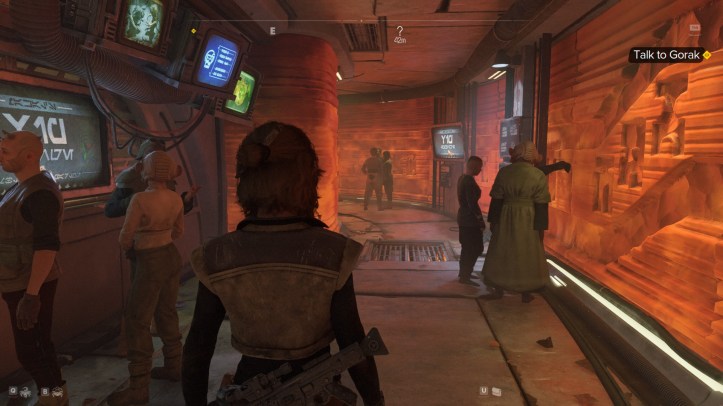

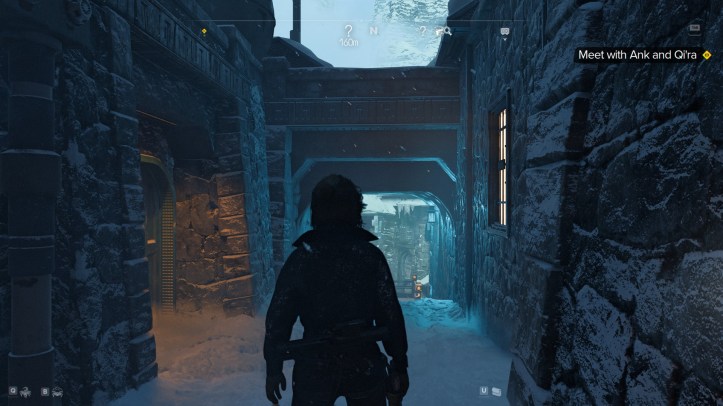
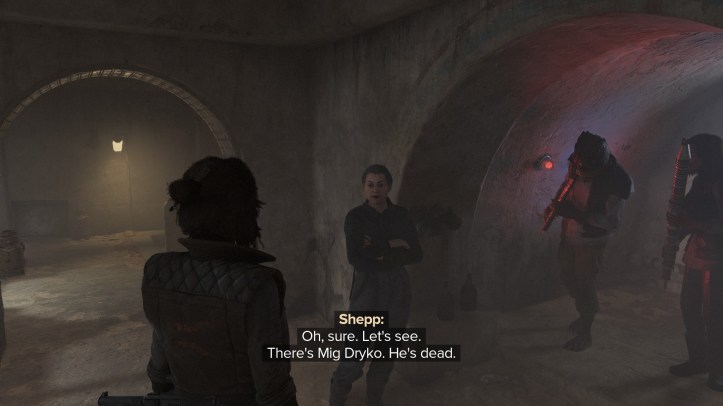
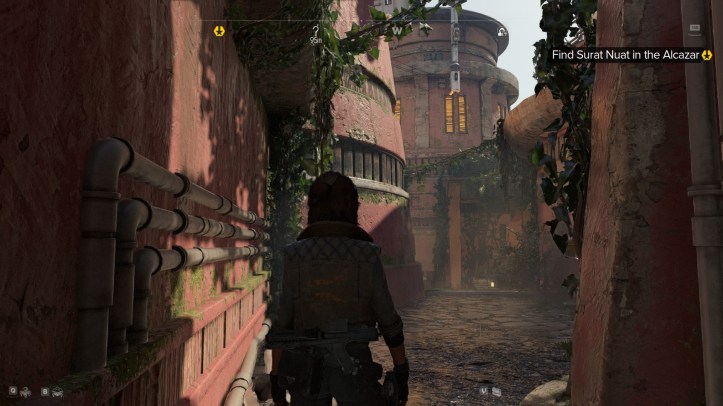
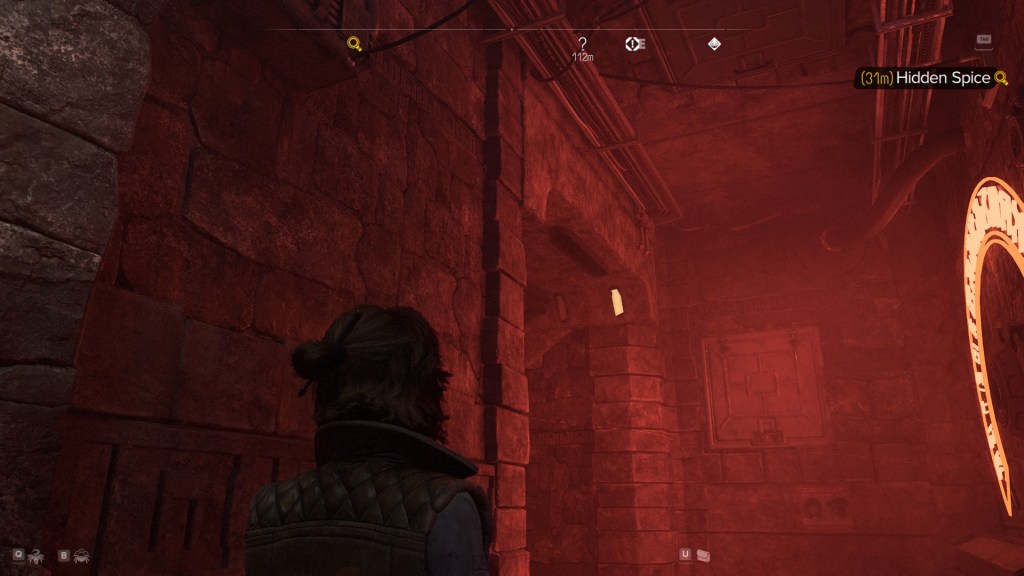
Star Wars Outlaws also has this specific balance between indoor and outdoor space – this is something that you don’t find in Fallen Order. Outlaws has a very specific vision of the built environment. It’s not strictly indoor and outdoor, but it’s a difference between areas that are urbanised, built-up, industrial, often indoors, and the external, unbuilt, natural environment. In the built environment, everything is very heavy-set. Buildings look thick and heavy. Walls are dense – they’re not wafer-thin plates of steel, they’re bulkheads, often between half a meter and a meter thick. There’s this constant sense of claustrophobia. Corridors and walkways are often narrow and littered with people or the junk of their lives – Outlaws if anything is most distinct from your typical Ubisoft looter-shooter in its sense of place as lived-in. I wrote some time ago about the character loops in Assassin’s Creed – how NPCs in the road will loop through a string of animations. Often that string lasts for maybe fifteen to thirty seconds – long enough that as you run past, you won’t notice any repetition. That’s the depth of the facade. Outlaws doesn’t really utilise elaborate animation loops, but it’s always densely populated. It’s filled with loiterers, people having conversations, gossips. Many of the Assassin’s Creed games have a ‘shove’ button, where you can push your way through a crowd or knock characters out of your way when you’re running. Again, Outlaws doesn’t have anything like that. People in the road are immoveable. They add to the sense of close, intimate living: you can only go around. Through all of that, Outlaws cultivates this sense of the built world as cluttered and heavy. The walls are always close. They have weight, heft. Doorways and ceilings often have this contrasting elevation, sometimes easily twice your height. They encroach or they dwarf you – sometimes they crush down, threateningly close, but mostly they leave you swimming in this enormous vertical space.



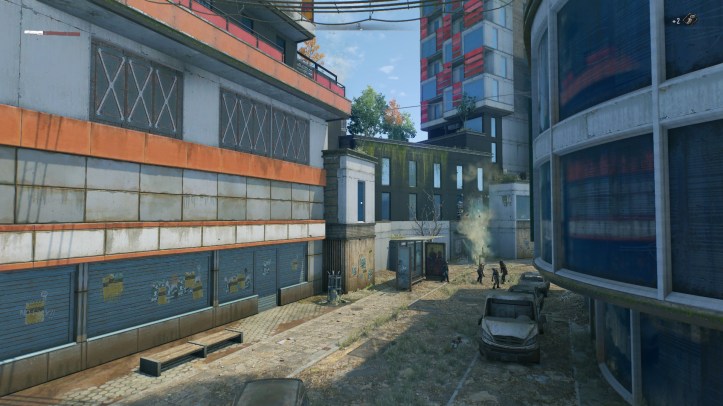
Again, Gears of War (in the gallery below) feels like the most relevant point of reference for how this game uses its space. Gears is a game about bulky potato men in massive armoured suits. Note below the thick heavy walls, the sense of weight and heft to everything. In the image of the town, the third image, each building looks like a distinct, modular beast. It almost feels like you could pick up any of those buildings in your hand and they would have weight and texture, material density. Compare them especially to the buildings in Dying Light 2, the zombie parkour game we’ve been discussing recently – those buildings (pictured on the final two slides below) look wafer-thin. They don’t really look like buildings: they’re surfaces, planes, flat faces. They are for running along or climbing up. They’re thin. The buildings in Gears, and in Outlaws, are thick and monstrous. They have roots. They threaten, encroach.

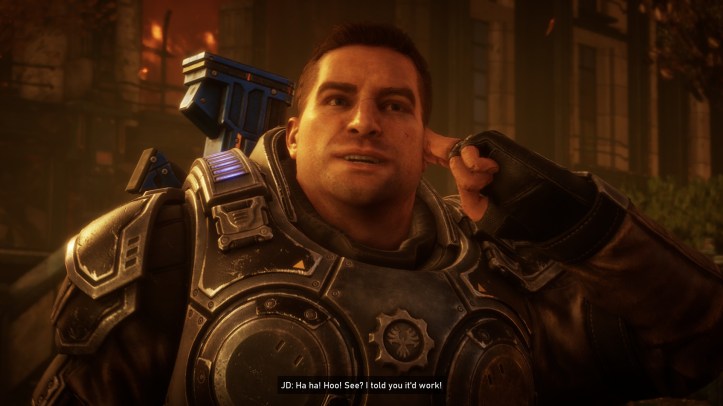


Your movement in Outlaws is also closer to that of JD and the Cogs, rather than Dying Light‘s parkour experts. It’s often heavy, slightly clumsy. You’re a stealthy rogue, but you’re not particularly quick. You have a silent stun blaster which only fires one shot: to recharge it, you need to carry out silent melee takedowns. There’s not a lot of tolerance for mistakes – not a lot of recourse. If you mess up being sneaky, a firefight will break out. You’ll be sneaking up behind someone when they turn around, and you realise you won’t be able to get to them in time to silence them quietly – or someone will come round a corner or appear from an angle that you weren’t expecting. Outlaws often plays on this experience of being exposed, of being caught out in the open. You have these moments where someone goes ‘Halt!’, and you know you don’t have enough time to cover the distance. That’s part of the game’s sense of heavy, lumbering movement – there are very lengthy moments of discovery, where you’re not yet in a firefight but you know you can’t move quick enough to avoid one. Stealth takedowns are often also slow, choreographed movements. Some of them are just a simple clonk on the head, but some of them are elaborate, performative routines. You push someone onto the ground and then punch them in the head when they try to get back up. If you’re behind someone, your pet Nyx will grab their sleeve and turn them around, in this slow, balletic piroutte, and after they’ve been spun a hundred and eighty degrees to face you, you’ll punch them in the face. They take an inordinate amount of time. They’re slow. It’s not Deathloop, where Colt will snap a neck in a quick, practiced movement. It’s heavy.

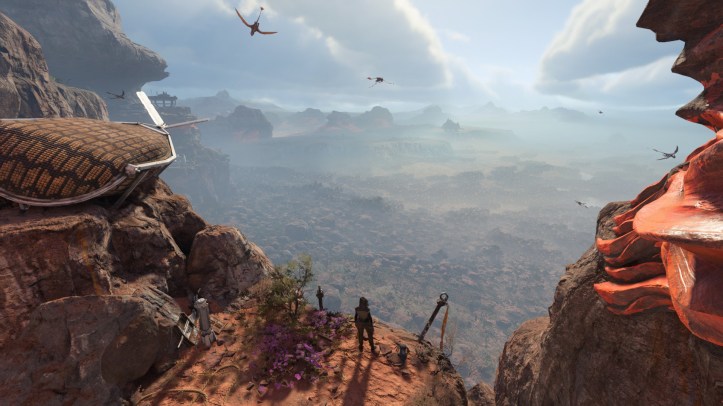


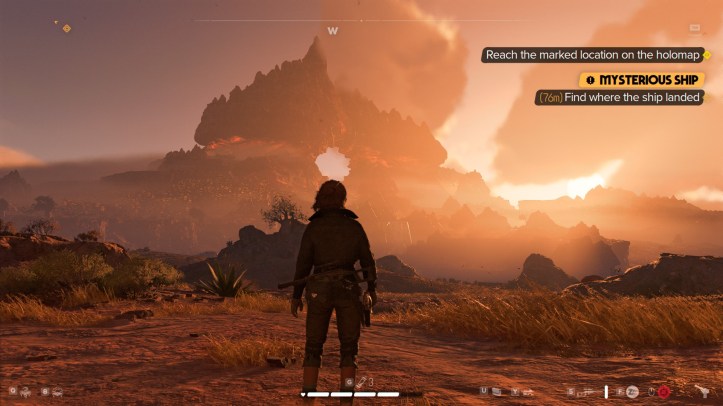

As a character, then, the protagonist Kay Vess is much more aligned with the interior built environment than the outside natural world. She is slow and heavy like the city is slow and heavy. The natural world outside is – well, it’s breathtaking. Outlaws features four main locations – Tatooine, Toshara, Akiva, and Kijimi, plus the tutorial city of Canto Bight. Toshara is the game’s first main level. It sets the tone for the rest of the game, having you split your time between a key urban hub (the city of Mirogana) and the savannah wilderness outside. The wilderness, as discussed, is presented as the opposite of everything urban. It’s bright, open, delicious. It’s unfettered, unconcerned. Different factions have set their mark on different areas, but they never manage to constrain or constrict the land. There’s nothing immediately comparable to Fallen Order, where the Empire has started to industrialise Kashyyyk. Instead, the city-scapes that do exist are built in alignment with the land. There are no massive earthworks – they haven’t flattened fields or levelled mountains. Mirogana is built into the hollow space under a giant mushrooming rock. Tatooine, while visually probably the least interesting landscape in the game, most obviously compels and drives its inhabitants. Its buildings are the colour of the soil. Special attention is drawn to the moisture farms, the special machinery needed to survive on this rock. Tatooine dictates the conditions of the people crawling around on its surface. They do not control or corral the natural world: they conform to it. They are shaped by it, they align with its contours.
There’s been a lot said about this most recent era of Star Wars, but something I keep coming back to is its consistent depiction of space. You take your speeder and get out into the open, out into the unbuilt world, away from your heavy, dense environment – and it’s beautiful, it’s aspirational, but you also realise the extent to which the city is built around the contours of the land. It’s not just there, some ahistorical lump in the earth – it’s embedded in the world, in history, in the slow paths carved out by the geological past. The contrast emphasises the difference between nature and the city, in the first instance, but more deeply you realise that they’re not in opposition. The city has always been built around the natural world. You’re not meant to be heavy. You’re not meant to starve, you’re not meant to be poor, you’re not meant to go scrounging around through your life, doing odd jobs for warring factions. You were meant to be light. You were meant to be free.
 Death is a Whale
[…] Built Space in Star Wars Outlaws(deathisawhale.com, James Tregonning) […]
LikeLike